Faster Restaurant Inventory Counts: Practical Systems to Improve Accuracy
Faster restaurant inventory counts are not just about saving time at the end of a shift. They help owners and managers see food cost issues earlier, reduce waste, order with more confidence, and avoid the frustration of discovering stock problems too late. In busy restaurants, inventory counting often becomes inconsistent because the process depends on memory, handwritten notes, and rushed staff handoffs. A better system combines simple counting rules, menu discipline, and digital records so the team can move faster while making fewer mistakes.
The most effective approach is usually not a full operational overhaul. It is a set of practical changes: organizing storage the same way every time, counting the same items in the same units, limiting unnecessary menu complexity, and connecting inventory habits to ordering and sales data. When these pieces work together, counts become easier to complete and much more reliable.
Build a Counting Process Your Team Can Repeat
Inventory gets slow when every staff member counts differently. One person estimates half a pan, another writes partial cases, and a third mixes bottle counts with weight-based notes. The result is not only inaccuracy but also extra time spent fixing discrepancies later. The first priority is to make the process repeatable.
Standardize count units for every item
Each ingredient should have one primary counting unit that the whole team understands. For example, chicken breast may be counted by kilograms, burger buns by packs, olive oil by bottles, and canned tomatoes by cases plus open units. Avoid switching between units depending on who is counting. If one person writes “2.5 bags” and another writes “11 pounds,” comparisons become difficult.
A practical setup might look like this:
- Cheese: kilograms
- Frozen fries: bags
- Soft drinks: cases and single bottles
- House sauce: liters
- Wine: unopened bottles plus open bottle estimate rule
For open products, create a simple rule. For example, sauces can be counted to the nearest quarter container, and wine can be counted by bottle level using the same visual guide every time. The goal is consistency, not perfect laboratory precision.
Count in storage order, not alphabetical order
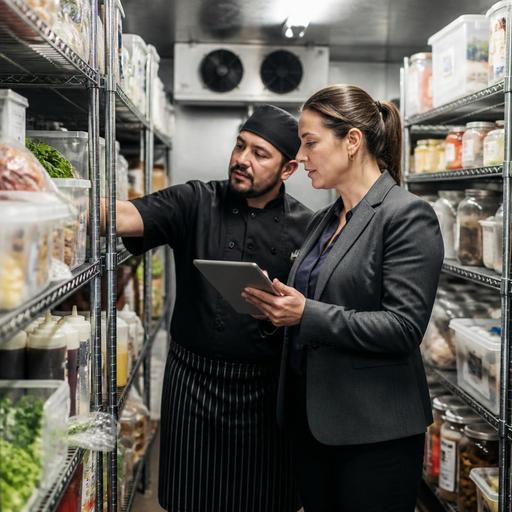
Many inventory sheets slow teams down because they list items in a format that does not match the physical space. Staff walk back and forth across dry storage, refrigeration, and bar areas trying to find the next line item. Instead, set the count sheet in the same order that a person physically moves through the restaurant: walk-in cooler, freezer, prep station, dry storage, bar, and cleaning supplies.
This simple change reduces missed items and cuts wasted movement. It also makes training easier because the route itself becomes part of the routine.
Assign responsibility by zone
In a full-service restaurant, one person should not handle every area alone if that creates bottlenecks. Divide the count into zones and assign clear ownership. For example, the kitchen lead counts proteins and produce, the bar manager counts beverage stock, and a supervisor reviews high-value items such as seafood, steaks, liquor, and specialty ingredients.
This method works best when the review step is short and focused. Managers do not need to recount everything. They only need to verify the items most likely to affect cost or create discrepancies.
Reduce Errors by Tightening Menu and Prep Controls
Inventory accuracy is not only a counting issue. It is also a menu management issue. Restaurants with too many variations, unclear recipes, or uncontrolled substitutions often struggle to reconcile stock because actual usage is hard to trace.
Link recipes to real portions
If the menu says a pasta dish includes parmesan, chili oil, and garnish, the portion used in service should match the recipe used for costing and ordering. When cooks add “just a little extra” throughout the week, inventory results become noisy and difficult to trust. Recipe cards, portion tools, and line training improve count accuracy because they make usage more predictable.
For example, if your signature chicken sandwich uses one fillet, one bun, two pickle slices, and one measured sauce portion, stock depletion should follow a recognizable pattern. If sauce is free-poured and pickles are added inconsistently, inventory surprises become common even when sales are stable.
Limit untracked substitutions
Substitutions can improve guest satisfaction, but they need structure. If staff swap sides, proteins, or modifiers without recording them consistently, inventory counts will not align with sales mix. This is where digital ordering and POS-linked menu controls help. When modifiers and substitutions are captured systematically, managers can understand why one ingredient ran out early while another moved slowly.
Restaurants using digital menu tools can update item availability, remove sold-out ingredients, and keep front-of-house and kitchen teams aligned. That reduces the number of workarounds that create inventory confusion later.
Use Short-Cycle Counts Instead of One Big Weekly Surprise
Many operators rely on a large weekly or monthly inventory session that takes too long and still misses important changes. A more practical method is cycle counting: check selected categories more frequently, especially expensive, fast-moving, or high-risk items.
Focus often on the items that matter most
Not every product needs the same counting frequency. High-value proteins, liquor, seafood, coffee beans, cooking oil, and popular delivery packaging may need more frequent checks than low-risk dry goods. Daily or every-other-day spot counts can catch problems before they become expensive.
Useful categories for short-cycle counts include:
- Proteins with high cost per unit
- Liquor, wine, and premium beverages
- Fast-moving produce with short shelf life
- Packaging used for takeout and delivery
- Signature ingredients tied to best-selling menu items
This approach gives managers faster visibility. If shrimp usage suddenly exceeds expected sales, or if takeout containers disappear faster than order volume suggests, the team can investigate immediately instead of waiting until the end of the month.
Create a fixed schedule
A cycle count only works if it is predictable. For instance, bar inventory every Monday and Thursday, proteins every evening, freezer items every Wednesday, and full count every month-end. Staff should know the schedule in advance so counting becomes part of operations rather than an interruption.
Make Inventory Faster With Better Digital Records
Paper sheets can work in a very small operation, but they often create duplicate work. Someone counts by hand, someone else re-enters the numbers, and then a manager tries to compare them with purchases and sales. Digital records reduce that friction.
Use one source of truth for menu and item status
When menu availability, orders, and item changes are scattered across chat messages, printed notes, and verbal updates, inventory errors increase. A more connected setup helps everyone work from the same information. If an item is unavailable, it should be updated quickly so staff stop selling it. If a modifier changes, the kitchen should see it immediately. This reduces emergency substitutions and stock mismatches.
Platforms such as Restomas support restaurant digitization by helping operators manage menus, orders, and service flow in a more organized way. While inventory still depends on disciplined counting, accurate digital menu management makes stock movement easier to understand and easier to control.
Review variances, not just totals
The count itself is only part of the process. The real improvement comes from reviewing where expected stock and actual stock differ. Variance checks can reveal portion creep, receiving errors, waste, spoilage, transfer issues, or even theft. A manager should ask simple questions:
- Did sales volume justify the ingredient usage?
- Were there undocumented staff meals or promos?
- Did prep produce more waste than usual?
- Was a supplier delivery short or recorded incorrectly?
- Did the team use an item in another recipe without updating the system?
These conversations are where inventory becomes a management tool rather than a bookkeeping task.
Train Staff to Count the Same Way Every Time
Even the best inventory template fails if the team has not been trained on how to use it. Counting should be part of onboarding for kitchen leads, bar managers, and shift supervisors. Keep the training practical: show where items live, explain count units, define rules for open containers, and demonstrate how to flag questionable numbers.
It also helps to build a quick close-out habit before count sessions. Label open products, return stock to correct shelves, separate damaged goods, and avoid mixing partial packs with full cases. A tidy storage area dramatically improves both speed and accuracy.
For restaurant owners, the key lesson is simple: inventory gets better when operations get clearer. Organized storage, recipe discipline, digital menu control, and regular cycle counts all support one another. Faster counts are not about rushing. They are about removing the confusion that slows teams down in the first place.
If you want a cleaner digital foundation for menu updates, order flow, and day-to-day restaurant control, Restomas can help support that process.
