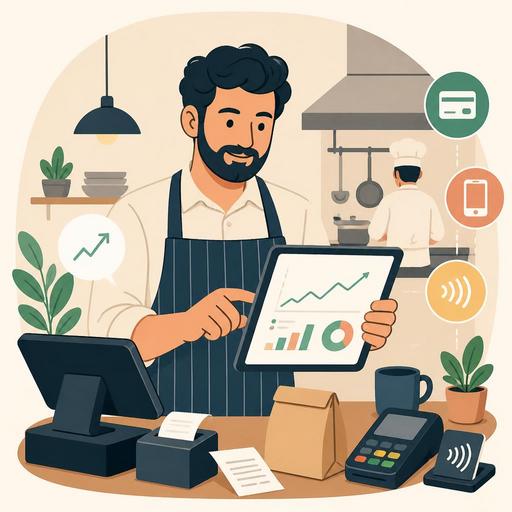
5 Critical Benefits of Real-Time Cash Flow Tracking in Restaurants
Real-time cash flow tracking is a topic that often isn't discussed as much as revenue in restaurant management, yet it directly determines the quality of daily decisions. When register movements, card collections, online-order revenue, supplier payments, and staff expenses are spread throughout the day, the business owner must be able to give a clear answer at the end of the day not just to "how much did I sell?" but also to "how much is actually left on hand today?" Especially for restaurants, cafes, and businesses selling across multiple channels, this visibility affects many areas, from the purchasing plan to shift management, and from promotion decisions to location performance.
A restaurant looking profitable doesn't mean it had comfortable cash management that day. For example, sales may be strong during the lunch service; but on the same day, a supplier payment, a platform commission deduction, a courier expense, or an unexpected small outlay can narrow the business's room to maneuver. That is why tracking cash flow not in weekly reports but with updates that are as real-time or intraday as possible builds a healthier management reflex.
1. It bases daily decisions on data, not guesswork
One of the most common problems restaurant managers face is making decisions based on past habit. Real-time cash flow tracking, by contrast, lets you see the actual state of that day. When register activity, collections that have hit the bank, pending payments, and planned expenses are seen within the same frame, it becomes possible to act on data rather than intuition.
Let's consider a concrete example: a high-volume meat or seafood order is about to be placed before the dinner service. Even if revenue looks good, you may realize during the day that the marketplace collection hasn't yet landed in the account, that POS deductions are higher than expected, or that short-term liquidity is tight because of a bulk payment made in the morning. This visibility lets you optimize the quantity instead of canceling the order entirely, discuss payment terms with an alternative supplier, or rethink which products to feature on the menu that day.
The most important result of this approach is that the business becomes less exposed to surprises. In particular, monitoring POS integration, order channels, and payment flows within a single management logic keeps the manager from getting lost among fragmented screens throughout the day.
2. It reduces unnecessary risk in supply and stock planning
When cash flow and stock management are thought of separately, two kinds of errors arise: over-purchasing, or running short on a critical product. Real-time tracking lets you evaluate purchasing decisions not only with the logic of "stock is low," but together with the question "how much room do I have right now?"
Especially in restaurants that use perishable products, holding excess stock doesn't guarantee sales. On the contrary, it means leaving cash sitting on the shelf or in storage. A business with up-to-date cash visibility can plan supply in shorter cycles and act more cautiously on items that carry a high waste risk.
- Order quantities are set more accurately according to the daily sales rhythm.
- The risk of strain on purchases requiring upfront payment is reduced.
- The decision to use an alternative supplier for critical products is made earlier.
- The products to feature on the menu are chosen by evaluating stock on hand and the cash position together.
For example, consider a cafe selling coffee, desserts, and sandwiches. Weekday morning sales may be strong while evening hours are weak. If the manager clearly sees the collection flow during the day, they can make a more accurate decision about whether to place a second small order on the same day. This reduces both stock waste and cash crunch.
3. It makes staff planning more realistic
Staff cost is one of the most sensitive line items in restaurant operations. But many businesses build the shift plan based only on expected demand; they don't regularly analyze how that demand translates into cash. Real-time cash flow tracking makes staffing decisions more balanced.
The aim here is not just to cut costs. The real aim is to make visible the impact on the business of having too few or too many staff at the wrong time. If, on certain days, the collection structure proceeds with a delay despite high order volume, then the need for extra staff on that shift and the short-term payment pressure must be evaluated together. Conversely, keeping too many staff on during low-demand periods can also needlessly inflate the cash outflow.
Let's go through a concrete scenario: on weekend evenings the dining room is full and delivery orders are rising too. Seeing this, the business owner may automatically want to open an extra shift. But if real-time flow shows that platform order payments are arriving with a delay and that there's rent or a bulk supply payment that week, the solution may not be to add a new shift directly, but to increase table turnover, simplify the menu flow, or rearrange the division of tasks.
At this point, interpreting order-management data together with financial flow provides a big advantage. Seeing operational density and the real situation reflected at the register in the same window helps make calmer, more controlled decisions in staff management.
4. It reduces blind spots in promotion and pricing decisions
Many restaurants focus on sales volume when designing promotions; yet a sales increase doesn't always mean healthy cash flow. In particular, discounted menus, platform-based promotions, or heavy delivery campaigns can suppress net collection while seemingly boosting orders. Real-time cash flow tracking lets you spot this difference early.
For example, a "buy two, pay for one" type of offer can strain kitchen capacity and increase the volume of low-margin products. If the business is monitoring the real-time collection, commission, and expense impact, it can understand more quickly whether the promotion is genuinely a relief or a strain. That way, instead of removing the promotion entirely, it can make the following adjustments:
- Highlighting more cost-controlled products instead of low-profit ones
- Limiting the promotion to certain hours of the day
- Encouraging on-premise consumption rather than delivery
- Creating menu setups that increase add-on sales
A similar situation applies to price updates. To know when and how to revise a price as supply costs rise, you need to look not only at the cost list but also at the speed of the cash cycle. Some products may look profitable on paper but, due to slow-moving stock and low collection quality, may not give the business the expected contribution.
5. It enables a more accurate reading of location and channel performance
In restaurants using multiple sales channels, the biggest mistake is treating all revenue as a single pool. When dine-in service, pickup, phone orders, the marketplace, and the business's own online channel all blend into the same revenue figure, it can be hard to see what kind of cash rhythm each channel creates. Real-time tracking makes this distinction visible.
For example, in a business with two locations, the first location may generate higher revenue; but the second location may be healthier in terms of cash thanks to faster collection, fewer refunds, and a more controlled expense structure. Similarly, even though the business's own order channel may look lower in volume, it can provide a stronger flow to the business because commission pressure is lower.
This visibility gives managers the opportunity to ask the following questions:
- Which channel is genuinely more liquid today?
- Which location has sales but also high cash pressure?
- Which product group generates revenue but doesn't ease the register?
- In which time window is operations busy but collection quality weak?
The answers to these questions are a guide not only for the finance team but for the kitchen, service, and purchasing teams too. Digitalization here doesn't just mean producing reports. The real value is the data turning into daily action. When the order flow from the QR menu, POS data, reservation density, and payment movements are interpreted together, the business is managed far more nimbly.
Actionable steps for real-time cash flow tracking in restaurants
You don't need a large finance department to set up this system. What matters is turning scattered data into a single decision framework.
- Standardize the daily cash view: Track the register, bank, card collections, pending payments, and planned expenses in the same flow.
- Separate the sales channels: Evaluate dine-in, delivery, pickup, and marketplace performance separately.
- Tie stock and purchasing decisions to finance: Plan critical purchases based not only on stock level but on current liquidity.
- Manage the shift plan dynamically, not weekly: Read order volume and collection structure together.
- Establish a recurring reporting rhythm: Create short checklists for end-of-day, start-of-week, and payment days.
In conclusion, real-time cash flow tracking in restaurants is not just an accounting discipline; it is a management tool that makes the entire operation more controlled, more foresighted, and more resilient. Businesses that can read data instantly spot problems before they grow, evaluate opportunities faster, and put their daily decisions on firmer ground.
Restomas can help restaurants make these decisions more clearly by making order, payment, and operational data more visible.