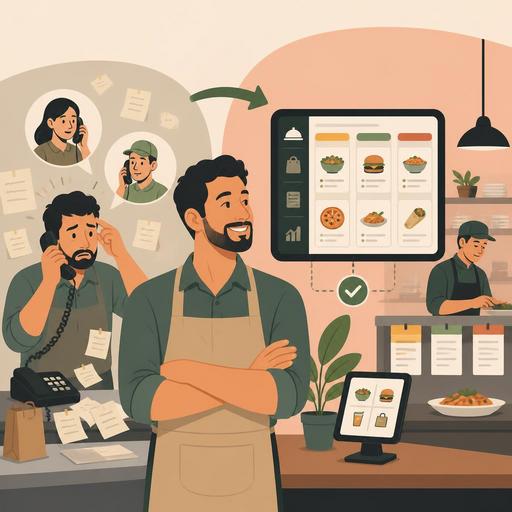
5 Financial Gains of Moving from Phone Orders to Digital
Digitizing phone orders is, for restaurants, not just a matter of a modern look; it means direct cost control, revenue protection, and operational efficiency. Especially during busy hours, orders taken by phone can lead to financial losses due to causes such as misunderstandings, incomplete records, lines on hold, and staff being split across multiple tasks at the same time. A digital order flow, on the other hand, makes the order more standard, traceable, and measurable, making it easier for the manager to stay on top of the register, the kitchen, and the customer experience all at once.
In this article, we will examine in 5 headings how moving from phone orders to digital order management makes a concrete contribution to a restaurant's budget. The aim is not to praise technology; it is to clarify the areas that truly create a monetary impact within daily operations.
1. It lowers the cost of order errors
One of the most common problems with phone orders is information being conveyed incompletely or incorrectly between the customer and the staff. A misunderstood address, a skipped product variation, extra requests not being noted, or products with similar names getting mixed up all create direct costs such as refunds, remaking, free compensation, or a disrupted courier route.
In a digital order flow, the customer enters their product, quantity, note, and delivery information themselves. That way, the source of the order becomes standardized. When the kitchen, register, and delivery side work with the same data, friction stemming from "that's not what I said" decreases. This difference becomes more visible, especially in highly customizable menus.
For example, at a burger restaurant, details like "no onions, extra pickles, sugar-free drink with the menu" can easily be skipped in an order taken by phone. In a digital interface, however, when options are presented in a selectable way, the margin for error drops. This means not only customer satisfaction, but also a reduction in wasted product, free re-sends, and lost time.
2. It reduces lost sales during busy hours
A phone line can carry only a limited number of orders at once. During lunch service, match time, rainy evenings, or campaign days, if the line is busy the customer often does not call back; they turn to another business. This invisible loss is a revenue erosion that many restaurants experience without realizing it.
A digital order channel, on the other hand, can handle a large number of requests at the same time. There is no need to wait for staff to pick up the phone for an order to be taken. The customer reviews the menu, builds their cart, and completes their order. This flow is important especially for users who decide quickly and have little tolerance for waiting.
The financial benefit here is not just taking more orders. It is also making order-acceptance capacity partly independent of staff numbers. In other words, it becomes possible to handle more requests during busy moments without adding an extra phone staff member. When the QR menu, online order screen, and order management panel work together, the business handles incoming demand in a more controlled way.
The practical question for managers is this: during the busiest hours, how many customers are waiting on the line, giving up, or abandoning their order halfway? The answer to this question often already shows why a digitalization investment is necessary.
3. It shifts staff time to more profitable tasks
Taking an order by phone is not just a few minutes of conversation. It creates a fragmented workload: answering the call, explaining the menu, confirming the product, taking the address, noting the payment information, relaying it to the kitchen, and calling back when needed. This time can lower service quality in other areas, especially at businesses working with few staff.
Digital systems automate a significant part of the order-taking work. That way, the team can focus more on the following areas:
- Welcoming guests and the table experience
- Preparation and quality control in the kitchen
- Packaging standards and delivery coordination
- Complaint resolution and upsell opportunities
This change does not have to lower the payroll cost all at once; it often improves profitability by freeing up time for more valuable tasks. For example, if the employee answering the phone at the register slows down the payment flow in the dining room during a busy moment, an indirect revenue loss occurs. With the move to digital ordering, this employee can contribute to faster table turnover or a more orderly delivery dispatch.
It also provides an advantage in training new staff. Taking orders by phone is a difficult process requiring menu knowledge and communication skills. As digital flows become standardized, training time is simplified and the risk of error decreases.
4. It makes the average basket visible and manageable
In a phone order, cross-selling is often left to the staff's initiative. Some employees suggest a beverage, some remind the customer about dessert, and some, out of busyness, just try to close the order. This creates fluctuation in sales performance. In a digital order, however, add-on product suggestions, menu combinations, and complementary options can be shown more consistently.
For example, a customer who chooses a main product can be systematically offered a suitable beverage, sauce, dessert, or large-size option. The critical point here is not to sell aggressively; it is to make complementary items the customer might already find sensible visible at the right moment.
The financial value of digital order management is also not limited to showing suggestions. It is possible to see which products are preferred together, which menus stand out at which hours, and on which items the basket is abandoned. This visibility is valuable for menu engineering.
Actions that can be derived from this
- Define complementary products next to the best-selling items.
- Position products with strong profit margins more visibly in the digital menu.
- Simplify frequently confused variations.
- Evaluate separately the products that slow the kitchen down during busy hours.
For restaurant owners, what matters is not "showing many products," but building a flow that makes the ordering decision easier. A well-designed digital menu is therefore both a sales and an operations tool.
5. It strengthens cash flow and decision quality
When phone orders are managed with scattered notes, different apps, or verbal handover, the business owner struggles to see the clear picture at the end of the day. Which channel brought more orders, which product was cancelled more, at which hours did congestion occur, which orders had a delivery problem? If the answers to these questions are not clear, financial improvement also relies on guesswork.
A digital order flow, on the other hand, produces records. Order time, product distribution, cancellation reason, payment method, and operational intensity can be tracked more systematically. When data is consolidated in one place via POS integration or centralized order management, the manager's decision-making quality rises.
This opens the door to the following financial outcomes:
- Noticing loss-making processes earlier
- Seeing campaign impact on an order basis
- Adjusting the staff plan according to busy hours
- Planning stock and prep quantities more accurately
For example, if orders coming in at certain hours are seen to be consistently late, the problem may be courier capacity, kitchen preparation, or menu complexity. Every day this continues unnoticed produces both customer loss and hidden cost. Digital visibility helps catch this loss early.
4 practical tips for making the transition correctly
Digitizing phone orders does not have to mean making a "full transition" overnight. The healthiest approach is to start with a controlled hybrid model and expand based on data.
- Simplify the menu first: Before moving to digital ordering, clarify names, variations, and descriptions.
- Test the busy-hour scenario: The order panel, kitchen flow, and delivery coordination should be considered together.
- Involve the team in the process: No matter how good the system is, efficiency drops if staff do not embrace it.
- Monitor the data in the first 30 days: Track regularly where errors decrease most and which products work better on the digital channel.
The harmonious operation of tools such as the QR menu, online ordering, reservations, and order management in particular increases the real financial impact of digitalization. Building a structure that considers the entire operation, rather than fragmented solutions, delivers a more sustainable result.
In conclusion, digitizing phone orders is a strong step for reducing error costs, capturing lost demand, using staff time more efficiently, managing basket value, and making sounder financial decisions. If you want to start this transformation in your restaurant with a measurable and simple structure, Restomas's digital ordering and menu management solutions can help make the process more controlled.