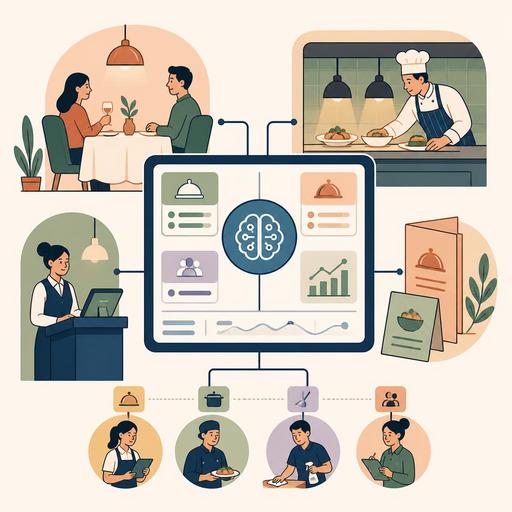
6 Operational Processes Artificial Intelligence Has Taken Over in Restaurants
Artificial intelligence in restaurants is no longer just a concept that appears in trend headlines; it has become a practical working model that takes on certain parts of daily operations in an invisible yet effective way. Today, thanks to a well-designed digital infrastructure, many processes — from the order flow to menu optimization, from reservation management to customer communication — can be run more quickly, more consistently, and more measurably. The critical point here is this: AI does not run the restaurant on its own; by taking over the recurring, data-heavy, and rule-based tasks, it enables the manager to make better decisions.
In this article, we will address the six processes that AI genuinely takes over in restaurant management, the real-world counterpart of each, and the actions business owners can apply right away. The aim is less about saying "we use AI" and more about clearly seeing which workload is eased and how.
1. Order forecasting and demand planning
One of the hardest topics for a restaurant is forecasting accurately enough how much business there will be tomorrow. The weather, the weekday-weekend balance, special occasions, campaigns, events in your area, and past ordering patterns all affect this forecast. AI-supported systems read these variables together to create a more orderly planning foundation than manual forecasting.
For example, a business experiencing an office rush at lunch does not have the same ordering rhythm as a neighborhood restaurant working the evening service. Similarly, a brand with a strong takeaway network needs different prep plans than a cafe with high dine-in traffic. AI helps determine, by examining past order data, which products come to the fore at which hours. This directly affects prep quantities, shift design, and stock usage.
A clear action for the restaurant owner
- Classify the last 3-6 months of order data by hour, day, and product.
- Separate the best-selling products as "steady demand" and campaign-sensitive products as "variable demand."
- Set up a structure where you can see QR menu, order management, and POS data on a single screen.
When data is gathered in one place, AI-supported interpretation becomes much more meaningful. Scattered data produces poor planning.
2. Menu performance analysis and product optimization
Many businesses update their menu intuitively: decisions like "this product hasn't been selling lately" or "let's highlight this one" are often based on observation. Yet AI-supported menu management makes it possible to read product performance more systematically. AI can evaluate menu performance not only by sales count but also by signals such as views, additions to the cart, conversion to orders, cancellations, and co-purchases.
Especially in digital menus, which products are viewed a lot but ordered little is an important indicator. Is the problem the price, the description, the photo, or the category order? AI notices such patterns more quickly. For example, if a pasta product is frequently viewed but rarely ordered, the product name may be unclear or the description may not support the customer's decision. By contrast, a less visible beverage can sell more alongside main products with the right pairing.
At this point, menu management ceases to be merely a design task and turns into a data-driven optimization area. With digital infrastructures like Restomas, monitoring QR menu performance, testing category orders, and updating product descriptions become much more agile.
Headings to review with AI on the menu
- Which product is viewed a lot but ordered little?
- Which product creates a co-selling opportunity?
- Which category becomes invisible because it sits low on a mobile screen?
- Which product description leaves the customer undecided?
3. Reservations, table occupancy, and balancing the flow
In reservation management, the real problem is not just getting tables but balancing the flow. Reservations piled into the same time slot lower service quality; tables left empty more than necessary cause a loss of revenue. AI here can create a more balanced flow plan by analyzing past reservation behavior, no-show tendencies, service time, and table turnover speed.
For example, two-person reservations blocking four-person tables on certain days, or long sittings during busy hours making it harder to accept new customers, are common problems. Smart systems can offer more suitable seating suggestions based on table type. They can also automate tasks such as reservation confirmation messages at certain hours, waitlist management, and occupancy forecasting.
The human touch is still important in this process; but AI relieves the reception team from rethinking every decision from scratch. Especially when the reservation module is read together with order and table data, dining-room management becomes more predictable.
4. Automating recurring responses in customer communication
Most of the customer questions a restaurant receives are similar: operating hours, valet availability, the kids' menu, allergen information, reservation availability, the takeaway area, vegan options, campaign conditions. Answering these questions manually across every channel both takes time and increases the risk of inconsistent information. AI-supported messaging flows and smart response systems take over much of this recurring communication.
The aim here is not to talk to the customer robotically, but to protect the team's time. When standard questions are answered quickly, staff can focus on more complex requests. For example, directing a customer asking about allergens to the right information within the menu is critical not only for speed but also for trust. Likewise, routing a reservation request to the appropriate channel or automatically sharing the QR menu link simplifies the experience.
- Put frequently asked questions into writing.
- Standardize the response language to match your brand tone.
- Define a clear handover rule for situations that require human intervention.
If automation is started before this structure is set up, customer satisfaction may decline even if speed increases.
5. Staff planning and task distribution
One of the most sensitive areas in restaurant management is having the right number of staff at the right time. Too few staff lowers service quality, while too many creates cost pressure. AI can support staff planning by analyzing past intensity data and shift patterns. It becomes more visible which day needs extra support at the register, at which hours the prep workload increases in the kitchen, or in which shift the delivery operation gets squeezed.
Especially in businesses working across multiple channels, dine-in, takeaway, and pickup order traffic are managed at the same time. In this case, planning the shift by looking only at the number of tables falls short. When order management data is evaluated together with staff planning, task distribution can be done more realistically. AI here does not replace the manager; it works like a second pair of eyes that confirms the intuitive plan or flags errors early.
As a concrete approach, at the end of each shift you can look at the following questions: at which hour did the most delays occur? At which station did a pile-up happen? Which product group disrupted the kitchen's pace? When the answers to these questions are gathered regularly, AI-supported planning gives much stronger results.
6. Anomaly detection: errors, losses, and operational deviations
One of AI's most valuable contributions is making visible the deviations that are hard to notice within the daily flow. Situations such as a sudden rise in the cancellation rate, the unexpected drop in a product's performance, a longer prep time at certain hours, unusual discount usage, or a mismatch between stock and sales can easily slip past manual tracking.
This kind of anomaly detection is critically important, especially for growing businesses. Problems noticed by eye at a single branch can be understood only through data across multiple branches. AI-supported reporting lets the manager look not only at end-of-day totals but also at cause-and-effect relationships. For example, a drop in a product's sales is not meaningful on its own; it should be read together with a change in its position on the menu, supply-related quality fluctuations, or a longer prep time in the same period.
Things to watch in this process
- If data quality is low, the resulting insight can be misleading.
- If technology integration is weak, the team tracks the same data from different places.
- If decision ownership is unclear, the detected problem does not turn into action.
In short, AI takes over the most recurring, measurable, and rule-based tasks in restaurant operations: demand forecasting, menu analysis, the reservation flow, customer communication, staff planning support, and anomaly detection. But success comes not from buying technology, but from collecting data regularly, standardizing processes, and having teams turn these insights into daily decisions.
If you want to see your restaurant's QR menu, order management, reservation, and operational data more holistically, platforms like Restomas can make this transition simpler and more actionable.
