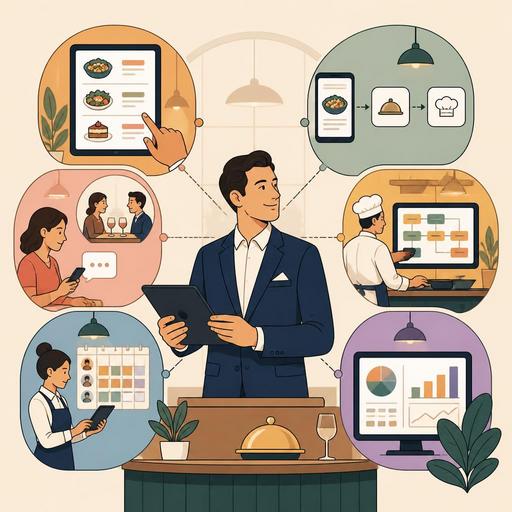
6 Processes Automated by Artificial Intelligence in Restaurant Management
The processes being automated by artificial intelligence in restaurant management are no longer only the agenda of large chains. Independent restaurants, cafes, and multi-branch businesses are also turning to AI-supported tools to speed up the order flow, balance the kitchen load, manage the menu more intelligently, and improve the customer experience. The critical point here is this: AI does not run the restaurant on its own; by carrying the right data to the right screen at the right moment, it enables the manager to make faster and more accurate decisions.
In this article, we will examine in depth the 6 processes that AI has genuinely begun to take over in restaurants. The aim is not to admire technology from afar; it is to clarify which tasks are suited to automation, in which ones the human touch still remains decisive, and which steps you can take today as a business owner.
1. Order collection and routing process
The most visible transformation in restaurant operations is happening in the way the order is taken. Thanks to the QR menu, self-service screens, online order panels, and tabletop digital solutions, AI-supported systems analyze the customer's selections and collect the order with fewer errors. For example, the system can issue a warning when an add-on incompatible with the chosen product is selected, make options containing allergens more visible, or direct the customer based on delivery time during busy hours.
This takes a significant cognitive load off staff, especially during busy service moments. Instead of the server memorizing every variation, the register manually tracking every campaign, or the kitchen trying to decode an order with missing notes, the order data drops into the system in a cleaner form. When combined with POS integration and kitchen displays, problems such as an order going to the wrong station or prep priority getting jumbled also decrease.
What AI takes over here is not just "taking the order." The real value comes from processing the order according to context. The system can route more intelligently based on the time, table type, product combination, and past ordering behavior.
A clear action for the business
- Standardize product variations on your QR menu.
- Make sure the data flow between the POS and the kitchen display is seamless.
- Report separately the order types that produce the most errors.
- Identify which products slow the order flow during busy hours.
2. Menu optimization and product visibility
Many restaurants manage their menu by intuition: decisions are made with rationales such as "this product is loved," "the chef wants to highlight this," or "the customer asks about this." Yet AI-supported menu management makes it possible to read product performance more systematically. Insights such as which product is viewed but not selected, which sells frequently but leaves a low profit, and which combinations are preferred together strengthen menu decisions.
Especially in digital menus, the product order, category structure, description language, and use of visuals make a big difference. AI helps the menu become more functional here by interpreting the customer's behavioral traces. For example, it is possible to present products that go out quickly at lunch more visibly, bring sharing plates forward during the evening service, or pull products at risk of stockout into the background in a controlled way.
This approach takes the menu beyond being merely an aesthetic list; it turns it into a living tool aligned with operations and supporting the sales target. On platforms that offer a digital menu and order infrastructure such as Restomas, collecting this data regularly reduces the manual tracking burden and improves decision quality.
What to watch in menu optimization
- Write product names simply and clearly.
- Do not increase the number of categories unnecessarily.
- Make products that frequently have stock issues digitally manageable.
- Position products with a strong visual but difficult prep according to the service pace.
3. Demand forecasting and prep planning
One of the areas where AI produces the most value in restaurants is demand forecasting. When variables such as the weather, the type of day, past sales patterns, campaign impact, reservation intensity, and delivery traffic are evaluated together, it becomes clearer which product group may come to the fore in which time range. This directly affects the prep plan, the shift schedule, and purchasing decisions.
For example, a restaurant working in an office district at weekday lunchtimes does not have the same needs as a neighborhood restaurant with weekend evening intensity. AI-supported analysis makes this difference visible. This way the kitchen less often experiences the dilemma of "did we overproduce, or did we run out of the product too early?"
What matters here is not seeing the forecast as an absolute truth, but using it as a decision-support mechanism. The chef's field experience, the manager's knowledge of local events, and the team leader's service observation are still very valuable. But when these intuitions are combined with a data-driven framework, they give more consistent results.
4. Customer communication and a personalized experience
In restaurants, customer communication often remains limited to sending campaign messages. Yet AI, by making sense of customer behavior, enables more relevant and more timely communication. Offering a dessert pairing to a customer who regularly orders coffee, sending a suitable reminder to a guest who makes reservations on certain days, or preparing a win-back message for a user who has not returned for a long time are simple examples of this.
The critical line here is between personalization and an intrusive sense of being tracked. AI-supported communication should treat the customer not as a data point, but as a guest with preferences. For this reason, the segmentation logic must be set up clearly; not every message should go to every customer.
When reservations, order history, and menu preferences are gathered in a single digital structure, the communication language also becomes more consistent. For example, the same message flow should not be used for a customer who books a birthday reservation, looks at gluten-free products, and prefers weekend brunch.
5. In-kitchen workflow and prep priority
Chaos in the kitchen often arises not from intensity but from a lack of priority. It is hard to answer in real time questions such as which order should go out first, which station is creating a bottleneck, and which product is lengthening the prep time. An AI-supported kitchen flow can evaluate orders not only by arrival sequence but also by prep time, table status, takeaway timing, and station load.
This way a more meaningful ordering forms on the kitchen displays. This difference is especially pronounced in businesses running both dine-in and takeaway. Not all orders arriving at the same time have equal priority. Sending out all the items of a single table in sync and completing on time an order that has to catch a courier require different operational decisions.
AI here does not replace the chef; but it focuses the team's attention on the right point. The final decision still rests with the kitchen leadership. Yet a data-supported workflow makes service quality more stable.
6. Staff planning and task distribution
One of the areas restaurant managers struggle with most is placing the right staff at the right time. Too many staff increase costs, while too few lower service quality. AI-supported planning tools help build a more balanced shift schedule by looking at past intensity, reservation status, weather conditions, the campaign calendar, and the performance of order channels.
This approach does not just solve the question "how many people should work?" It also makes visible who is more effective in which role. Some team members are strong at opening prep, some at high table turnover, and some at takeaway coordination. Data-driven task distribution makes staff management more fair and more measurable.
There is an important caution for business owners here: AI should not mechanize staff management. Team motivation, training level, and the realities on the floor must always be taken into account. Technology should be used not to replace the manager, but to help them plan more consistently.
Conclusion: AI takes over the most repetitive decisions
When you look closely at the processes AI takes over in restaurants, a common pattern emerges: the most benefit appears in recurring, data-generating, and standardizable tasks. Order collection, menu visibility, demand forecasting, customer communication, kitchen priority, and staff planning therefore stand out. By contrast, in areas such as guest relations, crisis management, the flavor standard, and brand tone, the human factor is still decisive.
The right approach for restaurant owners is not to try to transform the entire operation at once; it is to first choose the process that creates the most friction. Are order errors increasing? Is the menu too crowded? Are kitchen priorities getting jumbled? Is the staff shift unbalanced? When the right question is identified, the contribution AI can make also becomes more concrete.
Restomas, with its digital infrastructure spanning from the QR menu to the order and operational flow, can offer a simple starting point for restaurants that want to make this transformation more organized and manageable.