6 Tactics That Dramatically Reduce Order-Taking Time in a Restaurant
Shortening order-taking time is a critical issue in restaurant operations that directly affects both table turnover and customer satisfaction. Especially during busy service hours, a server reaching the table late, indecision over the menu, disconnected communication between the kitchen and the dining room, and manual processes slow down the overall flow. The good news is this: with the right operational arrangements, it is possible to reduce this time noticeably. What's more, this does not require employing more staff alone; often, process design, digital support, and a clear task flow make a bigger difference.
In this article, we will cover 6 operational tactics that help reduce order time meaningfully in restaurants. The aim is not to list theoretical suggestions but to offer actionable steps for building a more fluid ordering experience among the dining room, the kitchen, and the digital channel.
1. Simplify the menu in a way that speeds up decision-making
A significant portion of order-taking time lengthens because the customer cannot decide what to eat. Overly crowded menus with unclear categories or insufficient descriptions cause the server to stay longer at the table and answer questions over and over. For this reason, speed is related not only to the service team's performance but also to menu design.
For example, if very similar products are listed one after another in the main course section, the customer's comparison time lengthens. Instead, making featured products prominent, clearly labeling popular options, and writing product descriptions in a short but guiding way lowers the decision time.
- Group similar products under a single heading.
- Present the most preferred products in a visible position.
- Clarify the portion, main content, and cooking style in product descriptions.
- Turn extra options into controlled choices instead of endlessly expanding variations.
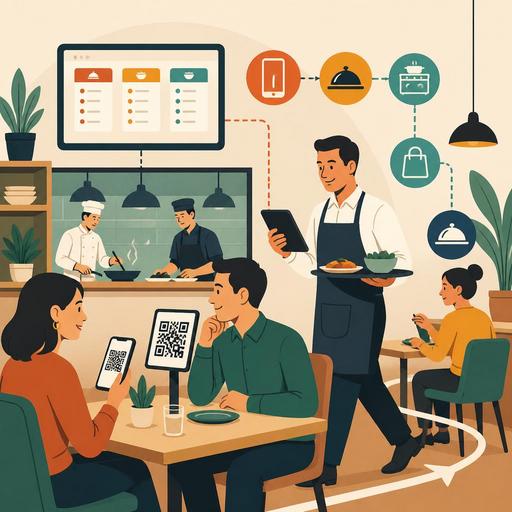
This advantage is even greater for businesses that use a digital menu. When the category flow, product image, filtering, and current stock information are set up correctly on the QR menu, the customer decides faster; the server, meanwhile, focuses on guidance and experience management instead of writing down orders.
2. Clarify the first-contact standard at the table
In many restaurants, order time lengthens because of a first-contact delay rather than the kitchen's busyness. If the customer is waiting for water, the menu, and a greeting after sitting down, time is lost before the order cycle even begins. For this reason, the answer to the question "within how many minutes, in what order, and with which sentence will first contact be made" should be clear within the team.
An example standard might be as follows: the table is greeted right after being seated, digital or physical menu guidance is provided, the day's featured products are mentioned briefly, and the drink order is taken early. This small arrangement starts the customer's decision process before the main order arrives.
What should happen in a well-functioning first-contact flow?
- The responsible staff member should be visible as soon as the table is seated.
- Access to the menu should be provided without delay.
- Brief guidance should be given instead of a long introduction.
- The drink order should be taken early to start the table process.
- 2-3 clear suggestions should be offered for indecisive customers.
The aim here is not to provide robotic service but to reduce uncertainty. Experienced teams know: the moments when a customer says "let's look a bit more" often stem from a lack of guidance. A clear greeting standard speeds up the transition to ordering.
3. Rely on instant digital flow, not the server's memory
During busy hours, writing the order on paper, then entering it into the POS, or relaying it to the kitchen verbally creates serious time loss. What's more, the risk of misunderstanding increases. For businesses that want to shorten order-taking time, the basic principle is this: the order should land in the system in one go, through the right channel, and instantly.
For example, if a server has to also walk to the register point after taking the order at the table, not only seconds but also operational focus is lost. This disconnect becomes more pronounced for staff managing several tables at the same time. Mobile order screens, customer entries through the QR menu, or POS-integrated flows are important for this reason.
The contribution of digitalization here is not only speed. The following advantages also emerge:
- The order lands directly at the relevant station.
- Notes are relayed completely.
- The extra product, sauce, or cooking preference does not get lost.
- The need for repeated communication between the dining room and the kitchen is reduced.
Restaurant digitalization solutions like Restomas are especially useful at this point; because gathering the menu, order, and operational flow into a single arrangement reduces the service team's need to move back and forth among scattered tools. This lowers not only the order-taking time but also the error level.
4. Prepare staff with micro-trainings to reduce off-menu questions
If the order is taking a long time at the table, the problem is not always with the customer; sometimes the team does not fully command the product knowledge. If staff hesitate on questions such as "Is this product spicy?", "Is there a gluten-free alternative?", or "Which side does it come with?", the tableside time lengthens. For this reason, a micro-training model that supports daily operations is more effective than long training presentations.
Micro-training means short 5-10 minute information refreshers before a shift. New products, depleted stock, the day's campaign, allergen information, or frequently asked customer questions are clarified in these sessions. This way, the team gives more confident and faster answers at the table.
Headings that can be addressed in micro-training
- Products out of stock today
- The dishes to be featured for the day
- Frequently asked content and allergen information
- Side product and beverage pairings
- Combinations that offer an upsell opportunity
This approach increases ordering speed while also improving sales quality. Because staff who answer quickly can guide the customer without rushing them. This difference is felt very clearly, especially in restaurants with crowded menus.
5. Remove the invisible bottlenecks between the kitchen and the dining room
Order-taking time is not just the time spent at the table. If the team does not know how busy the kitchen is, it conveys the wrong expectation to the customer, then the order is revised, the product is changed, or the service sequence is disrupted. This indirectly slows down the taking of new orders. Because staff deal with old order problems instead of new tables.
At this point, tools such as a kitchen display, prep-status tracking, and product-level temporary close-out provide great ease. For example, if the prep time of a specific product has lengthened, the dining-room team can see this in advance and steer the customer toward options that can be prepared faster. Similarly, an out-of-stock product remaining open on the menu creates unnecessary conversation and back-and-forth at the table.
Operations managers should regularly ask these questions:
- Which products require the most explanation at the time of ordering?
- At which hours do kitchen turnarounds lock up the dining room?
- Which order notes are most often relayed incorrectly?
- When which products run out, is the menu not updated instantly?
The answers to these questions reveal the real bottlenecks that lengthen order time. The problem is often not "the team is slow" but "the process is invisible."
6. Track the time with data, not with feeling
Many businesses sense that order time is long but do not clearly know which step is slowing it down. Yet for improvement, measurement comes first. Complex reports are not needed here; even a few simple operational indicators provide strong insight.
For example, the following metrics can be tracked regularly:
- The time from the customer sitting down to the moment of first contact
- The time from opening the menu to the order being created
- The time between the order landing in the system and kitchen confirmation
- The average number of revisions per order
- The table-level waiting differences during busy hours
Thanks to this data, it becomes possible to see in which shift, in which section, or in which menu category the delay occurs. After that, taking targeted action becomes easier. For example, if the problem is not first contact, menu simplification or the QR ordering flow becomes more of a priority. If the problem is note relay, POS integration and the kitchen display layout come to the fore.
Shortening order-taking time is possible not with a single magic move but with small yet effective steps that improve the menu, the team, the technology, and kitchen communication at the same time. The best result is an arrangement in which the customer orders faster but does not feel rushed. Because good operations are invisible; they are simply felt as fluid.
With digital tools extending from the QR menu to order management, Restomas can offer a simple start to restaurants that want to set up this flow in a more organized way.
