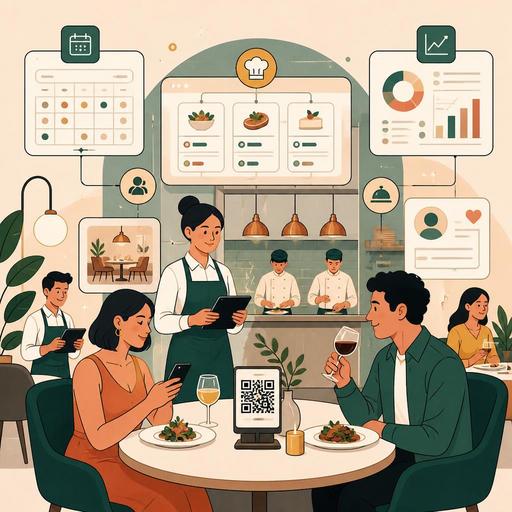
7 Critical Shifts That Will Shape the Restaurant Industry in 2026
The 7 critical shifts that will shape the restaurant industry in 2026 are not merely a list of new technology headlines; they represent a wave of change that touches the entire business, from menu design to service flow, from staff planning to customer communication. For restaurant owners, the real issue is less about which trend is popular and more about being able to tell which one genuinely improves day-to-day operations. In the period ahead, the competitive edge will belong to businesses that use digital tools not just to "be present," but to make faster decisions, deliver more consistent service, and protect profitability.
Today many restaurants face several pressures at once: volatile food costs, high staff turnover, rising customer expectations, the influence of review platforms, and the operational complexity created by multi-channel order management. As 2026 approaches, the common thread among successful businesses will be that, instead of trying to put out each of these fires one by one, they redesign the system itself. That is precisely why the following seven shifts carry strategic weight.
1. The move from static menus to dynamic menu management updated in real time
Printed menus do not have to disappear entirely; however, dynamic menu management is no longer the exception but the standard expectation. In an environment where product availability changes throughout the day, costs fluctuate, and promotions have shorter lifespans, keeping the menu fixed creates risk for the business.
For example, in a cafe with a strong brunch service, automatically pushing breakfast items into the background after 2:00 p.m., highlighting high-margin beverages in the evening, or reducing the visibility of a dessert that is running low on stock all become possible with a digital menu. The goal here is not merely aesthetic; it is to prevent mismatched expectations and to manage the flow of sales.
In 2026, the leading approach in menu management will be a context-driven menu structure rather than "one menu for everyone":
- Different product ordering depending on the time of day
- Stock-aligned content by branch
- More visible presentation of allergen, ingredient, and portion information
- Controlled promotion of campaign products
Systems that offer a QR menu and centralized content management make this transition operationally easier. Especially in multi-branch structures, being able to update everything from a single panel becomes decisive for both brand consistency and speed.
2. The priority will shift from collecting orders to orchestrating the order flow
In the past, the problem was taking the order; today, the real problem is distributing the order to the kitchen, the register, the dining room, and takeaway in the correct sequence. In 2026, the competitive advantage for restaurants will lie not in opening more channels, but in cleanly managing the flow between channels.
An order placed at the table, an extra item added through the QR menu, a special request tied to a phone reservation, the surge of orders dropping in from external delivery platforms... When these are managed in disconnected systems, the likelihood of error rises. The server says "I noted it down," but the kitchen does not see it; the register notices a product change too late; and the customer experiences the delay as a single, unified experience.
For this reason, in the new era businesses should focus on this question: Regardless of where the order originates, can I manage it in the same operational language?
Consider a concrete example: during the lunch rush, table service continues in the dining room while takeaway orders increase at the same time. If the system does not clearly show prioritization, product notes, and channel distinction on the kitchen display, the team works on reflex; and in a rush, reflex produces errors. Here, order management tools are not just a digital convenience but the backbone of service quality.
3. In customer experience, a sense of control will be as decisive as speed
Customers no longer want fast service alone; they also expect a greater sense of control over the process. Seeing a product's ingredients, reviewing allergen information, accessing the menu without waiting, quickly reordering when needed, or clearly knowing their reservation status are all part of that feeling.
Although this shift is especially pronounced among younger urban customers, it is now spreading to a broader profile. Because the issue is not a fascination with technology; it is the reduction of uncertainty. Not having to wait for a menu, not having to ask again "is this dish spicy," and not having to flag down staff just to request the check all make the experience more seamless.
For a strong customer experience in 2026, restaurants will need to review the following areas:
- Time to access the menu
- Clarity of product information
- Correct reflection of additional requests in the order
- Transparency of the reservation and table flow
- Clarity of communication before and after payment
The point to watch here is not positioning digitalization as an alternative to human contact. A well-designed digital experience allows staff to host more guests rather than spend their time on repeated explanations.
4. The era of managing the staffing gap through process design, not just hiring
The difficulty of finding and retaining staff in the restaurant industry is nothing new; however, in 2026 the distinguishing feature of successful businesses will be that they do not try to solve this problem solely by seeking new employees. The real transformation lies in building processes that reduce the team's workload.
For example, a server repeating the same basic information at every table, the kitchen struggling with illegible checks, or the manager gathering data from different channels at the end of a shift all create invisible losses of time. As this loss grows, staff fatigue increases and the tolerance for error declines.
Getting more work done with fewer people is not a healthy goal; but enabling the same team to work with less friction is a realistic one. To this end, restaurant managers can consider the following steps:
- Digitalizing recurring information flows
- Standardizing order notes
- Gathering reservation, table, and order data on a single screen
- Establishing a clear operational flow that makes it easier for new staff to learn
This approach indirectly affects employee satisfaction. Because what tires a team most is not the rush, but uncertainty.
5. Tracking data will mean making daily decisions, not just pulling reports
Many businesses have data but cannot turn it into a decision-making mechanism. In 2026, what will make the difference is not looking at a report at the end of the month, but being able to make small yet effective decisions throughout the day. Which product is viewed frequently but ordered rarely? At which hours does table turnover slow down? Which products attract too many special notes? The answers to these questions directly affect menu and operations design.
For example, if a product is asked about often but sells little, the issue may be price, description, visual expectation, or service time. Similarly, if reservation occupancy is high but table utilization efficiency is low, the problem is not demand but the flow plan. What makes data meaningful is that it is simple and actionable enough for the team to use.
A practical framework for restaurant owners might look like this:
- Data to review weekly: best sellers, slow sellers, cancelled items, peak hours
- Data to review daily: out-of-stock products, service delays, table turnover flow
- Data to review monthly: menu performance, branch-level differences, campaign impact
Centralized reporting and integrated operations dashboards are becoming increasingly critical for creating this visibility.
6. Social media will evolve from a showcase into an operational support channel
Social media has long been a visibility space for restaurants; in 2026, it will be used more as an operational support channel. Customers no longer want only to see photos; they want to reach the menu, make a reservation, learn campaign details, and quickly access accurate information.
For this reason, the connection between social media content and the restaurant's digital infrastructure will strengthen. A new dessert shared in a story that is hard to find on the menu, the absence of a reservation link on the profile, or a campaign applied differently at the register all create a loss of trust. Content and operations must say the same thing.
In practice, the following approach will stand out:
- Using an up-to-date digital menu link for every campaign
- Clarifying the reservation flow during busy periods
- Managing temporary products on social media and the menu simultaneously
- Reflecting recurring questions from reviews and messages in the menu descriptions
In this way, social media becomes a channel that reduces information confusion instead of generating extra work.
7. Integrated systems will no longer be a luxury but the basic infrastructure that prevents disarray
One of the most important changes of 2026 will be that proceeding with disconnected tools becomes more costly for restaurants. When the menu is in one place, reservations in another, order tracking somewhere else, and register data elsewhere, the manager constantly tries to close the gaps in between. This creates a loss of both time and attention.
The value of integrated structures lies not in "looking more high-tech" but in enabling different teams to see the same reality at the same time. When the dining room, kitchen, register, and management all look at the same data, misunderstandings decrease. This difference becomes even more visible in multi-branch businesses.
Here, the fundamental action for restaurant owners is to map the existing flow before adding a new tool. Provide clear answers to these three questions:
- How does an order travel from the first point of contact to the kitchen?
- How long does it take for a menu change to be reflected across all channels?
- Can reservation, table, and payment data be viewed together?
If the answers to these questions are weak, the problem is not the team but the design of the system.
In short, 2026 will be a year not only of new tools but of smarter ways of operating in the restaurant industry. Dynamic menus, an integrated order flow, daily decision-making with data, a customer experience with a high sense of control, and simpler staffing processes will become the common ground of strong businesses. Restaurants that prepare for this transformation early can move from merely following change to being among those who drive it.
If you want to see your restaurant operations in a more holistic way, Restomas's approach of bringing together QR menu, order management, and reservation flow can be a good starting point.
