7 Mistakes That Erode Profitability in Takeaway Orders
Mistakes made in takeaway orders do not just mean a delivery delay or a complaint about a missing item; they often directly affect profitability, brand perception, and the repeat-order rate. Especially during busy hours, failing to manage the order flow properly, a lack of coordination between the kitchen and the front of house, and not keeping menu information up to date create greater operational costs for restaurants than they appear to. In this article, we address the 7 most common critical mistakes in takeaway, with field examples and actionable solutions.
1. Managing order channels in a scattered way
When the phone, messaging apps, different marketplaces, and the restaurant's own order line all operate at the same time, the failure to consolidate orders into a single flow creates serious confusion. An order being overlooked, the same order being prepared twice, or delivery information being relayed incorrectly are typical results of this disorder.
For example, during the evening rush, if an order taken over the phone is jotted down on paper while an order coming in from an online channel at the same time is relayed to the kitchen faster, the team may set the wrong priority. As a result, the order that came in earlier goes out later, and the customer perceives the delay as the restaurant's overall service quality.
What should be done?
- Make all order channels visible on a single screen as much as possible.
- Create a clear flow for the moment the order is received, confirmed, ready, and handed to the courier.
- Use a standard record template for phone orders: address, product, beverage, note, payment type, delivery time.
A centralized order management approach reduces dependence on verbal handover within the team and lowers the margin for error.
2. Offering products unsuitable for delivery without control
Every product may be suitable for dine-in service; but the same does not hold for takeaway. Products that quickly lose their crispy texture, plates with sauce that overflows, or menus with a delicate hot-cold balance do not deliver the expected experience during delivery. The problem is usually not in the kitchen, but in a wrong product-channel match.
Imagine a burger restaurant: a product much loved in dine-in service can receive a low rating in takeaway because the bun goes soft and the fries steam up. The customer does not know that the product was actually made well; they only evaluate the order that arrived.
What should be done?
- Think of the takeaway menu separately from the dine-in menu.
- Highlight products that hold up to travel time.
- Package extra sauces, garnishes, and hot-cold components separately where possible.
- Clearly show delivery-suitable variations on the QR menu and digital menu.
Making menu management digital provides an advantage here, because product descriptions, variations, and temporary closures can be updated faster.
3. Not planning preparation time realistically
The estimated time given in takeaway is the foundation of customer expectation. Yet many businesses set this time not according to the kitchen's real capacity, but according to the ideal scenario. When volume, bulk orders arriving at the same time, shift changes, or limited prep space are not taken into account, delays become inevitable.
Especially on weekend evenings, an order quoted at 20 minutes going out in 40 minutes creates not only impatience but also distrust in the customer. On the next order, the customer may not return to the same restaurant.
What should be done?
- Track average preparation times by product.
- Define a separate delivery promise for busy hours.
- When kitchen capacity is full, automatically reflect a longer time on new orders.
- Plan the number of couriers in harmony with the kitchen's output speed, not independently of it.
Operational efficiency means not only being fast, but promising the right time at the right moment.
4. Letting the packaging standard vary from staff to staff
The same order being packaged differently across different shifts makes the customer experience inconsistent. A spoon coming with the soup one day but not the next, sauces sometimes being added and sometimes forgotten, or beverages being bagged incorrectly may seem like small details. Yet in the takeaway experience, the customer evaluates the restaurant the moment they open the package.
When the packaging standard is unclear, the source of the error is not a single person but a lack of system. That is why it is misleading to view the problems merely as "carelessness."
What should be done?
Prepare a short and visible packaging checklist for each product group. For example:
- Main product
- Side product
- Sauces and extra ingredients
- Fork, knife, napkin
- Beverage lid and leak-proof check
- Order slip or verification label
When this checklist becomes standard at the kitchen pass, onboarding new staff also becomes easier. Making product notes visible on digital order screens reduces the chance of missing critical details like "no onions" or "spicy sauce on the side."
5. Taking incomplete address, delivery notes, and customer information
A significant portion of delays in takeaway happen not in the kitchen, but at the delivery stage. Missing apartment information, a wrong phone number, the door code not being written down, or the block being omitted at gated complexes cause a ready order to wait on the road. This lowers product quality.
Moreover, the problem is not only time. When the courier cannot reach the customer, both delivery cost rises and the risk of a second preparation in the kitchen arises. This mistake is seen more often at businesses that take orders by phone in particular.
What should be done?
- Define mandatory fields in address entry.
- Support the delivery note with guiding questions instead of free text.
- Use the saved information of repeat customers after verifying it.
- Check the phone number and payment type one last time before the courier sets off.
As with reservation and customer record logic, keeping delivery information organized reduces the operational load.
6. Failing to manage courier-kitchen communication in real time
If the order is ready but there is no courier, the kitchen waits. If the courier is ready but the order has not gone out yet, the delivery chain stalls again. In takeaway, the bottleneck usually stems not from kitchen performance, but from a lack of synchronization.
For example, when three orders are ready at the same time, if it is unclear which route should go out first, which order should be kept hot, and which deliveries can be combined, the team proceeds with on-the-spot decisions. This creates an operation that is dependent on the person rather than on a standard.
What should be done?
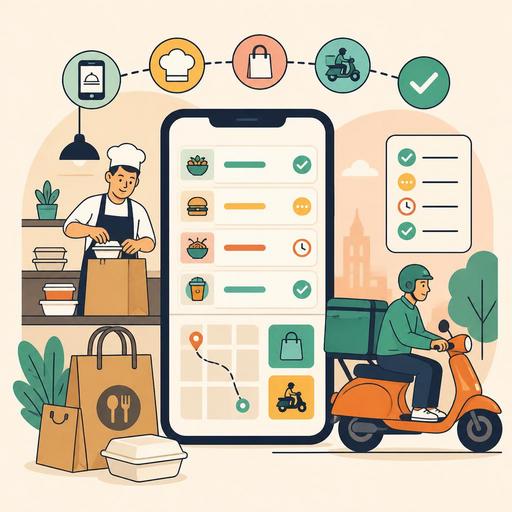
Set up a simple but disciplined flow:
- Order being prepared in the kitchen
- Packaging completed
- Courier assigned
- Out for delivery
- Delivered
When these steps are visible, the front of house, the kitchen, and the delivery team all speak the same language. The value of order management tools emerges exactly here: everyone sees the same status at the same time.
7. Resolving complaints only on the spot without recording them
When a customer reports a missing item, sending a new one is of course important. But proceeding without asking why the same mistake keeps recurring is postponing the problem rather than solving it. In most businesses, takeaway complaints remain scattered; they are discussed on the phone, forgotten during the shift, and the same problem is experienced again the next day.
Yet when complaints are recorded correctly, they turn into very valuable operational data. Which products most often have missing items? At which hours do delays increase? In which areas is delivery problematic? The answers to these questions are the foundation of an improvement plan.
What should be done?
- Record complaints by category: delay, missing item, wrong item, quality, packaging.
- Review recurring problems in short weekly team meetings.
- Analyze the source of the problem on a process basis, not a person basis.
- Update menu, kitchen flow, and order-screen notes based on feedback.
This approach improves the customer experience while also reducing unnecessary pressure on staff, because the team sees more clearly what causes which problem and why.
Conclusion: Success in takeaway requires a system before speed
Errors in takeaway orders are never reduced to zero; but with the right system, recurring mistakes can be significantly decreased. Centralizing order channels, designing a delivery-suitable menu, planning preparation time realistically, establishing a packaging standard, and turning complaints into data strengthen both the restaurant's operation and customer satisfaction.
For many restaurants today, the real differentiator is not working harder, but building a more visible and manageable flow. Digital tools like Restomas can also help build a more controlled operation from order to delivery by simplifying this flow.