Which 6 Processes Has AI Really Taken Over in Restaurants?
The question of which 6 processes AI has taken over in restaurant management is today on the agenda not only of technology enthusiasts but also of operators dealing with cost pressure, staff shortages, and changing customer expectations. But there is an important distinction here: AI does not run the restaurant on its own; it speeds up processes that are repetitive, data-heavy, and require decision support. Set up correctly, it reduces the burden on the manager, the chef, and the service team; structured wrongly, it merely creates new confusion. For this reason, the topic should be viewed not as a "trend" but as a matter of operational design.
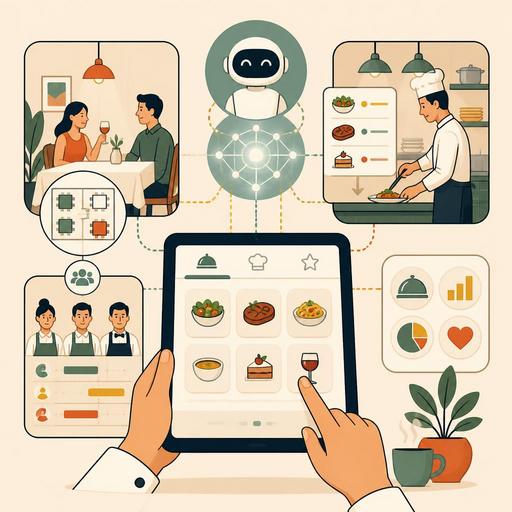
Today, AI's most visible effect in restaurants is not eliminating human judgment entirely but enabling people to make faster and more consistent decisions. This is clearly visible in areas such as order management, menu analysis, customer communication, demand forecasting, the reservation flow, and staff planning. Below, we address 6 processes that genuinely deliver value in the field and the actions restaurant owners can take.
1. Order intake and routing process
One of the areas AI has taken over fastest in restaurants is the first contact point of the order. Requests coming through QR menus, online order screens, kiosks, messaging channels, or call-center-like structures can now be classified more systematically. The aim here is not just to take the order; it is to route the order to the right channel, the right kitchen flow, and the right preparation sequence.
For example, while a customer is searching for a product on the menu, the system can highlight products frequently chosen together, make allergen information visible, and automatically hide items that are out of stock. This way, the staff's repetitive burden of "this product is sold out," "what would you like with it," and "which kitchen will it go to" decreases. This process runs much more efficiently, especially in businesses with a digital menu and order management infrastructure.
The important point here is to think of AI not just as a recommendation engine but as an operational layer that reduces order errors. In systems like Restomas that offer a QR menu and order flow, when product visibility, category structure, and real-time update discipline are in place, the benefit gained from AI also increases.
What should you do?
- Simplify the most-confused product names.
- Make sure out-of-stock products are instantly removed from the digital menu.
- Standardize add-on, portion, and allergen options.
- Make visible which station the order goes to.
2. Menu optimization and product recommendations
Many restaurants manage their menu intuitively; yet AI makes it possible to see more clearly which part of the menu attracts attention, which products are ordered together, and which are viewed but not selected. This way, menu management moves out of the "I have a feeling" approach and becomes more systematic.
Let's consider a concrete example: grilled products attract high interest, but the rate of adding a side is low. AI-supported analysis can show that the problem is not price but menu placement, the wording of the description, or add-on visibility. Likewise, some products are clicked a lot but ordered little; this can point to a problem related to the product photo, the description, price perception, or preparation time.
In this process, AI is not a magic box that tells you which product you should remove entirely. But it makes you ask questions like these faster:
- Which products sell together?
- Which products slow down the flow during busy hours?
- Which category leaves the customer undecided?
- Which products should be more visible on the digital menu?
This approach is valuable especially for businesses that update their menu frequently, work seasonally, or run takeaway and dining-room operations together.
3. Demand forecasting and preparation planning
One of AI's most critical contributions to restaurant management is helping predict the near future more accurately by looking at past data. Anticipating which day, which hour, which channel, and which product group will see high demand directly affects both kitchen preparation and stock use.
The aim here is not to make a flawless forecast but to narrow the uncertainty. For example, corporate orders may rise at weekday lunch, reservation density may increase on Friday evening, and takeaway may come to the fore on rainy days. Human managers can sense these patterns; AI, on the other hand, makes them visible regularly and reduces the chance of missing recurring patterns.
This way, the following decisions are made more soundly:
- How much of which prep products should be prepared?
- How many people are enough on which shift?
- Which products should be featured at certain hours?
- On which channel density is expected, how should the flow be balanced?
If order data, reservation data, and the sales flow are kept scattered in different places, the value gained from AI drops. For this reason, you first need to gather the data into a single operational logic. Without digitalization, forecast quality remains limited.
4. Reservation and table-planning management
On the reservation side, AI is not just a "system that reserves tables." Its real contribution is managing no-show risk, table-turnover speed, peak-hour congestion, and channel-based reservation behavior better. Especially in restaurants with limited table capacity, this area is directly related to revenue and the customer experience.
For example, if similarly sized groups pile up into the same time slot, service can falter. AI-supported planning can help distribute reservations evenly, run a confirmation mechanism at certain hours, or optimize the flow according to table-usage duration. This makes the host team's job easier while also making the wait time more predictable.
The most common mistake in reservation management is using the technology merely as a calendar. Yet the system produces real value when it evaluates customer notes, repeat visits, special requests, and density patterns together. When this information is gathered in one place with reservation infrastructure like Restomas, the table plan can be managed in a more controlled way.
5. Customer communication and feedback classification
In restaurants, customer messages no longer come only by phone. Instagram DMs, WhatsApp, Google reviews, reservation notes, online order remarks, and form requests all flow together. AI stands out here most in the job of classifying and prioritizing messages.
For example, which of the incoming messages is a reservation request, which is a complaint, which is an allergen question, and which is a corporate event request? Separating these manually both takes time and produces errors. Thanks to AI-supported filtering, the team can respond to critical messages first. This makes a serious difference in the customer experience; because a late reply often means a lost customer.
In addition, it becomes easier to see recurring themes in reviews and feedback. If guests constantly write similar things about service speed, product temperature, table preparation, or reservation confirmation, this is not just a reputation issue; it is an operational problem. AI helps you catch these signals earlier.
A practical application suggestion
Each week, tag incoming reviews under these four headings: service, taste, speed, communication. Then pick the two most recurring problems and turn them into action at the next week's team meeting. Maximum benefit from AI comes not from collecting data but from tying the data to a decision rhythm.
6. Staff planning and managerial decision support
One of AI's quiet but powerful effects is in staff planning. Topics such as which role is short on which shift, at which hours service gets clogged, and on which days an imbalance forms between the kitchen and the dining room become more clearly visible. This is important especially for businesses experiencing high turnover.
Here AI does not replace human resources; it reduces the manager's blind spot. For example, if the number of orders rises on the weekend evening shift while the number of runners falls short, the problem can sometimes be not "the team is slow" but "the shift structure is wrong." Likewise, if a pileup occurs at the register at certain hours, the solution may be not hiring new staff but redistributing the order channel.
For the best result, managers should adopt this approach:
- First define which decision they want to make better,
- Then regularly collect the data that supports this decision,
- Finally use AI as an action tool, not a report.
Conclusion: AI takes over the bottleneck, not the job
The processes AI has taken over in restaurants actually converge on a single common point: reducing repetitive work and making bottlenecks more visible. In many areas, from ordering to reservations and from the menu to the shift plan, rather than replacing the human team, it enables them to work more accurately, faster, and more consistently. For this reason, the right question is not "Whose job will AI take?" but "Which process creates the most friction in our business?"
Start small: first choose a single process, organize the data, bring the team into the same flow, and measure the result. When core building blocks such as the digital menu, order management, and reservations are in place, the advantage AI provides also becomes more visible. Restomas can help simplify restaurants' digitalization journey by making these core flows more organized and trackable.
