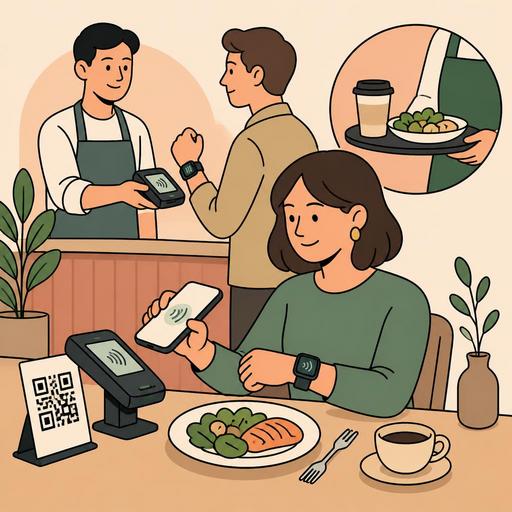
A Guide to Contactless Payment with Apple Pay and Google Pay in Restaurants
Apple Pay and Google Pay are redefining the contactless payment experience in restaurants. For customers who head out without carrying a wallet, payment is no longer just the final step at the register; it is part of an expectation of speed, trust, and fluidity. For this reason, accepting Apple Pay and Google Pay in restaurants does not merely mean adding a new payment method. It is also a strategic decision that affects service flow, table turnover, register operations, and customer satisfaction.
Today many guests see paying with their phone or smartwatch as natural behavior. This expectation becomes more visible especially during busy lunch service, grab-and-go coffee spots, quick-service restaurants, and venues catering to a younger customer base. But the critical issue here is more than saying "we accept contactless payment." What truly makes the difference is turning this method into a seamless experience from the menu to the order, from the table to the register.
What does the wallet-free customer era mean for restaurants?
A wallet-free customer is a guest who comes to the restaurant without carrying a physical card or cash and expects to complete the entire process on their mobile device. For this type of customer, the experience must not be fragmented. If a guest who has reviewed products and made an ordering decision via the QR menu runs into a long register queue at the payment stage, the digital flow breaks down.
For example, consider a quick-service burger restaurant. The customer creates their order via a kiosk, cashier, or QR menu; at payment time they want to hold their phone near the terminal and complete the transaction in seconds. If the POS device is incompatible, if staff don't know how to use Apple Pay or Google Pay, or if the transaction requires an explanation every time, the expected convenience is lost.
This transformation has three fundamental consequences for restaurants:
- Speed expectations rise: Customers show less tolerance for delays at the moment of payment.
- Staff training becomes critical: A team that doesn't know how each device works can create a bottleneck at the register.
- Digital integrity gains importance: Menu, order, payment, and reporting must not be disconnected from one another.
What to check before accepting Apple Pay and Google Pay
Many businesses treat contactless payment support solely as a bank POS feature. Yet what matters in restaurant operations is for this method to work flawlessly under real service conditions. Before making the switch, evaluate the following items:
- POS and payment infrastructure compatibility: Make sure the device you use supports mobile wallet payments. You need not just theoretical support but a setup that works in the field.
- Register flow: In single-register businesses where a payment queue forms during busy hours, mobile payment alone won't solve the problem. You need to plan order-taking and collection points together.
- Staff scenarios: The server, cashier, and shift supervisor should know what to do in situations such as a failed transaction, a retry, or the use of a different device.
- Receipt and record processes: Whatever the payment method, in-house reporting and reconciliation must be clear.
Establishing standard operations is especially important in multi-location restaurants. If Apple Pay works flawlessly at one location while staff at another ask "do you have cash or a card?", the brand experience becomes inconsistent.
How does the contactless payment experience differ between table service and quick service?
The Apple Pay and Google Pay usage scenario varies by restaurant model. For this reason, it isn't right for every business to copy the same solution.
Table-service restaurants
In table service, the critical point is how the check is presented to the customer. The experience drags on if the guest waits for the check, the POS device arrives late at the table, or they're directed to the register to pay. In this model, portable payment devices and systems that work integrated with the order flow provide a major advantage. The server should be able to present the payment method naturally while closing out the check.
For example, in a bistro busy with evening service, closing the check at the table both preserves the service rhythm and reduces the bottleneck at closing time. The goal here is not to show off technology but to make the customer's departure from the restaurant smooth.
Quick service and grab-and-go spots
In this model, payment time directly affects queue management. In places such as coffee chains, sandwich bars, or food court businesses, the time that passes from the customer's ordering decision to delivery is very valuable. With the right setup, mobile wallet payments can reduce the micro-delays at the register.
However, the point to watch here is not to focus solely on payment speed. If the menu screen is complicated, if promotions are entered manually at the register, or if product variations slow down staff, payment technology alone won't be enough.
The most common operational mistakes
When putting new payment methods into use, restaurant owners often think the job is done once the technical setup is complete. Yet the most frequent problems emerge within daily operations.
- Staff not being familiar with the method: Hesitation when a customer wants to pay by phone undermines the sense of trust.
- Unclear communication despite accepting the payment: If this option isn't visible at the door, on the menu, or at the register, the customer is pushed into unnecessary questions.
- A disconnect between the digital order and payment flow: It's confusing when products selected via the QR menu drop into a different process at the payment stage.
- Failure to test during peak hours: A system that works during quiet times may behave differently during the lunch peak.
For this reason, it's wise to run a small pilot when adding a new payment method. Testing it in one shift, with a specific group of staff, and within real customer flow is far more valuable than guessing from behind a desk.
An actionable transition plan for restaurant owners
If you want to start accepting Apple Pay and Google Pay, treat it not as a one-off technical project but as a customer experience improvement. The plan below offers a practical starting point:
- Map out your current payment infrastructure: List which POS devices are used and which setup exists at which locations.
- Map your customer touchpoints: Determine where payment takes place at each point such as the QR menu, table order, register, and takeaway counter.
- Prepare short scenario-based training for staff: Clarify situations such as "the customer wants to pay by phone," "the transaction will be retried," and "collection will happen at the table."
- Simplify your communication: Clearly show on the menu, at the register, or at the entrance that contactless mobile payment is accepted.
- Unify reporting and operations: Track order, payment, and service data within the same flow as much as possible.
Digital menu and order management solutions play an important role here. Because the digital experience that begins as the customer reviews the menu must not be interrupted at the moment of payment. Platforms like Restomas can help restaurants manage this transition in a more planned way by addressing the QR menu, order flow, and operational visibility within the same framework.
In conclusion, Apple Pay and Google Pay are not options added to restaurants merely to look modern. When set up correctly, they simplify the service flow, improve the customer's departure experience, and give the business a more consistent operational foundation. The wallet-free customer era has begun; what matters is preparing for this change not just at the device level but across the entire restaurant experience.
If you want to plan the menu, order, and payment flow in your restaurant more holistically, you can explore the Restomas approach.
