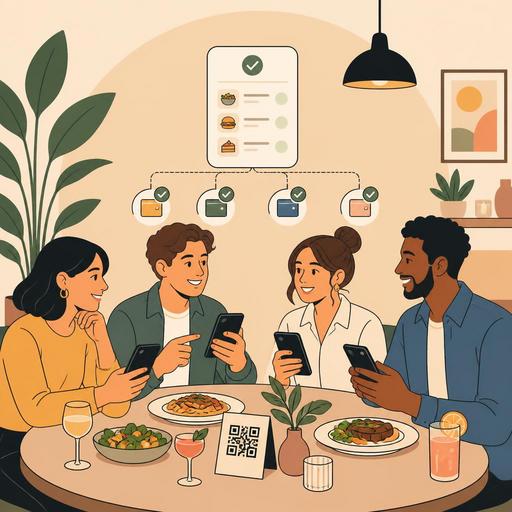
How Bill-Splitting Technology Improves the Experience for Groups of Friends in Restaurants
Why is bill-splitting technology now an operational matter in restaurants?
Bill-splitting technology, especially in restaurants with groups of friends, large tables, and a shared-dining pattern, is not just a payment convenience but directly a matter of operational efficiency. In scenarios where everyone at a table orders different items, shared plates arrive in the center, some guests consume alcoholic drinks, and some skip dessert, the moment of payment often becomes the most fragile point of the service experience.
A table that was satisfied throughout the meal can have a bad ending when the bill arrives because of a long wait, an incorrect split, the staff going back and forth to the register, or paying with a single card and then having guests transfer money among themselves. Moreover, this situation doesn't just create discomfort on the customer side; the time the server spends at the table grows longer, confusion arises on the register side, and during busy hours the rate of turning over new tables is affected.
Today, as digital ordering and payment infrastructures develop, the bill-splitting feature has moved out of the "nice to have" category and is turning into a competitive advantage, especially for businesses catering to a young crowd, office groups, and social gatherings. The critical point here is that the technology should not merely split the bill equally; it should support flexible scenarios based on individual items, per person, or shared consumption.
The real problem in groups of friends isn't money, it's uncertainty
Restaurant owners sometimes see bill-splitting purely as a payment-infrastructure problem. Yet the real tension at the table usually arises from uncertainty. When questions such as "Who ate what?", "How will the service charge be shared?", "Will we split the shared items equally?", and "Should we write the drinks down separately?" start being discussed at the moment of payment, the process drags on.
At this point, technology can make those small frictions in human relationships invisible. For example, in a system working with a QR menu and digital order flow, if orders can be marked on a per-person basis, who ordered which items becomes more transparent at the end of the meal. If shared items were sent to the center of the table, these items can be separated out as common line items. This way, instead of a split based on the server's memory or last-minute guesses, a payment arrangement based on the order flow emerges.
Let's consider a concrete example: a group of four friends comes to the restaurant. Two people order main courses, one consumes only an appetizer and a drink, and the other adds a dessert. Two shared mezes also come to the table. In the traditional setup, the server either tries to split the bill equally or does a manual calculation with the table's guidance. In a digital system, thanks to per-person ordering and shared-item marking, separate collection is managed much more controllably at the moment of payment.
For which businesses is it more critical?
- Tavern, tapas, and gastropub concepts where shared consumption is intense
- Cafes and casual dining restaurants catering to a young customer base
- Lunch-service businesses hosting teams that work around business districts
- Brunch and dinner venues with high turnover of large tables
The operational benefits of bill-splitting technology
A well-designed bill-splitting experience doesn't just satisfy the guest; it also provides concrete relief behind the scenes of the business. The first benefit is reducing the cognitive load on staff. Instead of the server separating items one by one at the moment of payment, redistributing discounts, or making manual corrections at the register, having the system support this lowers the chance of error.
The second benefit is preserving table turnover. Especially during busy service hours, guests waiting for the bill and then a lengthy splitting process can delay tables waiting to be seated. Speeding up the payment flow helps the restaurant maintain its rhythm.
The third benefit is making dispute and refund management easier. When a customer says "I didn't order this," the situation is examined more clearly if there are per-person or per-item records. This keeps both the front-of-house team and the register side away from needless arguments.
POS integration becomes important here. If the channel where the order is taken, the flow in which it reaches the kitchen, and the payment screen are disconnected from one another, bill-splitting fails in practice even if it exists on paper. The point restaurants need to watch is to evaluate payment convenience not in isolation but within the integrity of the menu, order, table, and collection flow.
The most common mistakes in implementation
Even though many businesses activate the bill-splitting feature, the experience can still be problematic. The fundamental reason for this is putting the technology into use without process design. The following mistakes are very common:
- Offering only equal splitting: Yet groups of friends often want per-person or per-item payment.
- Not training the server: Even though the system exists, if the team doesn't know how to use it in which scenario, a bottleneck occurs at the table.
- Not marking shared items: When shared plates are later attempted to be split, confusion arises.
- Separating the QR menu from the order flow: While the customer has a digital experience, switching to a fully manual process at the moment of payment creates a disconnect.
- Not clearly defining discount and campaign rules: Promotions such as "second drink free" can be confusing in a per-person split.
For example, in a business running a happy hour, some products may be on campaign and others at full price. If the system doesn't make visible how the promotion is applied to which line item, arguments easily arise in group payments. For this reason, just as important as the choice of technology is reflecting the menu rules and campaign logic correctly into the system.
A clear action plan for restaurant owners
For businesses that want to use bill-splitting technology efficiently, the matter is not just about choosing software. The following steps produce healthier results:
- Analyze your tables: Determine on which days and hours large groups come, which products are consumed jointly, and where the most delays occur at the moment of payment.
- Define three payment scenarios: Equal split, per-person split, and split with shared items. Make sure the team knows every scenario.
- Review your menu structure: Marking shared items with separate logic in the system provides great convenience later.
- Think about POS and digital ordering together: The QR menu, table ordering, and payment flow should complement one another.
- Create a short service protocol for staff: When the server brings the bill, they can use a standard phrase such as "if you like, we can split it per person or separate out the shared items."
- Run a peak-hour test: The feature should be tested not during calm times but in real intensity, such as a Friday evening.
This approach turns the technology from a showcase feature into a real service tool. Platforms that handle the QR menu, order management, and POS integration within the same frame, such as Restomas, also create value here; because the bill-splitting experience works best in systems where the order data flows in an organized way from the start.
The winning businesses of the future will be those that make the moment of payment invisible
The most-discussed topics in the guest experience are usually flavor, presentation, and atmosphere. However, one of the moments that influences the decision to revisit is how the bill is closed. Especially among groups of friends, the restaurant's final impression is often shaped by the payment process. A fast, transparent, and flexible bill-splitting experience strengthens the perception of the business as modern and customer-focused.
Today, when restaurant digitization is mentioned, most businesses first focus on the speed of taking orders. Yet the moment of collection is as much a part of digitization as the order. When bill-splitting technology is designed correctly, it relieves the front-of-house team, preserves customer satisfaction, and smooths the flow during busy service hours.
In short, the matter is not just the question "into how many parts should we split the bill?"; the matter is being able to complete the social dining experience without friction. If your restaurant hosts large groups, treating the moment of payment as a separate operational topic is no longer something that can be postponed.
Restomas can offer a simple starting point for restaurants that want to build a more organized digital experience extending from the QR menu to the order and payment flow.
