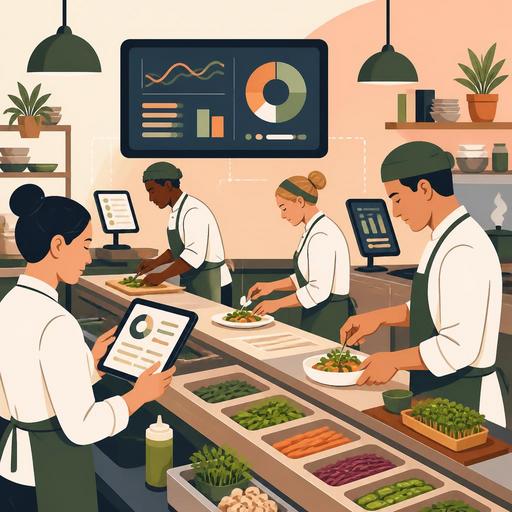
A Guide to Boosting Prep-Line Efficiency with Order Data
Improving prep-line efficiency with order data is a critical topic for restaurants that aim for speed, consistency, and profitability all at once, especially during busy service hours. Many businesses explain a slowdown in the kitchen only by a shortage of staff or limited space; yet the problem often stems from not reading closely enough how the order flow forms. The answers to questions like which product creates a pile-up at which hours, which station becomes a bottleneck, and which prep step delays service are hidden within the order data.
The prep-line is not just a line where ingredients are arranged; it is an operational system that sets the rhythm of production. For this reason, a data-driven approach means, in the kitchen, "working in the right sequence" rather than "working harder." Especially when information from tools such as the QR menu, the digital order flow, register data, and the kitchen display comes together, the prep-line layout relies on observation rather than guesswork.
Where does prep-line inefficiency begin?
In most restaurants, the prep-line problem is noticed when service begins, but its origin extends to earlier hours. When prep lists are kept general, the team gives equal weight to all products. Yet order data usually shows that some products are made far more intensively within specific time ranges. In such cases, the problem is not preparing too little, but allocating capacity to the wrong product at the wrong time.
For example, in a business selling bowls, burgers, and salads, while takeaway orders cluster mainly around burger combos at lunchtime, salads and light plates may come to the fore in the evening. If the prep-line is set up with a single standard in the morning, the bread-warming and garnish-completion station may struggle in the first half of the day while another section sits idle. In the evening, this time the cold-prep section comes under pressure.
Similarly, looking at individual best-selling products is not enough. The combinations of products ordered together also determine the prep-line load. Grilled chicken on its own may go out quickly; but if it is constantly paired with an extra sauce, a gluten-free side item, or a beverage promotion, the total prep time creates a different load in the kitchen plan.
Which signals should be read from order data?
Restaurant owners often look at revenue reports, but prep-line optimization requires more operational data. Here the aim is not just to see what was sold, but to understand what kind of production pressure it creates.
- Hourly product intensity: Which products peak in which time range?
- Load per station: Which orders occupy the same prep area at the same time?
- Modification frequency: In which products do changes such as extra sauce, removed ingredients, and doneness level cluster?
- Channel difference: Do dine-in, takeaway, and pickup orders create different pressures on the prep-line?
- Prep chain: How many micro-steps are needed for a product to reach service?
Consider a concrete example: in a cafe focused on breakfast and brunch, omelet orders may appear high. However, on looking a little more closely at the data, it may become clear that the delay stems not from the omelet itself but from the bread toasting, sauce portioning, and hot-beverage pairing that come alongside it. In this case the solution is not to hire more cooks; it is to reposition the bread station, portion the sauces in advance, or move beverage preparation to a different point in the order flow.
How do you update the prep-line design based on data?
Collecting data is not a solution on its own; what matters is turning this insight into physical flow. A good prep-line shortens the most frequently repeated movements and reduces decision points. To this end, first group products not by menu category but by production commonality.
For example, if three products with different menu names use the same sauce, the same garnish, and the same packaging step, these shared steps should be positioned close together on the prep-line. This way, even if the product name changes, staff proceed with a similar set of movements.
Actionable adjustment steps
- Identify the top 20: Determine not the products that receive the most orders, but the prep flows that recur most often in the kitchen.
- Write down the micro-steps: Make every step visible, such as cutting, heating, saucing, packaging, and adding garnish.
- Find the bottleneck at a single point: Identify the station that creates the most waiting at the same time.
- Separate what can be prepped ahead from what must be done on the spot: Take steps that can be portioned in advance out of the moment of service.
- Set up a separate configuration for peak hours: Instead of a single prep-line all day, plan different mini-layouts for lunch and dinner.
This approach is more easily applied in businesses that use digital order management. Seeing orders by hour, product, and channel provides a strong foundation not only for sales analysis but also for redesigning the prep-line flow.
Consider staff planning and the production flow together
Prep-line efficiency is not only about the counter layout; positioning the right person at the right station in the right time range is just as important. A common mistake is planning the shift schedule by total weekly intensity and not accounting for the type of production by the hour.
For example, a restaurant may be busy between 7:00 p.m. and 9:00 p.m.; but the character of that intensity may not be the same every day. On a Friday evening, more sharing plates and beverage pairings may come in, while on weekdays faster main-course orders come to the fore. In this case, keeping the same number of staff may seem sufficient, but if the station distribution is wrong, the prep-line slows down again.
Here is a practical method for managers: open the order data of the last few weeks and look not only at the total number of orders, but at the ratio of modified products, the channel breakdown, and the prep complexity per product. Then plan staff not with the logic of "how many people do we have," but with the logic of "what type of workload forms at which station."
The kitchen display, order sequencing, and digital flow tools are helpful at this stage; because the team leader sees earlier which product group is starting to pile up. This way, a staff member can move from the cold station to the packaging area, or garnish prep can be prioritized. These small shifts make service time more controlled during busy moments.
A practical way to turn data into a daily routine
Many businesses evaluate data only in monthly reports. Yet prep-line optimization requires shorter feedback loops. Brief end-of-day kitchen reviews are therefore very effective. The goal is not to hold long meetings, but to answer three clear questions every day:
- At which station did the most pile-up occur today?
- Which product or modification disrupted the flow?
- What can we prepare in advance for the same time range tomorrow?
When this discipline is maintained for a few weeks, intuitive management gives way to a repeatable system. For example, the impact on the prep-line of frequent orders for "no sauce," "extra cheese," or "with a different side" becomes visible. This creates many small but effective improvement opportunities, from clarifying menu descriptions to relabeling the prep containers.
Especially in restaurants that use QR menu and order management tools, the link between customer preferences and the kitchen operation is established more easily. It becomes clear not only which product is popular, but which one creates unnecessary friction in the kitchen. This perspective also makes menu decisions healthier.
Conclusion: Not a faster kitchen, but a smarter flow
Prep-line efficiency increases not by making the kitchen rush more, but by drawing the right operational decisions from order data. When hourly intensity, product combinations, modification frequency, and station load are evaluated together, the prep plan, team distribution, and counter layout become more accurate. As a result, service quality not only speeds up but also becomes more predictable.
In restaurants, production optimization often does not require a large investment; even making small adjustments with the right data can create a significant difference. Making the order flow visible with digital tools such as Restomas makes it easier to turn these decisions into a natural part of daily operations.
