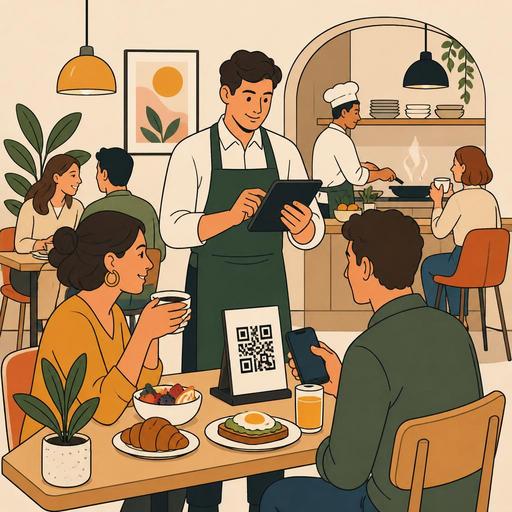
Managing Peak-Hour Flow at Breakfast Spots with a QR Menu
Why is QR menu optimization at the center of peak-hour management in breakfast restaurants?
QR menu optimization at breakfast restaurants is, especially for businesses that experience weekend rushes, not just a digital presentation choice but a direct operations management tool. Breakfast service differs from other meals; guests often arrive within the same time window, stay longer at the table, the number of order items per person rises, and the hot and cold stations in the kitchen work simultaneously. This structure can create congestion at every step, from order-taking time to the product preparation sequence.
While a printed menu increases the explanatory burden on the server, during a rush even the menu reaching the table late slows down the order cycle. A QR menu, by contrast, when set up correctly, guides the guest to decide faster, transfers cleaner data to the kitchen, and reduces the time the service team spends on repetitive questions. But the critical point here is not simply moving the menu to a digital medium. What truly makes the difference is a category structure suited to breakfast behavior, simplification of product variations, visibility management aligned to busy hours, and a properly designed at-table order flow.
For example, if a spread breakfast, a single-plate breakfast, omelets, hot dishes, coffee, and fresh drinks are listed randomly on the same screen, the customer's selection time grows longer. Layouts that ease decisions, such as "sharing for 2," "single-person quick breakfast," "suitable for a family with children," or "ready in 15 minutes," by contrast, ease both the sales flow and kitchen planning.
How should the menu structure be built for busy morning service?
In breakfast businesses, peak-hour management often begins not at the door but on the menu screen. Before the guest even places an order, the business can guide them into a particular flow. To do this, products on the QR menu need to be classified not only by type but by ordering behavior.
1. Create a main category structure that shortens decision time
The biggest problem with long breakfast menus is that the guest can't figure out where to find what. For this reason, between 5 and 7 clear categories on the first screen is enough for most businesses. For example:
- Spread Breakfasts
- Single-Person Breakfasts
- Eggs and Hot Dishes
- From the Oven and Accompaniments
- Coffees and Teas
- Fresh Drinks
- For Kids
This structure prevents the guest from scrolling unnecessarily. Decision fatigue forms very quickly, especially on a phone screen.
2. Reduce the explanatory burden on product cards
Breakfast plates are often multi-component. But writing long paragraph descriptions for each product creates clutter on the screen. A better method is to present the content briefly and functionally. For example, a direct list such as "Ezine cheese, tomato, cucumber, jam, butter, simit, brewed tea" is more effective than romantic but vague descriptions. Allergens, bread type, portion suitability, and extra add-on products should also be shown clearly in separate areas where possible.
3. Keep variations limited and sensible
Offering unlimited add-on ingredient options under an "Omelet" product looks flexible in theory; in practice, it increases the kitchen load. During peak hours, every customization means a new chance for error. Predefined combinations are more efficient instead: "Cheese omelet," "Vegetable omelet," "Plain omelet," and so on. It's healthier to limit the extras area to a few options that genuinely see high demand.
How can the customer experience be preserved with a QR menu without disrupting table turnover?
The breakfast customer doesn't have to be in a hurry; in fact, it's often the opposite. For this reason, the goal is not to speed the guest up but to reduce dissatisfaction caused by waiting. A well-optimized QR menu organizes the service flow without pressuring the time spent at the table.
What matters here is structuring the menu according to the order of decision-making. When a guest sits down at the restaurant, they generally think first of the main breakfast, then the hot add-ons, and then the drinks. If the menu supports this natural sequence, creating the order becomes more fluid. Also, the "let's add this too" behavior commonly seen in breakfast restaurants can be kept under control with the right cross-suggestions.
Let's consider a concrete example: when a two-person table opens the QR menu, if they first see a "popular picks for 2" area, they progress faster instead of scanning the whole menu for minutes. If, after the selection, the system offers sensible complements such as "additional hot suggestions" or "freshly squeezed drinks," both the basket grows and the order structure becomes more organized. This approach also reduces the need for the server to return to the table three times to pull the order together.
On busy reservation days, the QR menu working on a per-table basis also provides an advantage. Which table is ready to order, when the order dropped into the kitchen, and when additional requests came in all become more visible. This way, the service team focuses on real needs instead of the "was the order taken?" confusion.
Peak-hour menu strategies to balance the kitchen load
The fundamental mistake in peak-hour management is keeping all products at the same visibility at all times. Yet in breakfast service, the kitchen's bottleneck stations are clear: the egg station, the frying area, the coffee bar, the bread/oven output, and so on. The QR menu can be used as an active tool to balance this load.
- Feature products with short preparation times. Especially during busy arrival hours, single-person plates, products that come out fast with prepared mise en place, and standard drink combinations can be made more visible.
- Apply temporary stock and production control. When a jam variety, a special bread, a croissant, or certain cheeses are running out, making an instant visibility update on the menu reduces disappointment at the table.
- Apply a limited-variation policy during rushes. While broader customization is offered on weekdays, options that disrupt the kitchen flow can be reduced during the busiest weekend hours.
- Standardize production with combo menus. Frequent sales of certain plates also make purchasing and prep planning easier.
Digital menu management provides an important advantage here. A flow that can't be changed on a printed menu can be managed more nimbly on the digital side according to the time of day, busyness, or stock status. The value of structures that make menu updates, category organization, and the order flow more controlled, on platforms like Restomas, becomes visible exactly at this point: the goal is not flashy technology but a calmer service order.
An actionable QR menu optimization checklist for breakfast restaurants
The list below offers a practical starting framework for businesses that want quick results in breakfast service:
- Simplify the home screen: Show at most 7 categories on the first screen.
- Separate out the best-sellers: Add a "most preferred breakfasts" section.
- Think about preparation logic: Don't feature products that overload the same station at the same time.
- Write product names clearly: Use understandable names instead of creative but vague titles.
- Filter the extra options: Remove customizations that are rarely preferred.
- Digitize out-of-stock management: Don't let a sold-out product continue to appear on the menu.
- Keep cross-sells natural: Add drink and hot add-on suggestions suited to the main product.
- Track the per-table flow: Make the order's intake, transmission, and service process visible.
Each of these steps may look small on its own. But in businesses operating within a tight time window like breakfast, small frictions accumulate and turn into serious service problems. QR menu optimization is one of the most practical ways to reduce these frictions.
Conclusion: aim for a breakfast service that flows smartly, not fast
Successful peak-hour management in breakfast restaurants is always solved with better flow, not more staff. A well-designed QR menu eases the guest's decision, lightens the server's load, sends clearer orders to the kitchen, and makes the table experience seamless. Especially for businesses that experience weekend rushes, menu optimization is a strategic step that calms operations while preserving service quality.
If you want to bring the menu flow, order management, and table experience in your breakfast service into a more organized structure, taking a look at the digital tools Restomas offers can be a good start.
