How Does Showing Calorie Information on a Restaurant Menu Change Ordering?
Showing calorie information on a restaurant menu looks like a double-edged topic for many businesses: some managers think it will lower the sales of high-calorie items, while others believe transparency builds trust and makes ordering easier. In reality, the effect depends far less on whether calorie information appears on the menu and far more on how it is presented, which customer base it addresses, and how the menu is structured. On a well-designed menu, calorie information does not have to be a barrier to sales; on the contrary, it can shorten decision time, increase guest trust, and create a more balanced product mix.
Why is the effect of calorie information on sales not one-directional?
Calorie information does not create only an "eat less" message in the customer's mind. For many guests, this information provides a sense of control. Professionals on their lunch break, people who work out, those with dietary restrictions, parents choosing for their family, and customers who regularly eat out all find it easier to decide when they see clear information on the menu.
Imagine, for example, that a cafe offers a chicken sandwich, pasta, and salad. On a menu without calorie information, the customer may have to ask a staff member "which one is lighter?" On a menu with calorie information, the selection process is shortened. This in itself does not push low-calorie items to the front; it allows the customer to make a more informed choice based on their need at that moment. A guest who plans to make a more filling choice at dinner may still prefer the high-calorie burger; but they might add a salad instead of fries, or change their drink choice.
In other words, the effect is most often seen not at the item level, but on the composition of the basket. While the share of some main items decreases, add-on items or alternative categories may grow. That is why the topic should be viewed not just as "will sales go up or down?" but as "which product group is affected, and how?"
In which restaurant types does calorie information produce more positive results?
Not every business has the same customer expectation. The effect of calorie information is directly related to the concept and the target audience.
- In quick-service and chain businesses, presenting calorie information consistently is easier because recipes are standardized. Customers are also more inclined to make comparisons.
- In cafes and restaurants focused on healthy living, calorie information is almost part of the value proposition. Here, missing information can even create a loss of trust.
- In lunch-service businesses serving corporate districts, the advantage of fast and controlled selection is important.
- In fine-dining or experience-focused venues, calorie information may not be the main communication element; here it may be more appropriate to present it in a simpler way, optionally, or in a digital layer.
Consider a restaurant selling artisan pizza, for example. Writing calories in large type next to every item on the printed menu could disrupt the perception of experience. But when portion information, ingredients, and approximate calorie information appear once you open the product detail in the QR menu, this both provides transparency and preserves the menu's aesthetics. This approach is more balanced especially for businesses that want to protect their brand tone.
How do you show calorie information without lowering sales?
The most common reason calorie information harms sales is not its presence, but the way it is presented. If the menu uses language that makes the customer feel guilty, or puts all the focus on calories, the appetizing experience can weaken. Instead, the information should be positioned as a supporting layer.
1. Do not make calories the only decision criterion
Calories should not come before the product name, its description, the quality of its ingredients, and portion information. Instead of writing "Grilled chicken bowl - 520 kcal," it is more balanced to give the calorie information at a secondary level alongside a short description that explains what the product offers.
2. Present alternatives together
If you are showing calorie information, also open up choices for the customer. For example, options such as fries or a seasonal salad with a burger, a large or medium portion, or serving the sauce on the side make the customer feel freer.
3. Think in terms of categories
Desserts should not be hidden just because they are high in calories. Instead, balancing items such as shareable portions, mini desserts, and light finishes can be added to the menu. This way, the customer shows the behavior of "choosing a more suitable alternative" rather than "removing dessert entirely."
4. Use layered information in the digital menu
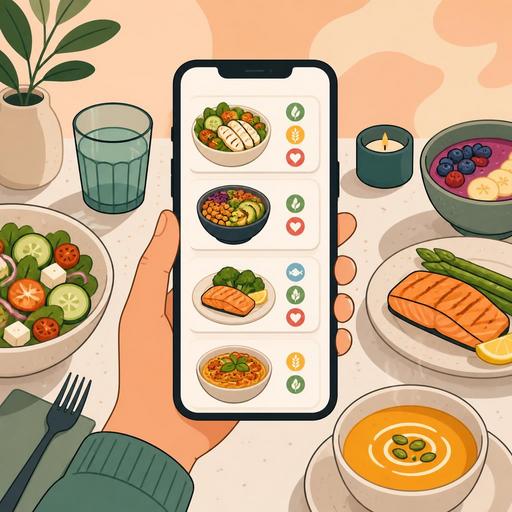
Instead of creating clutter on the printed menu, calorie, allergen, ingredient, and portion information can be presented together on the product detail screen in the QR menu. This both provides a clean design and creates a strong experience for the customer who is looking for information.
An actionable test plan for restaurant owners
The most accurate way to understand whether calorie information will have a positive or negative effect in your business is to run a controlled test. Rather than acting on assumptions, you need to track menu data. And you can start this without turning it into a large, complex project.
- First, set the goal: Is the aim to protect main-item sales, to improve basket balance, or to increase customer trust?
- Choose the product group: Instead of the whole menu, start with one category, such as bowls, salads, sandwiches, or healthy breakfasts.
- Try two presentation formats: In one version, place calorie information in the list view; in the other, on the product detail.
- Track add-on choices: Look at whether there is any shift in side, drink, dessert, and portion preferences.
- Get qualitative feedback from the service team: Is the customer asking fewer questions, deciding faster, and is the demand for a "lighter option" increasing?
Here, a digital menu infrastructure provides a critical advantage. Updating menu items quickly, editing descriptions, turning the information layer on and off for certain products, and seeing which products are reviewed more often makes the testing process far more manageable. Businesses using a QR menu in particular can try different display formats without incurring the cost of reprinting the printed menu.
Mistakes to avoid when providing calorie information
A well-intentioned practice can backfire because of the wrong details. The most common mistakes restaurants make are these:
- Inconsistent recipes: If the same product varies from location to location, calorie information turns into a trust problem.
- Excessive visibility: Giving the visual weight of every line on the menu to calories weakens the appetizing experience.
- Missing context: Writing calories alone, without portion weight or ingredient information, can be misleading.
- Judgmental language: Expressions such as "innocent," "guilt-free," or "no cheating" can create an off-putting effect on some customers.
- Misalignment with operations: Staff not knowing the product's ingredients causes a conflict between the information written on the menu and what is explained in the field.
Publishing calorie information without menu standardization is especially risky in multi-location structures. First, recipe and portion standards must be in place, and then menu communication should be designed. For this reason, the topic is not only marketing, but a matter of operations management.
Conclusion: Calorie information is not the enemy of sales, but a tool that must be structured correctly
Showing calorie information on a restaurant menu does not automatically reduce sales; in fact, with the right target audience, the right presentation, and the right menu architecture, it can increase customer trust, shorten decision time, and create a more balanced basket structure. The real issue is not to put calories at the center of the menu, but to offer the customer clear and simple information they can access the moment they need it.
For restaurant owners, the smartest approach is to start with a small category instead of transforming the entire menu at once, to test different display formats in the digital menu, and to track results at the product level. This way, you can answer the question "does calorie information reduce sales?" not with generic answers, but with your own business's real data.
To strike the right balance between transparency on the menu and sales performance, Restomas's digital menu and content management structure can make it easier to run controlled tests.
