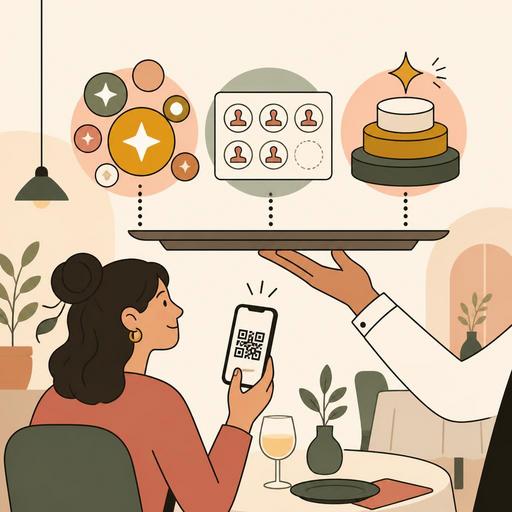
Choosing Between Points, Stamps, and Tiers in a Restaurant Loyalty Program
Choosing between points, stamps, and tiers in a restaurant loyalty program is not just a marketing decision for businesses that want to increase customer loyalty; it is also part of operational, profitability, and customer-experience design. Many restaurant owners focus on the question "which model brings more repeat business?" But the truly right question is this: For my service style, customer frequency, product margin, and digital infrastructure, which loyalty setup is sustainable? A poorly designed program creates confusion at the register, increases staff workload, and fails to generate the expected motivation in customers.
When choosing a loyalty system, there is no single "best" model. The needs of a coffee-focused quick-service cafe and a family restaurant with a broad menu are not the same. A brand with a strong delivery network and a business serving neighborhood regulars also can't get the same returns from the same tools. That is why points, stamp, and tier systems need to be compared not just theoretically, but through their use scenarios, operational load, ease of digital tracking, and the value they make the customer feel.
When does a points system make more sense?
A points system quantifies spending or ordering behavior and ties it to a reward. For example, the customer accumulates a certain number of points with each order and uses these points for a free product, a discount, or a special benefit. The biggest advantage of this model is its flexibility. Different point values can be assigned to different product groups, the multiplier can be increased during promotional periods, and personalization can be done by customer segment.
A points system is especially functional in the following businesses:
- Restaurants with a variable average basket size
- Businesses that manage delivery, pickup, and dine-in service together
- Brands whose menus contain both high- and low-margin products
- Chain structures that want to track customer data in more detail
Let's consider a concrete example: on a menu of burgers, drinks, and desserts, rewarding every product with the same loyalty logic may not be profitable. With a points system, the business can create a more advantageous setup for the products it wants to strategically highlight. That way the loyalty program doesn't just generate repeat visits; it also becomes a menu-steering tool.
However, the points system has a downside too: if it looks too complex to the customer, it loses its effect. If the answers to "how many points do I have, what are they worth, and when can I use them?" aren't clear, the program won't draw interest. That is why if a points system is going to be set up, it's important for it to be visible within the QR menu, the order screen, or the post-payment digital communication flow.
In which restaurants does a stamp system work better?
A stamp system is one of the simplest and most understandable loyalty models. The logic is clear: make a certain number of purchases, earn a reward. It's a strong option especially for businesses with high repeat-purchase behavior, a simple product structure, and regular visit frequency.
Examples of areas where a stamp system works well include:
- Coffee shops
- Dessert shops and ice cream parlors
- Quick-service spots with steady lunch traffic
- Businesses with a base of regulars who frequently buy the same product
From the customer's perspective, a stamp system requires low mental effort. An offer like "buy 9 coffees, get the 10th free" is grasped faster than reading a points table. This simplicity provides an advantage especially at busy registers and in a fast service flow. Staff training is easier too, because the setup is simple.
But the limit of the stamp system is its lack of flexibility. It isn't as strong as a points system at growing the basket, managing the product mix, or offering tailored deals to different customer segments. In addition, if it's run with physical cards, problems such as lost cards, fake stamps, or inconsistency dependent on staff discretion can arise. When digitized, however, this model becomes far more controlled. A digital stamp structure linked to order history offers the customer clarity while giving the business ease of tracking.
Why do tier systems stand out for branding and loyalty?
A tier system motivates the customer not just for the reward but for the sense of status and belonging. Levels such as Bronze, Silver, and Gold, or names specific to the business, can strengthen the customer's relationship with the brand. This structure is valuable especially for restaurants that want to create a sense of community, offer a premium experience, or build a base of regular patrons.
Situations where a tier system stands out include:
- Businesses that want to increase customer lifetime value
- Restaurants that want to offer different experiences to frequent guests
- Brands that can manage privileges such as reservation priority, special menu access, or event invitations
For example, for a fine dining restaurant, a "1 free for every 10 coffees" approach may not match the brand perception. By contrast, offering customers who reach a certain visit frequency priority reservations, access to the chef's special tasting nights, or the right to be the first group to try the new menu is more meaningful. Here the reward isn't just a discount; it's an experience.
The risk of a tier system, however, is expectation management. If you promise the customer a higher tier and offer weak privileges in return, the program can backfire. That is why, in a tier setup, the rewards must be operationally feasible. If processes such as reservations, table management, and customer notes are disconnected from digital tracking, tier benefits may not be applied consistently in the field.
When comparing, look at operations, not just marketing
The most common mistake in restaurant loyalty programs is evaluating the system solely through a marketing lens. Yet the right model must also account for kitchen load, register flow, staff training, and data tracking. The following questions make the decision easier:
- Do your customers differentiate most by spending amount or by visit frequency?
- Will the program be processed manually by staff, or tied to a digital flow?
- Do you want to offer a discount, a free product, or an experience privilege as the reward?
- Are you managing a single location, or do you need consistency across multiple locations?
- Can you see delivery and dine-in order data under the same roof?
At this point, digital infrastructure becomes critical. Having the loyalty system connected to the QR menu, order management, customer history, and promotion visibility both reduces friction on the customer side and gives the business a measurable structure. For example, if the customer can see their active benefit while looking at the menu, it becomes easier for them to decide at the moment of ordering. The business, too, can read more clearly which promotion drove repeat orders.
Which model should you start with, and how should you test it?
For restaurants setting up a loyalty program for the first time, the right approach is not to choose the most complex model, but to test the most understandable and measurable model within a small scope. This framework works well as a starting point:
- Set a single goal: More frequent visits, a higher basket, or a higher share of regulars?
- Choose one main product group: Start with a clear category like coffee, lunch menu, or dessert rather than the entire menu.
- Simplify the rules: If the customer can't understand it in 10 seconds, the system is too complex.
- Train staff by scenario: Everyone should give the same answer to "how does it work?" at the register.
- Increase digital visibility: Make the program visible on the menu, after payment, and in reservation communications.
- Review it regularly: The rewards used, the most frequently chosen products, and the low-participation points should be tracked.
As a practical suggestion: quick-service cafes and dessert shops can start with a stamp system, restaurants with high menu variety can test the points model, and experience-focused, reservation-heavy businesses can consider the tier system as a stronger tool. Over time, hybrid models can be built too. For example, a stamp for basic repeat visits and tier privileges for upper-segment customers can work together.
In conclusion, a good loyalty program does less to give the customer a "discount" and more to make repeating the relationship with the brand worthwhile. The right setup must be understandable, feasible, measurable, and aligned with the business's service reality. When you build a structure that works in integration with the restaurant's digital touchpoints, the loyalty program stops being a promotion and turns into a sustainable growth tool.
If you want to bring your loyalty setup into alignment with your QR menu, order flow, and customer experience, you can explore Restomas's tools focused on restaurant digitalization.