How Does a Contactless QR Payment Setup Pay for Itself in a Restaurant in 4 Hours?
Why can a contactless QR payment setup pay for itself this quickly?
Contactless QR payment changes not only the method of collecting payment in restaurants; it also transforms the table flow, the staff's use of time, and the guest's check-closing experience. The phrase "return in 4 hours" does not mean a guaranteed financial result for every business. But considering the time lost during busy service hours, especially between requesting the check, waiting for the POS device, preparing the receipt, and completing the payment, it is possible to see its operational payback within the same shift.
The basic logic here is this: the guest does not wait for the check, staff do not lose time carrying the POS device, and there are fewer micro-hiccups on the register side. As a result, the table closes faster, a new seating opens more easily, and the service flow does not get congested. This difference becomes far more visible especially in businesses where lunch service is short and evening service is busy.
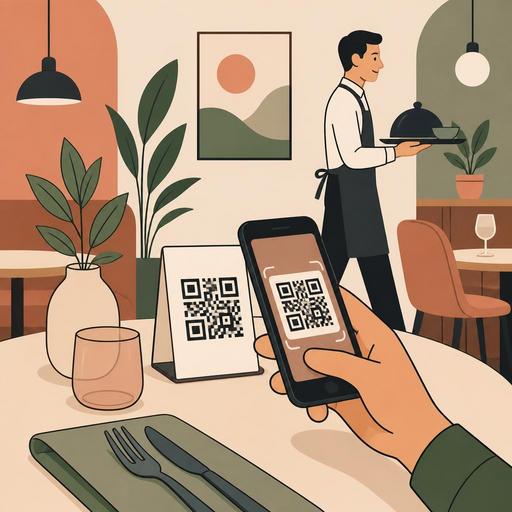
For example, imagine that in a crowded cafe two servers receive "can we get the check?" calls from different tables at the same time. In the classic setup, the server first drops the check into the system, finds the POS device, goes to the table, waits for the card to be charged, sometimes the PIN process drags on, and sometimes the check needs to be split. In the contactless QR payment model, however, the guest scans the code on the table, views their check, and completes the payment from their own screen. This seemingly small change creates serious relief at the busiest minutes.
Reading the 4-hour return correctly: time savings first, not money
Many restaurant owners measure a technology investment only by a direct increase in revenue. Yet the first return often comes in the form of time savings and the resolution of bottlenecks. To understand the effect of the QR payment system, it is more accurate to ask this question: "Which delays does this system eliminate during busy service?"
- The delay in requesting the check decreases.
- The POS-device waiting time can disappear.
- The server's tableside payment traffic drops.
- The check-closing process becomes smoother.
- Table turnover can improve, especially at peak hours.
That is why the phrase "return in 4 hours" should be interpreted as the system proving itself operationally within the first service window. Say you are at a restaurant that is fully booked on a Saturday evening. If the QR payment flow set up during the day prevents a queue from forming at the register that same evening, if staff are running around less, and if guests can leave without waiting for the check, the effect of the investment has already begun to show.
The important thing here is to design the technology not on its own, but as part of the service flow. If QR payment is not structured well, the guest does not understand what to do; if it is structured well, it is adopted almost without any training.
In which restaurants is the effect felt faster?
Not every business gets results at the same speed. Contactless QR payment makes the biggest difference in businesses that experience pile-ups at the moment of closing the check. The effect is felt faster especially in the following scenarios:
1. Businesses with fast turnover during lunch service
For restaurants near office districts, self-service-supported cafes, and concepts that turn many tables in a short time, payment time is a critical bottleneck. If the guest is waiting for the check after finishing their meal, the table is in fact vacated but has not yet been closed in the system.
2. Venues with high evening density and limited staff
Boutique restaurants and neighborhood cafes often work with a limited team. In such places, every minute a server spends on payment is subtracted from the time to take an order or meet a need at another table.
3. Group services where check-splitting is frequently needed
At groups of friends, business meals, or large tables, the request to "split the check" lengthens the classic payment process. A digital check view and payment flow can make this stage more understandable.
4. Businesses using a QR menu that have already developed a digital habit
In a restaurant that already uses a QR menu, customer behavior is more open to the digital experience. When a single flow is designed from menu to order and from order to payment, the transition becomes far more natural. On platforms that bring together the QR menu, order management, and operational tools, such as Restomas, this integrity is set up more easily.
5 practical steps to get same-day results from the setup
For the technology to pay off quickly, simply switching the system on is not enough; you also need to guide behavior in the field. The following steps increase the likelihood of making a difference in the first shift:
- Choose a single service flow first. Instead of transforming the entire restaurant at once, first choose a clear area such as the terrace, lunch service, or a specific group of tables. This way, you see the hiccups at a small scale.
- Place the QR code in a visible and understandable spot. Simply being on the table is not enough. The guest needs to clearly get the message, "I can pay the check here." Complicated directions lower the adoption rate.
- Train staff in the language of facilitation, not selling. It is enough for the server to say, "If you'd like, you can pay quickly from here." A forceful tone can create resistance in the guest.
- Synchronize the POS and check flow. QR payment must work in harmony with the record flow on the kitchen and service side. Otherwise, problems such as paid checks not being closed can occur.
- Track a single metric on the first day. The best starting metric is the time between requesting the check and the table being closed. Do not start with complex reports.
Let us give a concrete example: in a 12-table bistro, three tables request the check at the same time during evening service. In the classic setup, the server has to close these three tables one by one. In the QR payment flow, the server merely points the way; meanwhile, they can greet a newly arrived table, complete a drink service, or send out a plate from the kitchen without delay. In other words, the gain is felt not only at the moment of payment, but in the rhythm of the entire dining room.
Common mistakes: why do some businesses not see the effect they expected?
Contactless QR payment is a powerful tool, but it does not deliver the expected effect when set up incorrectly. The most common mistake is seeing the system only as "a new payment option." Yet the point is to redesign the check-closing process.
- The QR code being invisible: if the guest does not notice it, the system exists on paper, not in the field.
- Staff not taking ownership of the system: if the server does not recommend its use, adoption drops.
- Check confusion: split-check, comp, cancellation, or table-transfer scenarios must be tested in advance.
- Insufficient internet or device infrastructure: the digital experience must be seamless.
- Underestimating the customer experience: the simpler the payment screen, the more usage increases.
At this point, restaurant owners need to strike this balance: the system must be both easy for the guest and manageable for the team. If the QR payment flow proceeds under the same digital roof as the menu, order, and table management, there is less disconnection on the operational side. That is why integrated solutions like Restomas are valuable not just for payment, but for the end-to-end flow.
How is the real return measured?
To understand whether a technology is working, look not at exaggerated promises, but at observation in the field. In the first 24 hours, the answers to the following questions will give you a clear idea:
- Did the number of tables waiting for the check decrease?
- Were servers able to spend more time on service rather than payment?
- Was there less congestion on the register side?
- Could guests complete the payment process without asking questions?
- Did table closings become smoother during busy hours?
If you answer "yes" to most of these questions, the system has begun to produce a return. This return sometimes appears as turning more tables on the same day, sometimes as reducing staff stress, and sometimes as improving the guest's final experience. Even though they are not all written into the revenue line at once, they affect business performance.
In conclusion, contactless QR payment, when applied in the right restaurant type and with the right design, is an operational improvement that can show its effect within the very first service. The point is not just speeding up collection; it is taking the moment of the check out of being a bottleneck. If you too want to handle the QR menu, order flow, and payment experience within a single order, you can take a look at Restomas's digital tools suited to restaurant operations.
