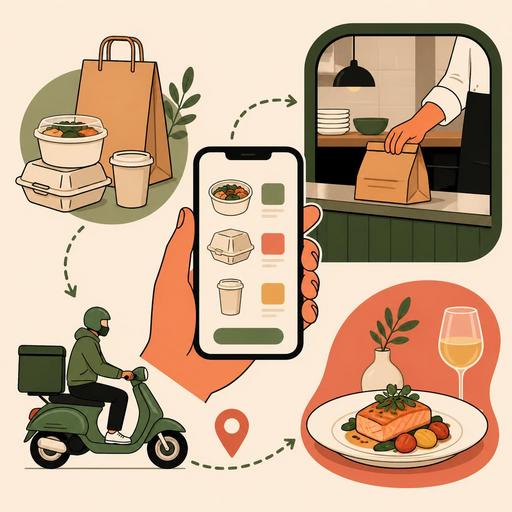
Designing a Menu Suited to Delivery: 4 Core Differences from Table Service
Designing a menu suited to delivery is not simply the classic table-service menu moved into a digital environment. In delivery-only operations, the product's journey begins in the kitchen, continues with courier delivery, and is completed at the customer's home or office. For this reason, preserving the same dish, the same portion, and the same presentation logic often does not produce the right result. For restaurant owners, the truly critical point is to rethink the menu not just in terms of taste, but in terms of transport durability, production flow, preparation time, and the digital ordering experience.
While in table service the temperature of the plate, the visual appeal of the presentation, and the server's guidance matter, in the delivery-only model the menu sells on its own. The item name, description, option structure, packaging compatibility, and kitchen workload directly affect order quality. Below, you will find the 4 core differences overlooked when moving from dine-in service to delivery, and how you can manage them in your business's favor.
1. Not Presentation, but Journey Durability Is the Priority
A plate served at the table reaches the customer as soon as it is prepared. In the delivery-only model, however, the product goes into a box, waits, is transported, sometimes stacked in layers, and only then consumed. For this reason, the first question in menu design should be "Will this dish still be good 20-30 minutes later?" as much as "Is this dish delicious?"
For example, crispy-coated items can quickly soften in a closed package that traps steam. Grilled meats can toughen if they rest too long. Items completely covered in sauce can lose their structure during transport. By contrast, some items become much more suitable for delivery with small adjustments:
- Sending the sauce in a separate container instead of pouring it over the item
- Packaging sides such as fries separately from the main hot dish
- Leaving greens, pickles, and crispy components for the moment of consumption
- Choosing the container based on the item type; not using the same container for an item that needs steam to escape and a saucy item
The critical mistake here is assuming that a plate that works well in the dining room will show the same success in delivery. In a delivery-only menu, some items need to be removed entirely, while others need to be reformulated. This is not a loss of quality, but channel-based optimization.
2. Menu Engineering Must Be Thought of Together with Kitchen Flow
Items served at the same time in table service may not have the same preparation tempo in delivery. Especially during busy hours, the success of a delivery-only menu is measured not just by selling a lot, but by being able to be produced at a repeatable speed. The wider the menu, the more transitions between prep stations, staff coordination, and the risk of error increase.
Let's think of a concrete example: the same menu contains a burger, pasta, a bowl, fried items, dessert, and specialty beverages. In the dining room, this variety can look like an advantage. But for delivery orders, each item requires a different container, a different waiting time, and a different final check. As a result, a kitchen bottleneck forms. Opening too many categories under a single brand in particular is more operationally costly than it appears.
For this reason, the following questions must be answered clearly in delivery-only menu design:
- Which items can share the same prep line?
- Which items slow down the kitchen during busy hours?
- For which items does the number of modifications increase the error rate?
- Which items, when they receive high demand, block other orders?
Here, digital order management provides great convenience. Decisions such as item-based adjustments, category simplification, temporarily closing stock, or highlighting certain items at certain hours help protect kitchen flow. On platforms like Restomas, managing menu updates and order flow centrally prevents the menu and operations from becoming disconnected, especially during busy service hours.
3. The Description and Option Structure Takes the Server's Place
In table service, when a customer is undecided, the server provides guidance: the spice level is explained, the portion is described, a sauce is suggested, an add-on is offered. In the delivery-only model, this role is taken on by the menu text and option structure. A poorly written item name or a cluttered options screen can cause the customer to abandon the order halfway or choose an item with the wrong expectation.
A good delivery menu description should be short but clear. It should clearly explain the item's basic contents, its distinctive feature, and, if necessary, the consumption experience. For example, instead of writing just "Chicken Bowl," making the contents understandable is more functional. However, stretching the description out like a novel is also not right; the customer wants to decide quickly.
Things to watch for in delivery menu descriptions
- State the main protein or main ingredient in the first line
- Clearly write details that create expectations, such as spice level, sauce, and garnish
- Separate required and optional selections from one another
- Don't open up unnecessarily many options for a single item
- Keep upsell areas logical; don't attach every add-on to every item
For example, offering all the combinations of bread type, doneness level, two different cheeses, three sauces, four sides, extra toppings, and beverages for a single burger all at once tires the customer. Instead, creating a few clear, high-demand combinations is more efficient. Businesses using a QR menu and digital ordering infrastructure can simplify the menu and increase conversion by seeing which options are chosen most.
4. In a Delivery Menu, Profitability Is Protected Through Composition, Not Portion Size
In table service, a large portion sometimes increases perceived value. In delivery, however, the cost consists not only of the item's gram weight; packaging, courier time, the risk of remaking, the possibility of a return, and campaign pressure also enter the equation. For this reason, to protect profitability in a delivery-only menu, you need to build the item's composition cleverly rather than increasing the portion size.
For example, a main item sent on its own can create a sense of incompleteness in the customer. When the same item is turned into a menu with a more balanced pairing, both the basket value and satisfaction can increase. But the aim here is not aggressive selling; it is correct structuring. Additions of a beverage, sauce, dessert, or side should be designed without complicating operations or spoiling the product experience.
In practice, the following approach works:
- Create a few well-thought-out menu combinations instead of single items
- Reduce components that increase packaging cost but make no difference
- Avoid making complaint-prone items into promotional items
- Package items that are easy to prepare, travel well, and are consumed together
For example, instead of adding a steaming hot garnish next to a fried item, choosing a more stable accompaniment protects quality after delivery. Likewise, instead of multi-layered plates prone to falling apart, items with combined but distinct layers are safer for delivery.
An Actionable Checklist for Transitioning to a Delivery-Only Menu
Many menus that look right in theory cause problems on the ground during the first busy evening service. For this reason, the healthiest method is to make the transition test-focused rather than all at once.
- List your best-selling items and classify them by transport durability
- Evaluate items with long preparation times separately
- Identify items with a high potential for complaints
- Simplify and standardize item descriptions
- Speed up order flow by reducing the number of options
- Create a temporary-closure or category-priority plan for busy hours
- Test packaging on an item basis; avoid a one-size-fits-all container approach
Delivery-only menu design is not an aesthetic menu-arrangement task; it is a system design that manages operations, profitability, and the customer experience all at once. An item that is strong in dine-in service can be weak in delivery. The reverse is also possible. Businesses that see this difference early build fewer errors, a clearer menu structure, and a more sustainable order flow.
If you want to think about your menu on a channel basis and control your digital menu and order flow from a single place, the flexible structure Restomas offers can help you simplify this process.
