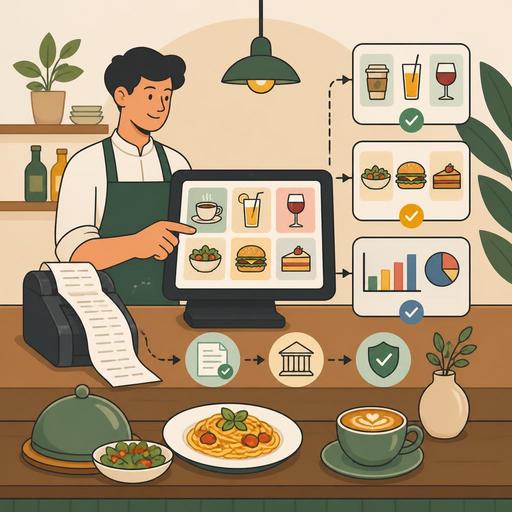
A Digital Compliance Guide for VAT and Excise Tax Tracking in Restaurants
Why should you place VAT and excise tax tracking at the center of operations in restaurants?
VAT and excise tax tracking in restaurants is not a technical matter for accounting to resolve at period end; it is an operational area directly linked to the daily sales flow, product cards, check structure, POS integration, and stock movements. The problem most often arises not from the tax itself, but from the data being scattered. When the same product is opened under different names at different registers, when takeaway and dine-in sales are tracked in separate systems, or when alcoholic and non-alcoholic products are managed with the same logic, the business begins to produce non-compliance without realizing it.
Product variety is especially high in businesses such as restaurants, cafes, and bars. The menu is updated frequently, campaigns come into play, prices change, and differences in practice arise between staff shifts. In this environment, tracking tax-relevant records with manual methods increases the risk of error. A digital compliance approach, rather than making staff memorize tax rates, focuses on ensuring that the right product proceeds with the right category, the right price, the right sales channel, and the right document flow.
The goal here is not to fear penalties and weigh down the process; on the contrary, it is to build an auditable structure by simplifying the sales and document order. This way, the business owner, the branch manager, the register supervisor, and the accounting office all look at the same data and don't lose time over differing interpretations.
The most common critical mistakes restaurants make in VAT and excise tax management
A significant portion of tax-related risks arise not from complex legislation, but from small mistakes that repeat in the daily flow. Although these mistakes seem insignificant on their own, they can create serious inconsistencies in month-end reports, document discipline, and product-level sales analyses.
- Product cards not being standardized: When the same beverage or menu item is opened under different names, reports become fragmented.
- Leaving tax logic to staff rather than the menu: The server or cashier is expected to know by heart which product belongs to which group.
- Campaigns not being defined correctly in the system: Menu, combo, and complimentary structures are not designed in line with the document order.
- Tracking alcoholic product sales in the same flow as other categories: The separation remains weak, especially on the audit and reporting side.
- Keeping takeaway, dine-in, and pickup channels in different systems: End-of-day reconciliation becomes difficult.
- POS, check, and accounting data being disconnected: A product that appears in one system shows up differently in another.
Let's consider a concrete example: suppose four different product cards have been opened in your restaurant, such as "glass of wine," "special glass," "wine glass," and "house wine glass." Operationally, it looks like a sale has been made; however, on the reporting side, the same product group is split. Accounting spends extra hours correcting which sale falls into which category. This not only creates reporting confusion; it also produces a chain of errors in areas such as discounts, cancellations, complimentary items, and stock deductions.
The 4 fundamental control points that need to be set up for digital compliance
To strengthen tax compliance in a restaurant, you first need to start not from the question "which document was issued," but from the question "where is the data born and how is it carried?" For a solid structure, four control points should be established.
1. Product card and category standard
Every product should have a single name, a clear category, and a defined sales logic. The name shown on the menu and the product card on the POS side should proceed as compatibly as possible. It is especially helpful to create a separate card policy for alcoholic beverages, set menus, add-on ingredients, and promotional items.
2. Channel-based sales separation
Dine-in, takeaway, pickup, and third-party delivery channels should be tracked separately. Because the same product can be sold through different channels with different prices, commissions, campaigns, or operational flows. When channel separation is weak, end-of-day control becomes complicated.
3. Matching of check, payment, and cancellation records
Looking only at the sales amount is not enough. Cancelled products, complimentary items, promotions, table merges, and split payments should be recorded. An auditable structure makes visible not only the sales but also the exceptions.
4. Using the same data language as accounting
When the operations team within the business speaks the language of "product," the accounting team speaks "document," and the manager speaks "revenue," a disconnect occurs. When digital systems bring these three areas together in the same flow, the margin for error drops. Structures that design the menu, order, and POS connection under one roof, like Restomas, are valuable for this reason; because the data is born at one point and not reproduced in different spreadsheets.
A weekly checklist for the restaurant manager to reduce penalty risk
Tax compliance is not a topic to be handed off entirely to the accountant. With short weekly checks, the business manager or branch supervisor can catch many problems before they grow. There is no need to set up a heavy audit system for this; a regular control rhythm is enough.
- Check the newly added products: If there has been a weekly menu update, review the category and price definitions of the product cards.
- Examine the top 20 best-selling products: Look for duplicate names, incorrectly opened variations, or inconsistent prices.
- Read the cancellation and complimentary report: In which shift and on which products are they concentrated? This report is important for fraud control as much as for tax.
- Compare the channel-based sales report: Are the dine-in, takeaway, and pickup figures consistent with one another?
- Confirm the document flow with accounting: Is the sales logic seen in operations the same as the record language going to accounting?
For example, in a restaurant doing busy service on a Friday evening, selling some products under temporary cards like "general beverage" or "miscellaneous" to process transactions quickly during a shift may look practical in the short term. But within a few weeks, this habit renders reports meaningless. A weekly checklist is exactly what makes these small but cumulative problems visible.
How should menu management, POS integration, and tax compliance be considered together?
Many businesses see menu management as a marketing matter and tax compliance as an accounting matter. Yet in restaurant operations, these two topics are not separate from one another. Every change made to the menu affects, in the background, the product card, the price, the stock flow, the sales channel, and the document order.
For instance, when you add a new tasting menu, you don't just make a design update. The individual sale of the items within it, the set price, the promotional design, and the reporting structure also change. Likewise, campaigns such as happy hour, a discount on the second item, or a complimentary drink alongside a meal are not just sales-boosting tools; they require the record structure to be designed correctly.
For this reason, the ideal approach is this: every element that changes on the menu should have a counterpart in the POS and order flow; and every change in the order flow should be reflected cleanly in reporting. In systems where the QR menu, order management, and POS integration work together, this matching is easier to establish. Once a product is defined correctly, the same logic is preserved both in the menu the guest sees and in the background of operations.
Practical recommendation: When making a menu update, involve not only the design lead but also the register supervisor and the accounting side in the process. The decision "a new product has been added" is not the same as the decision "it has been defined correctly in the system."
An applicable transition plan for digital compliance
If you want to make VAT and excise tax management in your restaurant more controlled, don't try to change the entire system overnight. A phased transition is much healthier.
- Clean up the product inventory: Weed out duplicate, outdated, or ambiguous product cards.
- Clarify the category structure: Create a standard for drinks, menus, extras, promotions, and special sales types.
- Unify the sales channels: Where possible, bring dine-in, the QR menu, takeaway, and the register together under the same reporting logic.
- Set authorization and transaction rules: Be clear about who can open a product, who can change a price, and who can make a cancellation.
- Establish a weekly reporting routine: Best-selling products, cancellations, complimentary items, and channel-based sales should be reviewed regularly.
- Create a joint control calendar with your accountant: Leave no blind spot between the operational data and the accounting record.
In conclusion, tax compliance in restaurants is less about memorizing legislation and more about setting up the right digital order. When a product card standard, channel-based tracking, POS integration, and regular reporting work together, operations speed up and penalty risks become more manageable. Restomas, by making the menu and order flow more orderly, can provide a clean foundation for building this digital compliance structure.