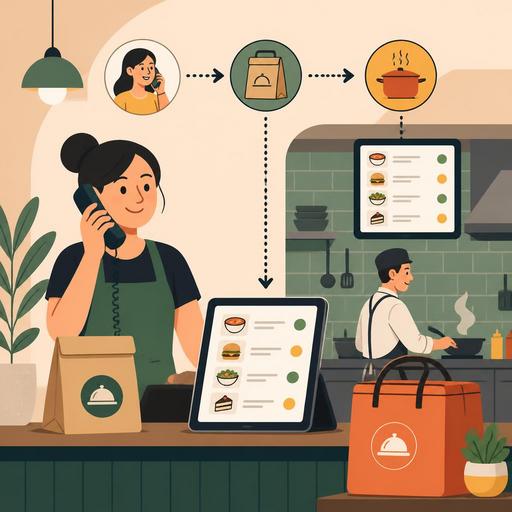
5 Financial Benefits of Digitalizing Phone Orders for Your Restaurant
Digitalizing phone orders is a critical step in restaurants not only to organize call traffic, but also to reduce the cost of errors, use labor more efficiently, and bring revenue leakage from order to delivery under control. In many businesses, the phone is still an important order channel; however, taking the order verbally, jotting it down on paper, relaying it to the kitchen again, and processing payment information afterward produce invisible but constantly recurring financial losses. A well-designed digital order flow, on the other hand, standardizes this scattered structure and creates a data foundation on which a manager can base decisions.
1. Refund and compensation costs caused by order errors decrease
The most common problem with orders taken by phone is that information is conveyed incompletely or incorrectly. The wrong item, a missing sauce, an incorrect address, the wrong portion, or notes relayed incompletely to the kitchen affect not only customer satisfaction but profitability directly. Because with such errors, the business is most often forced to prepare a new item, offer free delivery, apply a discount, or come up with some form of compensation so as not to lose the customer.
In a digital order flow, on the other hand, product options, extra ingredients, items to be removed, delivery notes, and customer details are gathered in standard fields. This way, the question "what exactly was requested?" is no longer left to interpretations that vary from person to person. Especially during busy evening hours, this standardization creates an important layer of safety between the kitchen and the register.
For example, with an order that includes a family meal, a drink substitution, and an extra sauce, some of the details can easily be missed when notes are taken over the phone. On a digital order screen, however, every selection is recorded; the kitchen team also sees the same information clearly. As a result, the cost of the product, courier time, and customer relationship spent on producing compensation goes down.
2. Staff time is used more efficiently, and hidden labor costs are kept under control
A phone order looks like just a few minutes of conversation; but in reality, the process does not end there. Steps such as listening to the order, repeating it, taking notes, entering it into the system, confirming with the kitchen, checking the address, and calling the customer back when necessary create additional workload around a single order. During busy hours, this load can split the attention of the front-of-house staff and affect dining-room operations as well.
Digitalization provides a two-layered benefit here. First, it reduces the time it takes to enter the order. Second, it lowers the mental load on the staff. Instead of rewriting or confirming information, the team focuses on production, packaging, and the customer experience. This makes shift planning healthier, especially in restaurants working with a limited crew.
The critical point for business owners is this: every need for additional staff may not appear directly as a payroll line item; sometimes the problem is that the existing team spends time in the wrong place. Digitalizing order management increases team capacity visibly by reducing unnecessary micro-tasks.
- Reduces repetitive data entry
- Lowers time spent waiting on the phone
- Reduces task collisions during shift congestion
- Makes it easier for new staff to adapt to the process
3. Missed orders decrease and demand is captured better
A busy phone line can mean a missed order. Especially during lunch breaks, match days, weekend evenings, or campaign periods, a structure that runs through a single line struggles to meet demand. If a customer calls a few times and can't get through, they most often turn to an alternative business. This loss often does not even show up in reports as a "non-existent order."
A digital order infrastructure prevents demand from being squeezed into a single communication channel. When the customer can create their order online, the business can manage more orders at the same time. Moreover, since orders are recorded by time, item, region, or moment of intensity, the manager doesn't just say "we were very busy"; they can also see during which time window capacity pressure built up.
This visibility is valuable from a financial standpoint. Because seeing the hours when demand is missed makes it possible to set up the staffing plan, the preparation level, and campaign timing more accurately. If heavy phone traffic occurs at certain hours, the solution may not always be to add new staff; balancing the order channel digitally produces a more lasting result.
Which signals indicate the need for digitalization?
- If customers frequently say they get a busy signal
- If a callback need arises for the same order
- If the register and the phone are handled by the same person during busy hours
- If there is a discrepancy between the phone order and the kitchen output
- If you don't know how many orders are missed at which hour
4. The average basket value rises in a more controlled way
With phone orders, upselling depends entirely on the staff member's initiative, energy, and memory. One employee may have made recommending a drink a habit; another may skip it when things get busy. As a result, upsell and cross-sell performance varies from person to person. This leads to sales opportunities not being evaluated in a standard way.
In a digital ordering experience, by contrast, suggestions for additional items can be systematized. When the main item is selected, a suitable drink, dessert, extra sauce, or larger-size alternative can be presented visibly. The important point here is not aggressive selling that bothers the customer; it is sensible pairings that make decision-making easier.
For example, presenting meal-completion options in an organized way to a customer who orders a burger, and drink and dessert combinations to a customer who orders a pizza, creates a revenue increase that doesn't depend on staff memory. In addition, thanks to the digital menu and order flow, you can see which items are more often preferred together. This information is useful in many areas, from campaign design to menu engineering.
For restaurants, the real value here is that the sales increase is not left to chance. As the order flow becomes digital, the recommendation mechanism also becomes measurable.
5. Reporting quality improves, and more accurate financial decisions are made
In businesses where phone orders are managed through paper notes, messaging apps, or scattered register records, one of the biggest problems is data integrity. The total revenue can be seen at the end of the day; but how much of which product was sold, during which hours intensity occurred, on which orders errors arose, or which customers placed repeat orders cannot be tracked clearly.
Digitalization changes this picture. When orders are processed as standard data, the manager not only sees the past; they also have a stronger foundation for planning the future. Which items produce more errors on the phone channel? In which regions do delivery notes cause problems? At which hours is additional staff really needed? The answers to these questions can be given based on records rather than intuition.
This visibility is especially valuable for businesses that want to build a connection between menu management, the takeaway operation, and the customer experience. Thinking of tools such as the QR menu, order management, reservations, and POS integration within the same operational logic prevents data from being fragmented. This way, both the customer experience is simplified on the front end, and financial decisions are made more safely behind the scenes.
A practical transition plan for digitalizing phone orders
Many restaurant owners see digital transformation as a large and complex project. Yet the healthiest approach is not to remove phone orders entirely all at once; it is to first digitalize the critical breaking points.
- Map the current flow: Clarify who takes the order, where it is written down, how it is relayed to the kitchen, and where errors occur.
- Define the required data fields: Standardize fields such as address, payment type, product note, allergen information, and delivery detail.
- Set up a single-screen logic: Aim for the order to be seen in a single flow rather than in different places by the staff, the kitchen, and the register.
- Start with your best-selling items: First digitalize the most frequently ordered category and combinations.
- Keep a weekly error log: Regularly track the reasons for wrong items, delays, callbacks, and cancellations.
This transition plan positions technology not merely as "a new tool," but as an operational standard that brings financial discipline.
Digitalizing phone orders makes the restaurant's invisible costs visible; integrated solutions like Restomas can help you set up this transition in a more orderly way without straining your operations.