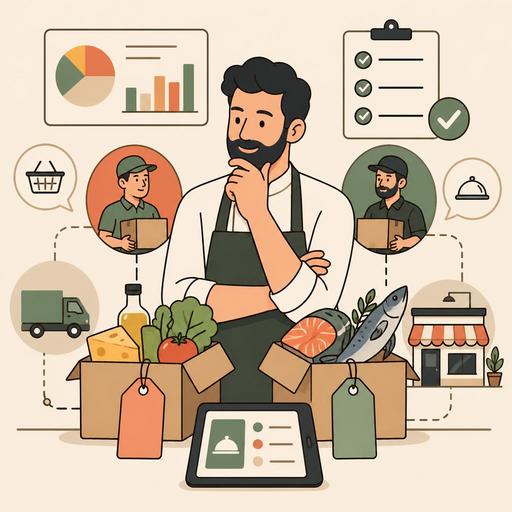
A Guide to Comparing Price and Delivery by Digitalizing Supplier Management in Restaurants
Digitalizing supplier management has become critical in restaurants not only for finding lower prices but also for seeing delivery reliability, maintaining product continuity, and making purchasing decisions without disrupting kitchen operations. In many businesses, the purchasing process still relies on WhatsApp messages, scattered Excel files, phone calls, and personal memory. Although this structure may look manageable on a small scale, it creates serious blind spots when the number of branches increases, the menu changes frequently, or cost pressure rises.
Especially for items such as meat, dairy, fruit and vegetables, coffee, beverages, and packaging, comparing the unit price alone is not enough. The same product can have a different weight, quality standard, delivery day, minimum order amount, and return approach across different suppliers. For this reason, a good digital supplier management system should answer not so much the question "who is cheaper?" as the question "which supplier is genuinely more suitable for our operation?"
The hidden costs of looking only at price
One of the mistakes restaurant owners frequently make is making the purchasing decision based solely on the quoted price. Yet a supplier that appears low-priced can raise the total cost through late delivery, missing products, variable quality, or irregular invoicing processes.
Let's consider a concrete example: a cafe with a strong breakfast service chooses the supplier offering the lowest price for cheese and olives. However, this supplier frequently misses delivery times. As a result, the kitchen team opens the day with incomplete stock, uses an alternative product, or makes a last-minute local purchase. On paper, there is a low-unit-price advantage; in practice, operational stress, deterioration in the product standard, and inconsistency in the customer experience occur.
For this reason, the following headings need to appear together on digital comparison screens:
- Unit price and case-based cost
- Delivery day and time window
- Minimum order requirement
- Time to complete a missing product
- Ease of returns and exchanges
- Consistency in past orders
This approach takes purchasing out of being a "price-gathering task" and turns it into "operational risk management."
How is a digital supplier comparison system set up?
To digitalize supplier management, you do not first need a complex software project. What matters is standardizing the data and making the decision criteria visible. The first step is to define the products you purchase in a common language. Because scattered definitions such as "tomato," "paste tomato," "medium tomato," or "1 crate of tomatoes" disrupt a sound comparison.
1. Standardize the product cards
Determine basic fields for each product: product name, brand if any, weight, unit, target quality grade, acceptance criteria, and area of use. For example, for mozzarella, not only the price but also the water content, melting performance, and suitability for use at the pizza station can matter.
2. Fix the quote-gathering format
Collect the quotes coming from suppliers in a common format rather than free text. If, for the same product, one sends a case price and another a per-kilogram price, the comparison breaks down. Using a digital form or a central order screen reduces this problem.
3. Record delivery performance
Keep these simple notes for each order: did it arrive on time, did it arrive incomplete, was there a quality dispute, was there an invoice discrepancy? These records become very valuable after a few weeks. Because the purchasing memory ceases to depend on individuals.
4. Connect it to the menu
Match the most critical products with the high-volume or high-margin products on the menu. For example, for a burger restaurant, the patty, bread, and fries; for a third-wave coffee shop, the coffee beans, milk, and cups and lids are more strategic items. The delivery risk on these products should be monitored with higher priority than the others.
Which metrics should be tracked in price and delivery comparison?
Digital supplier management that works in restaurants does not have to produce a large number of complex KPIs. Few but correct metrics are enough. The aim here is to enable the purchasing team or the business owner to make fast and consistent decisions.
- Last purchase price: What was the most recent price paid for the same product?
- Alternative supplier price: Who else has the product at the same standard?
- Delivery consistency: What share of orders arrived within the planned day and time window?
- Missing order rate: Which supplier frequently sends incomplete products?
- Emergency supply capability: Who provides faster support during unexpected demand?
- Quality dispute record: Which products regularly have problems?
For example, at a tradesman's restaurant with high lunch traffic, the price difference on legumes and oil items may be important; however, on daily fresh products, the delivery time becomes more critical. Likewise, at a fine-dining business, the supplier that provides the most consistent quality, rather than the cheapest product, may come to the fore. In other words, the right supplier changes according to the business model; the digital system's job is to make this visible.
Moving from a scattered purchasing process to central control
In many restaurants, the chef, branch manager, accounting, and business owner are involved in the same purchasing process from different points. If requests proceed through different channels, it becomes unclear why which product was bought and why which supplier was chosen. This makes budget control harder.
When a central digital structure is set up, the flow becomes clearer:
- Kitchen teams create a need request.
- The authorized person grants approval.
- Supplier quotes are compared on the same screen.
- The order status is tracked.
- A performance note is entered after delivery.
This structure yields strong results, especially in multi-branch restaurants. Because instead of each branch requesting products according to its own method, they work with common product cards and a common supplier list. This way, both price discipline is ensured and the brand standard is preserved.
On platforms focused on restaurant digitalization like Restomas, when the order flow, menu management, and operational data are gathered in a single place, it becomes easier to evaluate purchasing decisions together with menu performance and stock movements. This takes supplier management out of being a back-office task disconnected from the kitchen.
An actionable 30-day plan for restaurant owners
To turn theory into practice, you do not need to wait for a long transformation program. The plan below provides a controlled start to the process of digitalizing supplier management.
First 7 days
- List the 20 most frequently purchased products.
- Gather the current suppliers and last purchase prices of these products.
- Standardize the product names, units, and weights.
Days 8-15
- Determine at least one alternative supplier for each product.
- Request quotes in a common format.
- Gather the delivery day, minimum order, and return conditions in the same table.
Days 16-23
- Clarify the order approval process.
- Start keeping records of incomplete deliveries, quality issues, and late arrivals.
- Create a backup supplier plan for critical products.
Days 24-30
- Produce the first comparison report.
- Identify not just the cheapest one but the most consistent one.
- Re-examine the purchasing decisions for high-impact products on the menu.
The aim here is not to change everything in a single day; it is to take purchasing decisions out of personal habit and move them to a trackable system. Restaurants that build this structure manage price fluctuations more calmly, notice delivery disruptions earlier, and do kitchen planning more safely.
If you want to make the supply, menu, and order processes in your restaurant operation more visible, Restomas's digital tools can help you set up this transition in a more organized way.
