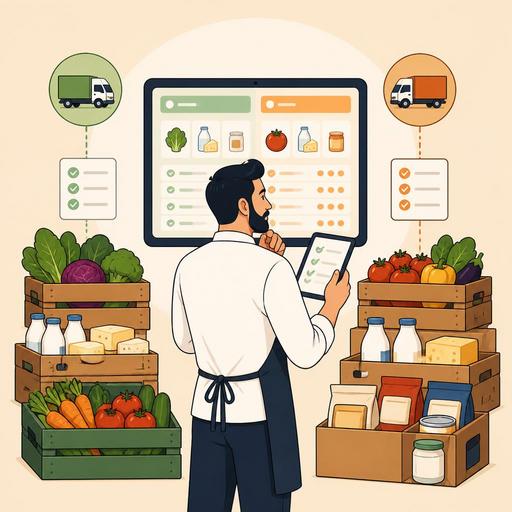
A Guide to Comparing Price and Delivery by Digitizing Supplier Management in Restaurants
Digitizing supplier management has become critical in restaurants not just for finding cheaper products, but for evaluating price, delivery consistency, product standards, and operational flow on a single screen. Especially in businesses that work with multiple suppliers, relying on phone calls, WhatsApp messages, paper receipts, and scattered Excel files slows down purchasing decisions, complicates kitchen planning, and blurs cost control. When the right digital structure is in place, the restaurant owner or branch manager sees more clearly which product is bought from whom and at what price, which supplier is running late and by how much, and which line item is squeezing menu profitability.
The core issue here is not simply "choosing the supplier with the lowest price." A product that looks cheap can cause service disruptions due to irregular delivery. Similarly, products that arrive on time but constantly vary in quality undermine recipe standards in the kitchen. For this reason, digital supplier management transforms the purchasing decision from a one-dimensional choice into a comparable operational discipline.
Compare price not in isolation, but in context
On the purchasing side, the most common mistake restaurants make is comparing the same product solely on unit price. Yet the true cost only becomes meaningful alongside variables such as product weight, wastage rate, delivery frequency, minimum order limit, and payment terms. When you set up a digital supplier comparison system, it becomes possible to keep these fields in a standard format for each line item.
For example, if a cafe buys milk daily, one supplier may offer a lower price; but if it delivers late in the day, the morning prep flow becomes harder. Another supplier may be slightly more expensive but, by delivering within a regular time window, becomes more valuable operationally. The same situation is even more pronounced in sensitive categories such as meat, seafood, greens, and baked goods.
That is why the digital table should include the following fields for each product:
- Unit price
- Unit type (kg, liter, piece, case)
- Net usable quantity
- Delivery day and time window
- Minimum order requirement
- Term and payment conditions
- Return or missing-item process
- Quality note and kitchen feedback
Thanks to this structure, the question "cheap or expensive?" turns into "is it more advantageous for the business overall?" Especially for restaurants practicing menu engineering, this approach allows them to update recipe costs more accurately.
Make delivery performance measurable
In supplier management, delivery is often discussed but rarely measured systematically. Yet delayed shipments, missing products, incorrect weights, or unplanned product substitutions can affect the kitchen team's entire day. One of the biggest contributions of digitization is moving these problems from being "felt" to being recorded.
A simple but effective method is to rate each delivery against a few criteria. The branch supervisor or the staff member responsible for receiving goods can do a quick check when products are received. This check can be done on paper as well; however, when kept digitally, historical comparisons become much more meaningful.
Criteria you can use to evaluate delivery
- On-time delivery: Was the designated time window respected?
- Complete shipment: Did all of the ordered line items arrive?
- Correct product: Are the brand, weight, or product type consistent with the order?
- Quality compliance: Do the freshness and physical condition of the product meet expectations?
- Response speed: When there is a problem, how quickly does the supplier respond?
For example, if a restaurant receives fruit and vegetable deliveries three times a week and is trying to decide between two suppliers, looking only at the price list after three months can be misleading. But digital records may show that one supplier frequently delivers incomplete orders while the other provides more stable service. This difference means fewer products being declared "out today" during service.
Why it is important to consolidate scattered communication channels into a single flow
In many businesses, the purchasing process moves in a fragmented way: the chef requests a product, the branch manager sends a message, the supplier confirms by phone, a different product arrives at delivery, and accounting sees yet another price. The problem here is not just the volume of communication; it is the proliferation of decisions that leave no trace. In a digital process, the order request, approval, delivery, and price update should be kept in the same flow as much as possible.
This approach is especially important for restaurants with multiple branches. When the central team can see which branch is buying at which price, bargaining power increases and non-standard purchases are noticed more quickly. Moreover, when menu management and the supply process are linked together, the impact of a product whose cost is rising on the menu price or promotion plan can be seen earlier.
This is exactly where the value of platforms focused on restaurant digitization, such as Restomas, emerges: when order, menu, operations, and reporting data are not disconnected from one another, managers can make more accurate decisions. Even if the supply side is not set up as a separate dedicated purchasing module, purchasing decisions are strengthened when product performance, sales movement, and operational rhythm are tracked on the same digital ground.
How to set up an applicable supplier comparison system
You don't need to view this transformation as a massive project. Even a mid-sized restaurant can build a clearer structure with a few basic steps. The important thing is to start with the most critical line items rather than trying to manage all products perfectly at once.
A practical implementation plan for the first 30 days
- Select critical products: Identify line items with high cost and operational impact, such as meat, chicken, dairy products, oil, coffee, and vegetables.
- List your current suppliers: For each one, write the price, delivery day, minimum order, and payment terms in a standard format.
- Create a delivery record field: Log delays, missing products, and a quality note for each delivery.
- Collect kitchen feedback: Have the chef and warehouse supervisor add a short note about product standards.
- Make a monthly comparison: Evaluate not only price, but delivery reliability and quality consistency together.
- Check the menu impact: See which dishes are squeezed by products whose costs are rising, and which require an alternative supplier.
Let's consider a concrete example: say a burger-focused restaurant buys brioche buns, ground beef, cheddar, and potatoes from three different suppliers. If the digital records show that the cheddar supplier frequently switches brands, this is not just a purchasing problem; it is a product-standard and customer-experience problem. Likewise, irregular delivery from the potato supplier can affect portion standards. When this data becomes visible, the business can decide with greater confidence whether to change the supplier or reschedule the order day.
The real benefit of digitization: not faster, but better decisions
Digitizing supplier management is often associated with speed; but the real gain is decision quality. It becomes more visible which supplier to continue with, for which product to find a second source, which line item offers a bulk-purchase advantage, and which price increase needs to be reflected on the menu. This allows the restaurant owner not just to solve daily crises, but to manage a purchasing strategy.
Moreover, this visibility also reduces dependence on individual staff. Purchasing knowledge no longer stays in one person's phone or memory. When a new branch manager arrives or kitchen management changes, the process doesn't have to be rebuilt from scratch. Standard data supports a standard decision discipline.
Ultimately, good supplier management is the balance struck between cost control and service continuity. Digital tools make it easier to strike this balance, because they allow you to see price, delivery, quality, and menu impact within the same frame. For businesses that want to grow their restaurant in a more controlled way, this approach is no longer a luxury but an operational necessity.
Restomas can help you evaluate purchasing and menu decisions on a more solid foundation by making the data in your restaurant operations more visible.
