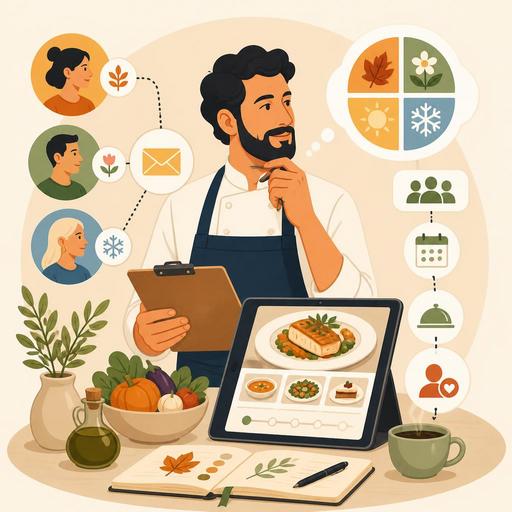
A Guide to Email Segmentation for Seasonal Campaigns in Restaurants
Email segmentation for seasonal campaigns in restaurants is one of the most practical ways to deliver the right offer to the right customer at the right time, instead of sending the same campaign to everyone. Especially during periods such as special occasions, the switch to a summer menu, the iftar season, New Year's reservations, or low-occupancy weekday hours, email marketing becomes a communication channel that directly affects reservations, repeat visits, and basket size. But what truly makes the difference here is not just a nice design; it is making sense of customer data, building the segments correctly, and preparing a message flow suited to each segment.
Why is segmentation needed in seasonal campaigns instead of bulk email?
A restaurant's customer base is not uniform. White-collar workers looking for fast service at lunch do not have the same expectations as customers planning a weekend family meal. Similarly, sending the same campaign to frequent loyal customers and to guests who have not been seen for a long time often creates low open rates, weak conversion, and unnecessary communication fatigue.
Segmentation comes into play precisely here. When you group customers by criteria such as behavior, order history, visit frequency, product preference, channel use, and timing, campaigns become more meaningful. For example, while it makes sense to send a new summer menu announcement to customers who order cold drinks and light plates in summer, an email focused on a sunset menu or a special table reservation gives stronger results for couples who make evening reservations.
For restaurants with strong digital infrastructure, this process becomes more manageable. When QR menu interactions, order preferences, reservation times, and repeat-visit behavior are evaluated together, segmentation ceases to be merely a marketing task and turns into a decision-making mechanism integrated with operations.
How do you create the most useful email segments for restaurants?
In seasonal campaigns, there are a few core segments every restaurant can use. What matters is not producing a large number of segments in theory, but creating groups that are actionable and measurable on the floor.
- New customers: People making a reservation for the first time, placing their first order through the QR menu, or newly added to the database.
- Loyal customers: Guests who come at regular intervals, reorder, or show high engagement.
- Lapsed customers: People for whom a certain amount of time has passed since their last visit or order.
- Category-based customers: Those showing interest in specific product groups such as breakfast, dessert, coffee, vegan products, the kids' menu, or cocktails.
- Time-based customers: Those who mainly come for lunch service, those who make weekend reservations, and dinner customers.
- Channel-based customers: Those focused on takeaway, those who dine in, and those who come with a reservation.
Consider a concrete example: in autumn you are going to run a campaign focused on hot drinks and desserts. Instead of sending this campaign to your entire list, it makes much more sense to send it to customers who have previously ordered dessert alongside coffee and have visited at least once in the afternoon within the last 60 days. This way, the offer matches the customer's actual behavior.
Another example is reservation-focused periods such as New Year's or Valentine's Day. In such campaigns, customers who have made special-occasion reservations in the past are more likely to book again. For this segment, an early-reservation advantage, table selection, or an emphasis on limited availability can be more effective.
Email templates you can use for seasonal campaigns
When preparing an email template, the aim is not just to give information but to direct the customer toward a single clear action. In every email your primary goal should be clear: a reservation, menu discovery, a reorder, or campaign redemption.
1. Early-access campaign template
Whom to send to: Loyal customers and the segment with a high repeat-visit rate.
When to use it: A new seasonal menu, a special tasting night, the start of a limited-time campaign.
Message structure: First create a sense of privilege, then present a clear offer, and finally direct to a single action button.
Sample wording: "Would you like to discover our new winter menu before the general announcement? Until this weekend, priority reservations are open for our loyal guests."
2. Win-back email
Whom to send to: Lapsed customers.
When to use it: Seasonal transitions, low-demand weeks, campaign launches.
Message structure: A short reminder, a new reason, and a low-friction call to return.
Sample wording: "We haven't been able to host you for a while. This month's seasonal menu features new dishes that could become your favorite. You can reserve your spot to try the new menu on weekday reservations."
3. Recommendation email based on product interest
Whom to send to: Customers with a specific category in their order history.
When to use it: Niche campaigns such as a summer drink launch, a brunch menu, a vegan week, or a dessert festival.
Message structure: First show that you know their interest, then present a similar but up-to-date offer.
Sample wording: "We know you prefer our brunch menu. This season, new sharing plates have been added to our weekend brunch service."
Why is it critical to plan the email campaign in line with operations?
Many restaurants think of an email campaign only from a marketing standpoint; yet successful campaigns produce real value when they are aligned with operational capacity. For example, instead of creating heavy demand for a Friday evening service that is already full, a campaign that directs reservations to Tuesday and Wednesday evenings can be smarter. Similarly, highlighting product groups the kitchen can manage comfortably preserves service quality during the campaign period.
For this reason, when planning a campaign you need to ask the following questions:
- On which days and at which hours do you need occupancy support?
- Which menu items are operationally suitable for the campaign?
- Can reservations, table turnover, and kitchen capacity handle this campaign?
- Which channel will manage the demand that comes in after the email?
Here, being able to track reservation management, digital menu updates, and the order flow within a single system provides an advantage. For example, making the seasonal product you highlight in the email visible on the QR menu, recording the campaign information in the reservation notes, and informing the service team in advance ensure the customer truly experiences the campaign without a hitch.
What should you pay attention to in content for higher opens and conversions?
Good segmentation, when combined with weak content, does not produce the expected result. In restaurant email marketing, simple, appetizing content with the right timing works better. Instead of overly long text, clear benefit and a strong visual flow should be preferred. Even so, before the visual, the offer itself must be clear.
- Write a specific subject line: Instead of general phrases like "seasonal offer," "a winter menu just for weekday evening reservations" is stronger.
- Present a single offer: Putting a reservation, takeaway, a dessert campaign, and an event announcement in the same email scatters the focus.
- Use a time limit: If it is genuinely limited, state a deadline; do not create artificial urgency.
- Care about mobile readability: Use short paragraphs and a clear call to action.
- Think about the post-email experience: When the customer clicks, they should land on an up-to-date menu, suitable reservation times, and clear information.
You also need to measure after the campaign. Questions such as which segment opened the most, which offer converted into reservations, and at which hours engagement rose allow you to plan more accurately for the next season. The aim here is not to send a single "successful email" but to build a communication system that learns over time.
An actionable seasonal-campaign plan for restaurant owners
To make the topic practical, you can follow a simple working sequence:
- List the seasonal opportunities within the next 60-90 days.
- Set a single goal for each campaign: a reservation, a repeat visit, or the sale of a specific product.
- Divide your customer data into at most 3-4 meaningful segments.
- Write a separate subject line and a separate offer for each segment.
- Match the campaign to the hours when operations are weak or open to growth.
- Prepare the counterpart of the offer you make in the email on the menu, reservation, and service side.
- Note the results at the end of the campaign and carry the learnings into the next period.
Seasonal campaigns are an opportunity not just to announce discounts, but to build a restaurant structure that knows its customers better and manages demand more intelligently. Email flows prepared with the right segmentation can fill empty hours, strengthen loyal customers, and grow new menu launches in a more controlled way.
Restomas can make it easier to plan your seasonal campaigns based on data by making reservations, the digital menu, and the order flow more visible.
