How to Manage the Second-Generation Succession Process in Family Restaurants
The second-generation succession process in family restaurants is not only about who the business will be handed over to; it is about safely transferring recipe knowledge, sourcing habits, staff culture, customer relationships, and daily operational know-how to the new generation. Many family businesses stay afloat for years on the founder's memory, phone book, handwritten notes, and one-on-one mentoring. But when it is time to hand over the reins, if this invisible accumulated knowledge has not been recorded, even a well-intentioned transition can be painful. For this reason, second-generation succession is, beyond being an emotional family matter, a business transformation that must be carefully designed.
The transition isn't complete until the founder's knowledge is turned into a system
One of the most common problems in family restaurants is that the founder manages the business very well, but this management knowledge has never been institutionalized. Critical details such as which product to buy from which supplier, how to approach which customer, which staff member is more efficient at which station during peak hours, and which menu item actually makes money are most often concentrated in a single person.
The biggest mistake the second generation makes is to assume, "I'll learn it over time anyway." Yet when the learning process moves forward without a plan, the transition period becomes fragile at the busiest time of the business. That is why invisible operational knowledge must first be made visible.
- Standard recipes should be written down.
- The supplier list, along with alternatives, should be put on record.
- Shift flows and the division of tasks should be clarified.
- Observations about menu profitability should be supported not only by intuition but by data.
- Patterns in customer complaints and satisfaction should be noted regularly.
For example, the founding chef's knowledge that "this dish sells a lot on Friday evenings" may be valuable; but if it isn't known during which time window, at which type of table, and alongside which campaign it stands out, the second generation will struggle to repeat the same success. Tools such as a digital menu and order tracking make these behavioral patterns more visible, taking the succession out of being dependent on one person.
Don't confuse delegating authority with losing control
In the second-generation takeover process, one of the biggest tensions within the family is that the founder does not want to step away from the business entirely, while the new generation cannot find any room to make decisions. At this point, the problem is most often not intent, but a lack of structure. People say "you handle it," but it is not clear who has the final say on which matters.
The healthy model is to establish a phased sharing of authority instead of a sudden, complete handover. This way, the founder preserves their experience, and the new generation evolves from being merely an implementer into a manager who makes decisions.
- First stage: The new generation observes daily operations and reports on them.
- Second stage: They take on responsibility in specific areas such as menu updates, the staffing plan, or the reservation flow.
- Third stage: Results are evaluated against defined KPI-like core business indicators.
- Final stage: The founder moves into an advisory role, and the daily decision-making burden decreases.
Here, digital tools provide an important balance. Because the business owner can track the order flow, table turnover, reservation status, or product performance without physically intervening in every detail. This visibility both increases the founder's sense of trust and broadens the second generation's room to maneuver.
How should the new generation's role be defined between the menu, the brand, and customer expectations?
The most exciting but also riskiest step for the second generation is usually touching the menu and the brand. The new generation may want to refresh the presentations, switch to digital ordering, become more visible on social media, or simplify the menu. The founder, meanwhile, carries the worry that "we shouldn't break the things that got us here." Both sides may be right.
The right approach is to test change in a controlled way while preserving the deep-rooted identity of the business. In other words, instead of changing the entire menu overnight, it is healthier to experiment with a few high-potential items.
A practical transition model
- Keep the items that receive the most orders.
- Instead of immediately removing low-performing but emotionally valuable items, reposition them.
- Test the items the new generation proposes for a limited time.
- Optimize the descriptions, visual order, and category structure through the QR menu or digital menu.
- Measure the reaction to change by regularly tracking customer reviews.
For example, in a neighborhood eatery that has been well known for years, the second generation could, instead of completely changing the main dishes, simplify the lunch menu flow and make it easier to order during peak hours. Or they could preserve the classic desserts while featuring a seasonal special menu on the digital menu to test demand. This way, innovation is introduced without damaging the brand's memory.
Team management: Staff loyalty should be tied to the system, not to the founder
In family restaurants, staff most often feel loyalty not to the business but directly to the founder. This loyalty is valuable; however, it can create risk during the succession process. Because employees may see the new generation as "the boss's son/daughter" and be slow to accept them as the real manager. To prevent this, the relationship needs to be shifted from personal loyalty to process loyalty.
The way to do this is through clear job descriptions, visible communication, and fair operations. The new generation should position themselves not just as someone who gives orders, but as a manager who improves the system and makes the team's work easier.
Concretely, the following steps help:
- Taking the shift plan out of last-minute decisions and making it visible in advance
- Not leaving the order flow dependent on verbal communication
- Announcing menu changes to the kitchen and service teams at the same time
- Freeing reservations and table flow from one person's memory
- Handling error tracking with the logic of process improvement rather than the language of blame
Digital order management and centralized menu control in particular reduce the kind of ambiguity captured by "but that's what I was told." This helps the new generation build their authority not by shouting, but by establishing order.
A successful handover requires an operations dashboard as much as a family constitution
When the succession process is discussed, people usually talk about share distribution, titles, or the balance within the family; however, in restaurant management the real breaking point occurs where daily operations become invisible. How is the cash flow being monitored, where are cancelled orders seen, on what basis are the best-selling items determined, on which days does reservation density increase? If the answers to these questions are not clear, the decisions the second generation makes also become disputable.
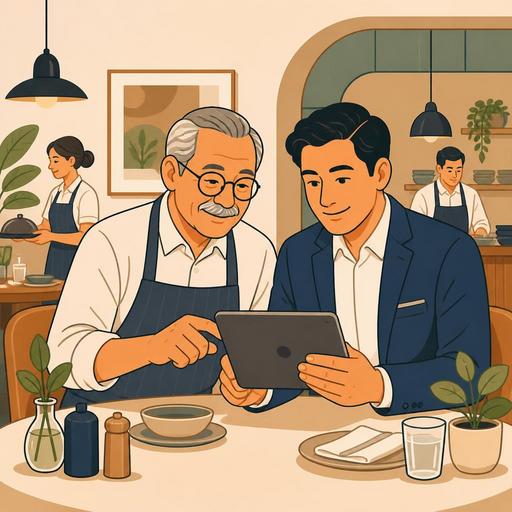
For this reason, the most practical approach for family restaurants is to create a shared operations dashboard during the transition period. When the founder and the new generation can look at the same data, discussions move away from personal interpretation and closer to the reality of the business. As menu performance, order flow, peak hours, table turnover, and customer requests become visible, the tension between "in my day it was like this" and "the world has changed now" becomes more manageable.
Second-generation takeover is neither solely about preserving tradition nor solely about innovating. The real matter is to turn the business's knowledge into a system without losing its character, to base decisions on processes rather than on individuals, and to support intra-family trust with operational transparency. When such a structure is built, the succession process not only proceeds smoothly; it also lays the foundation for the restaurant's next period of growth.
Family restaurants that want to make the transition process more visible and manageable can evaluate Restomas's digital menu, order, and operations tools in a simple way tailored to their own workflows.
