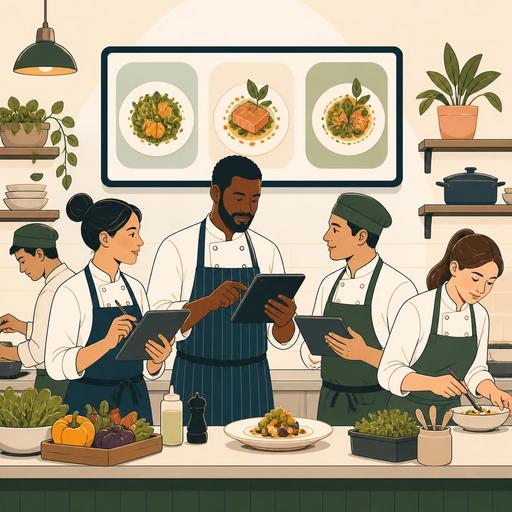
A Fast-Adaptation Plan for Kitchen Teams During Menu Updates
The fast adaptation of kitchen staff during menu changes is about far more than learning to serve a new dish. The real issue is preserving the recipe standard, not disrupting the prep flow, not slowing down service speed, and keeping intra-team communication clear. When a restaurant adds a new product, changes a portion weight, or switches to a seasonal menu, the small uncertainties that arise in the kitchen can soon turn into major operational problems. That is why a menu update requires process management as much as creativity.
Many businesses handle a menu change only on the design or sales side. Yet from the kitchen's perspective, every new product means different mise en place, a new cooking sequence, a changed station load, new allergen information, and a different presentation standard. If this change isn't planned in advance, you end up with a system the chef knows but the team can't fully grasp. The result is order delays, inconsistency between plates, and unnecessary stress.
Why does a menu change create resistance in the kitchen?
Kitchen teams often resist not change itself, but uncertainty. If a product's recipe isn't clear, its prep time isn't described, or it isn't clearly determined which station is responsible, staff naturally cling to the old routine. This becomes more visible especially during peak hours.
For example, consider a new bowl added to the menu during the lunch service. The cold station prepares the sauce, the hot station puts out the protein, and the packing side uses a different container. But if the order in which they should proceed wasn't worked out in advance, the same product can come out differently with each order. The problem isn't the staff's reluctance; it's a deficiency in the system.
That is why the first step should be to view a menu change not as an announcement but as an operational change. When the chef, the business manager, and the service side don't operate within the same framework, it becomes hard for the kitchen team to adapt quickly.
A 4-stage implementation plan for fast adaptation
To get through menu updates smoothly, the structure below offers a practical, actionable framework:
- Classify the change: Adding a new product, revising a recipe, changing the presentation, changing the portion weight, or removing a product are not the same thing. Each creates a different prep need.
- Map out the station-based impact: Determine which station's workload increases, which equipment will be used more, and which prep should be done in advance.
- Plan micro-training: Instead of long meetings, use short 10-15 minute training sessions to show the recipe, presentation, and critical error points.
- Manage the first service day in a controlled way: Rather than expecting full performance on day one, aim for observation, note-taking, and quick correction.
The critical point here is to break the menu change into small, repeatable steps instead of a one-time explanation. Especially with shift-based teams, since everyone can't be trained at the same time, the information flow needs to be recorded.
Recipe standards and visual clarity speed up adaptation
The environment in which kitchen staff adapt fastest is one where the decision burden has been reduced. To that end, every new or updated product should have a clear operation card containing the following information:
- The product's name and which menu category it belongs to
- The ingredient list and weights
- The mise en place steps required before prep
- The cooking process and station responsibility
- The presentation sequence and plating standard
- Points to watch for regarding allergens and customer notes
Let's give a concrete example: when a new citrus sauce is added to a grilled chicken salad, the change can look small. But if questions such as when the sauce's prep will be done, in which container it will be kept, how many grams will be added to the salad, and whether it will be sent separately for delivery orders aren't clear, error is inevitable. This is exactly where digital menu management and centralized product updates become important. Having the content change on the menu and the application knowledge in the kitchen move in sync makes a serious difference, especially in multi-location businesses.
When the QR menu, the order screen, and the kitchen flow are disconnected from one another, the information seen on the front of house and the information applied in the back can diverge. But when up-to-date product information, variations, and notes are kept in one place, the team asks fewer questions and experiences fewer comebacks.
Don't hold a training meeting, do a pre-service run-through
One of the most common mistakes in restaurants is announcing a menu change only with a verbal briefing. For kitchen teams, a verbal explanation alone isn't enough. The most effective method is a short pre-service run-through. This run-through doesn't have to take place in a full training-kitchen setup; the aim is for the team to see and repeat the product's critical moments.
A practical pre-service run-through can proceed like this:
- The chef prepares the new product from start to finish once.
- Each station steps in at the moment of its own task.
- Portion, timing, and presentation errors are noted on the spot.
- The two points most likely to get confused are repeated specifically.
- On the first real orders, one person serves as the check-point lead.
For example, when a new burger is added to the menu, not only the patty's doneness but also the order in which the bun is assembled, how much sauce is used, and how the side product is placed for delivery should be rehearsed, because what affects the customer experience is not only the flavor but the product coming out at the same standard every time.
To prevent chaos during peak hours, digital visibility is essential
The moments when menu changes strain the team the most are the peak hours. During these hours, staff can't find time to search for new information. That is why critical information must be visible. Whether through a kitchen screen, a prep list, or digital product notes, the information the team needs should be accessible within a few seconds.
Digital visibility provides a big advantage especially in the following areas:
- Instantly closing out products that are 86'd, that is, temporarily out of stock
- Having the variations of newly added products display correctly
- Having extra-ingredient or ingredient-removal notes land clearly in the kitchen
- Keeping product information identical across locations
- Having updated prices, content, and descriptions move in harmony with the front of house
The value of digitalization here is not having used technology, but lowering the cost of misunderstanding. Acting on information that is clearly visible in the system, instead of a server's interpretation of "the chef said so," also reduces friction within the team. Structures like Restomas that bring menu and order flow together in a single center are meaningful from an operational standpoint precisely for this reason: the change isn't just shown to the customer, it also becomes manageable for the team.
For lasting adaptation, set up a post-change control mechanism
It's hard to tell on the first day whether a menu change has been successful. The real measurement emerges in the first week. Which products prompted questions, which plates came back, which station struggled, and which prep time fell short? These questions should be gathered regularly.
Business owners and kitchen managers can use this mini checklist:
- What was the most frequent error made with the new product?
- Did the prep time take longer than estimated?
- Could service staff describe the product correctly?
- Did the kitchen notes reflect fully onto the order screen?
- Is the recipe sustainable in terms of cost and operations?
If the same problem recurs across three shifts, the issue isn't with the staff but with the process. In that case, you need to simplify the recipe, change the station distribution, or update the product description. Successful restaurants manage a menu change not with a "we launched it, we're done" mindset, but with an "we implemented, observed, and improved" approach.
In conclusion, the fast adaptation of kitchen staff during menu changes becomes possible through clear recipes, short run-throughs, visible information, and regular feedback. When the process is set up correctly, the team doesn't tire of change; on the contrary, it works in a more controlled, faster, and more consistent way. Restomas can make it easier to establish this order for restaurants that want to manage menu updates and order flow on the same plane.
