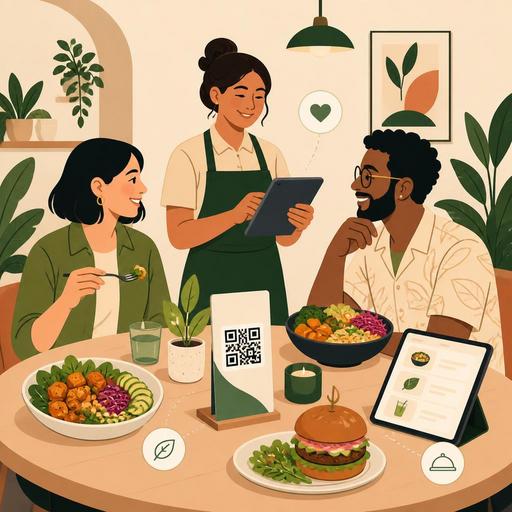
How to Grow a New Customer Base with Plant-Based Menu Demand in Restaurants
Plant-based and vegan menu demand is no longer seen merely as the expectation of a niche customer group. The visibility, accessibility, and correct presentation of plant-based options in restaurants are becoming increasingly important for reaching a new customer base, being chosen for group orders, and strengthening brand perception. The critical point here is not randomly adding a few labels to the menu; it is reading the demand correctly and turning it into an operationally sustainable structure.
Today, many businesses have to meet the different dietary preferences of people sitting at the same table simultaneously. One customer being vegan, another preferring lactose-free, and yet another looking for a lighter or more vegetable-heavy option is now an everyday situation. For this reason, plant-based menu growth is not only a new product development topic; it should be handled as a matter of menu engineering, service experience, kitchen flow, and digital menu management.
Why is plant-based demand not limited to vegan customers alone?
The most common mistake is to think of the plant-based menu as a narrow category addressing only customers who define themselves as vegan. Yet in practice, ordering behavior is broader. Some guests do not eat meat on certain days of the week, some look for a lighter meal, some make choices for environmental or ethical reasons, and some simply want a delicious alternative. In other words, the growing audience is not a single customer profile.
For example, offering an eggless breakfast plate, a plant-based milk option, and a filling sandwich at a brunch venue can win over not only the vegan customer, but also the group of friends who come along. Similarly, in a burger-concept business, a well-designed plant-based patty option can directly influence the decision to "not go somewhere else just because of the person who doesn't eat meat." The real value here is not losing the group.
That is why restaurant owners need to focus on this question: Which usage moment of my existing customer base do plant-based options address? A quick and light lunch, evening group gatherings, family orders, or office delivery? The right answer is more important than the number of products.
Adding a few products is not enough: visibility and naming are decisive
In many businesses, a plant-based product technically exists on the menu, but the customer does not notice it. The reason is often a weak category design, product names that do not whet the appetite, or an inadequate filtering experience. Instead of generic names like "vegan salad," clear names that describe the ingredients and the experience are more effective. The customer first wants to imagine the flavor, then confirm their choice.
For example, the following approach makes a difference:
- Weak presentation: Vegan pasta
- Stronger presentation: Penne in roasted-eggplant tomato sauce with cashew cream
In the second example, the product looks not only "suitable," but also desirable. This is important especially for customers who do not define themselves as vegan but are open to trying a plant-based option.
Businesses using a digital menu have an advantage here. Making products filterable within the QR menu with labels such as vegan, vegetarian, lactose-free, gluten-free shortens the customer's decision time. Moreover, when allergen information, ingredient notes, and add-and-remove options are shown clearly, the burden of questions on the service staff is also reduced. Being able to make menu updates quickly from a single point also makes it easier to test seasonal plant-based products.
Why is operational readiness critical in plant-based menu growth?
Offering a plant-based option is not just about creating a recipe. The real test begins in the kitchen. Stocking the product, managing cross-contamination risk, separating prep equipment, the staff's knowledge of ingredients, and correct guidance during service all directly affect customer satisfaction.
Consider a concrete example: you have a vegan bowl on your menu, but the sauce uses honey, or the bread is served with butter as standard. Even if you have technically launched a well-intentioned product, customer trust can be damaged. For this reason, product cards need to be handled not just as marketing copy, but as operational documents.
The following checklist can be applied within the business:
- Create a clear ingredient list for each plant-based product.
- Check the suitability of default garnishes, sauces, and breads separately.
- Give the service team short but standard response scripts.
- Simplify product names that create confusion in the kitchen.
- Set up an instant menu-update process for alternative products that frequently run out of stock.
Especially during busy hours, staff asking the kitchen again "was this product exactly vegan?" lowers service speed. Businesses with a digital order and menu infrastructure can reduce these uncertainties when they manage product descriptions and variations centrally. This way, a more consistent experience is created on both the table-service and delivery sides.
Which product strategy should be applied to reach a new customer base?
The biggest mistake when building a plant-based menu is designing the menu as a completely separate world. For most restaurants, the more effective approach is to create plant-based counterparts within existing strong categories. In other words, you need to preserve the order formats the customer already loves and rethink the content.
For example:
- For a pizza restaurant, genuinely filling plant-based pizza combinations rather than merely vegetable-heavy ones
- For a coffee shop, drink recipes compatible with plant-based milk and dessert pairings
- For a home-cooking concept, daily plates centered on legumes, grains, and vegetables
- For a burger brand, a complete product rounded out with sauce and bun harmony, not just a patty alternative
The aim here is not to say "we have it too," but to create a product that can be re-ordered. There is a big difference between a one-time curiosity order and lasting demand. That is why it is wise to first test new products in limited quantities, with clear descriptions, and in a trackable way. Which product is viewed more, which is added to the cart, which gets reviews, at which hours it is preferred? The answers to these questions are more valuable than intuition.
The QR menu, order management, and category-based editing tools are useful at this point, because they allow you to manage product trials without changing all the printed materials. A successful product is made permanent, while a weak one is revised in terms of visibility or recipe.
How should inclusiveness be established in marketing language?
In plant-based menu communication, an overly assertive or didactic tone can backfire. The customer does not want to be told what they should eat; they want an appetizing, clear, and reassuring presentation. For this reason, an inclusive tone should be used on social media, tabletop menu descriptions, and pre-reservation information.
A good communication language carries the following elements:
- It highlights the flavor and puts the label in second place.
- It gives ingredient information clearly and avoids vague expressions.
- It addresses the group experience; it creates the feeling that "there is an option for everyone."
- It conveys seasonality and the chef's touch.
For example, on social media, instead of just saying "Our new vegan product has arrived," it is more powerful to describe the preparation technique, the texture, the serving suggestion, and which meal it is suited to. Making plant-based options easy to find in reservation notes or on the online menu also affects conversion. Because a significant portion of customers look for an answer to the question "can I find something suitable here?" before coming to the venue.
Finally, plant-based menu growth should be seen not as a short-lived trend, but as a strategic response to the diversification of customer expectations. The winning businesses will be those that make this area not a separate showcase, but a natural part of the entire menu and operational system.
With Restomas, by managing your digital menu and order flow more flexibly, you can make plant-based options more visible to the customer and more actionable for the operations team.
