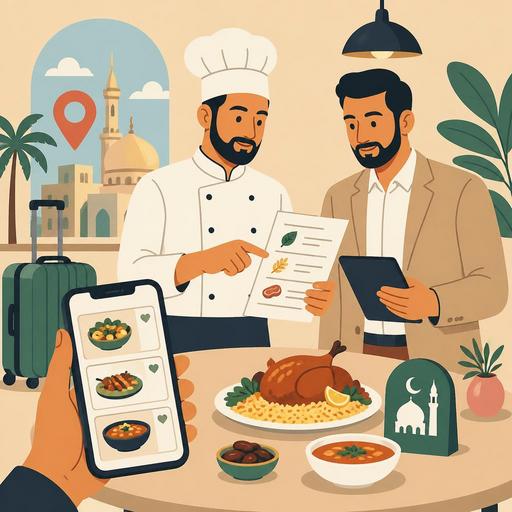
Opening a Halal-Certified Restaurant and a Guide to Growing in the Tourism Market
The halal certification process is, especially for restaurants operating in tourist areas, not merely a matter of compliance but also an opportunity to build trust, clarify menu communication, and reach different customer groups more comfortably. In addition to local guests, transparency in food-and-beverage preferences is very important for Muslim tourists from the Gulf countries, Southeast Asia, and Europe. For this reason, the halal compliance approach needs to be addressed not only within the kitchen but together with menu management, staff training, supply tracking, and the digital customer experience.
Many businesses think of halal certification solely in terms of documentation. Yet the result the guest sees is the descriptions on the menu, the answers staff give, the separation discipline in the kitchen, and the consistency in the ordering process. The certificate is not enough on its own; this standard needs to be kept alive at every point of the operation. Especially in the tourism market, the fundamental element that makes a guest choose your business is often the feeling of "being sure."
Why is the halal certification process not just about obtaining a document?
In practice, halal certification corresponds to a chain of control that extends from the source of the ingredient to service. The supply of meat and meat products, the ingredient lists of processed products, sauces, dessert components, additives, storage areas, prep equipment, and the risk of cross-contamination are parts of this chain. For the restaurant owner, the real issue is whether this structure can be managed sustainably.
For example, let's consider a hotel restaurant offering breakfast and a buffet. Cured sausage, salami, sausages, varieties of cheese, jams, dessert sauces, and ready-made baked goods may come from different suppliers. If document checks are not done at the product intake stage, if there is no labeling standard in storage, and if the team does not know which product is to be stored under which conditions, the certification preparation remains on paper. Similarly, in city restaurants offering burgers, steak, or world cuisine, marinade sauces, desserts containing gelatin, or ready-made base products can be overlooked risk areas.
For this reason, businesses first need to conduct a current-state analysis. Which products are used, are their documents up to date, how is separation done in the kitchen, at which points does the staff remain unsure? Without a clear answer to these questions, moving to the application process often leads to a waste of time.
The operational plan restaurant owners should prepare before applying
The first step for a successful halal compliance system is to put the daily operation in writing. In certification audits, how the business standardizes its practice is as important as its intention. Especially in restaurants that work across multiple shifts, verbal transfer of information is not enough.
Headings you should focus on during the preparation stage
- Create a supplier list: Record which product is bought from whom, the validity dates of product documents, and alternative suppliers.
- Review the product inventory: Evaluate risky items such as ready-made sauces, dessert bases, processed meats, frozen products, and beverage syrups separately.
- Separate storage and prep areas: Set clear rules for labeling, shelf layout, storage containers, and production equipment.
- Prepare staff training notes: The service team should not give vague answers to the question "Is this product halal?" coming from a guest.
- Update the menu descriptions: The product's content, preparation method, and, if necessary, supply standard should be clearly stated.
Digital menu management provides an important advantage here. While every change creates cost and time on printed menus, updating product descriptions through a QR menu or a central menu panel is much more practical. Especially in tourism businesses that experience seasonal change, being able to revise the descriptions on the menu instantly offers a serious operational convenience.
The trust and visibility effect that halal compliance creates in the tourism market
In tourist areas, restaurant selection is often done quickly. The guest looks at online reviews, examines the menu, observes the staff's approach, and decides in a short time. At this point, halal compliance turns into a filtering selection criterion for a specific customer base. However, what matters here is not just using the word "halal" but turning it into a trust-inspiring experience.
For example, at restaurants in a historic peninsula, coastal destinations, or around an airport, foreign tourists often look at the menu on their phones. If product contents are clear on the digital menu, the category structure is organized, and multilingual descriptions are available when needed, the guest's decision-making process shortens. By contrast, vague product names, incomplete descriptions, or unclear answers from staff can cause a loss of trust.
In the tourism market, visibility is not provided by a physical sign alone. A Google business profile, map apps, the website menu, and the social media bio are also part of this perception. A business that claims halal compliance should use the same language consistently across digital channels. What is written on the menu and what is said during service should be the same; the promise in a social media post and the practice in the kitchen should not contradict each other.
Points to watch in tourist-focused communication
- Avoid vague statements: Provide verified information instead of sentences like "it may be suitable."
- Use a multilingual menu: English descriptions in particular make a big difference in the tourist experience.
- Provide category clarity: Sections such as grill, breakfast, dessert, and children's menu should be clear.
- Standardize staff answers: The same information should be given in every shift.
The real issue after certification: maintaining the standard in daily operations
Many businesses think the process is complete once the document is obtained. Yet the most critical period is often what comes afterward. Supplier changes, emergency products purchased during the busy season, newly hired staff, campaign menus, or recipe updates made in the kitchen can disrupt the standard.
Let's give a concrete example: a coastal restaurant that is busy during the summer season may make a quick alternative purchase when it cannot obtain a product from the certified supplier it normally uses. If the purchasing team does not have a checklist, the kitchen may use the newly arrived product without confirming its suitability. Similarly, if the content of a ready-made sauce used in a new dessert added to the menu is not checked, the business may enter a risky area without noticing.
For this reason, digital tracking habits are important for restaurants. Managing product cards centrally, updating menu contents from a single panel, making the in-team task flow visible, and, when necessary, matching guest expectations with reservation notes increase operational consistency. Halal compliance is not just a kitchen matter; it is a shared discipline of the service, register, purchasing, and marketing teams.
An actionable roadmap for restaurant owners
For businesses that want to proceed without overcomplicating the topic but also without reducing its seriousness, the best approach is to build the system step by step. Especially single-branch restaurants or boutique cafes should start by first clarifying their own internal processes.
- First 1 week: List all products and suppliers, and mark risky items.
- First 2 weeks: Put storage layout, labeling, and prep-area rules in writing.
- First 1 month: Simplify menu descriptions and make content information visible on the digital menu.
- Ongoing: Create short training notes for new staff and repeat them on a shift basis.
- Regular checks: Make document and content verification a mandatory step when suppliers change.
This approach both eases the certification preparation and creates a more trustworthy brand perception in the tourism market. Because what is valuable from the guest's perspective is not just seeing a document; it is reaching accurate information quickly, understanding what they are eating on the menu, and feeling that the business behaves consistently on this matter.
If you want to make menu updates, the order flow, and guest communication more organized in your restaurant operation, Restomas's digital tools can help you reflect this standard in the daily operation more easily.
