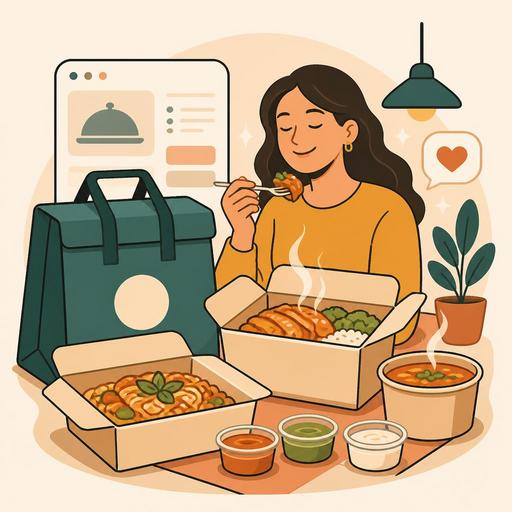
How the Packaging Experience in Takeaway Affects Customer Satisfaction
Why is the packaging experience in takeaway the invisible part of customer satisfaction?
Takeaway packaging has a greater impact on customer satisfaction than most restaurants think. The guest experiences the food not in the kitchen, but at home, at the office, or on the road. For this reason, how the food arrives is evaluated as much as the flavor. A burger bun gone soggy from steam when the lid is opened, a salad with its dressing spilled, or side products mixed together can weaken the perception of a well-prepared menu item within a few minutes.
Packaging here is not just a protective box. It takes on functions such as preserving heat, maintaining crispness, preventing leaks, presenting the portion neatly, and supporting order accuracy. Moreover, each of these reflects directly in reviews, the repeat-order rate, and trust in the brand. The customer often does not say "the packaging was bad"; instead they say "the product was stale," "it arrived a mess," or "it wasn't what I expected." In other words, the problem quietly starts with the packaging, while the result appears as a loss of satisfaction.
Especially for restaurants with strong takeaway, packaging is the menu's final touch in the field. A product cooked correctly in the kitchen can turn into a flawed experience because of the wrong packaging. That is why the packaging decision is not just a purchasing-cost matter; it is an operational and customer-experience decision.
At which touchpoints does the silent effect of packaging appear?
1. Temperature and texture preservation
Not every product performs well in the same container. For example, fried items can quickly go soft in a fully closed container with no air vent. Grilled products can become watery if they trap too much steam. While a leak-proof container is critical for soup, a structure that prevents crushing is more important for desserts. The fundamental question here is this: What physical change does this product undergo by the time it is delivered?
Let us give a concrete example: a business selling a crispy chicken menu sends the chicken, fries, and sauce in the same wide container, so steam and moisture affect the whole product. The same menu is perceived far better with a compartmented container, a separate sauce cup, and suitable packaging that balances the air vent. Even if the flavor does not change, the experience does.
2. Visual order and appetite perception
When the customer opens the package, they decide in the first few seconds: "Is this carefully done or not?" Internal order is very important, especially in bowls, salads, breakfast boxes, burger menus, and desserts. A scattered product creates a feeling of incompleteness. A neat layout, on the other hand, strengthens the perception of the portion. This also affects social media sharing; a product that arrives photographable provides an advantage for organic visibility.
3. Order accuracy and trust
Packaging is also part of the order-control process. Unlabeled packages can lead to similar products getting mixed up. When a product requested without spice and a standard product, or an order with an allergen sensitivity and a normal order, are closed up the same way, the risk of error rises. In the customer's eyes, this error is not just a kitchen mistake; it is interpreted as the brand's carelessness.
4. Ease of transport
A package the courier cannot carry safely will not reach the customer intact. Beverages that cannot be balanced, sauces with thin lids, and boxes that collapse when stacked all cause problems in the last meters of delivery. For this reason, the choice of packaging should be tested not on the tabletop, but in the delivery scenario.
How should restaurants think of packaging as part of menu engineering?
Many businesses calculate recipe cost, preparation time, and sales price when planning the menu; but the final state of the product in takeaway is not evaluated enough. Yet some products work very well in the dining room while lowering satisfaction in takeaway. At this point, packaging needs to be included in menu engineering.
A practical approach can be the following:
- Test each popular product in its state 20-30 minutes after delivery.
- Note the product's texture loss, temperature, and visual integrity.
- If necessary, separate the product components: sauce separate, garnish separate, hot and cold products separate.
- If changing the packaging is not enough, redesign the product presentation specifically for takeaway.
- In the courier-transport scenario, run tipping, leaking, and crushing tests.
For example, nachos, crispy products, plates containing poached eggs, or pasta with plenty of sauce may require a special solution in takeaway. Sometimes the most correct decision is not to remove the product from the menu, but to define a separate takeaway version. The menu can contain products with the same name but a different design for dine-in and takeaway.
Here, digital menu and order management tools come into play organically. Limiting add-ons unsuitable for takeaway, showing automatic notes for certain products, or standardizing the prep flow for courier handover is possible not just with kitchen skill, but with systematic management.
The most common packaging mistakes in operations and actionable solutions
A significant part of packaging-related dissatisfaction arises not from expensive solutions, but from process gaps. The following mistakes are seen frequently in restaurants:
- Using a single type of packaging: Choosing the same container for every product makes purchasing easier but weakens the experience.
- Adding sauce to the product too early: Especially in crispy and leafy products, this accelerates texture loss.
- Not labeling: Creates confusion with similar orders.
- Not standardizing the packaging order: Quality varies by shift.
- Not collecting courier feedback: You cannot see which package causes problems in transport.
The clear actions that can be taken against these mistakes are:
- Prepare a separate packaging matrix for the top 20 selling products.
- Use a short checklist at the packaging station: product, sauce, cutlery, beverage, label, seal.
- Clearly indicate "must be sent separately" components on the recipe card.
- Analyze complaints not just by product, but by the combination of product + packaging type + delivery time.
- Weekly, open the packages that receive the most returns or negative reviews and evaluate them with the team.
This approach also makes staff training easier. Because the problem stops being a vague call like "be more careful" and turns into a measurable standard.
How does digital tracking make packaging-related problems visible?
The hardest part of managing the silent effect of packaging is that the problem looks scattered. In one review the customer says "it came cold," another writes "it was all a mess," and a third notes "the fries were soggy." Although these seem like separate problems, they are often tied to the same root cause: a wrong packaging choice or a non-standard prep flow.
For this reason, restaurants should use order data not only for sales, but also for quality analysis. Which products receive more complaints at which hours? In which delivery areas do leak problems increase? Which menu combinations drop in quality when packaged together? Answering these questions takes the packaging decision out of intuition and turns it into a managerial one.
Tools such as digital order management, the QR menu, and POS integration make an indirect but valuable contribution here. Product notes flowing clearly, special requests not being lost, prep instructions appearing on the kitchen screen, and the order flow being traceable all help reduce packaging-related errors. Especially in multi-branch structures, digital processes make a serious difference in maintaining the same packaging standard.
A 30-day packaging plan you can apply to improve customer satisfaction
You don't need a big project to get started on this topic. A mid-sized restaurant can move quickly with the following framework:
- First week: Identify the top 10 selling takeaway products and test their current packaging performance.
- Second week: Categorize complaints: temperature, leakage, mixing, crushing, missing item.
- Third week: Try two or three alternative packages on a small scale; get feedback from staff and couriers.
- Fourth week: Create a packaging checklist, set a labeling standard, and simplify the notes in the digital order flow.
The aim of this plan is not just to look more elegant. The real goal is to carry the quality produced in the kitchen to the customer's door without it deteriorating. Because in takeaway, the brand experience is completed not at the moment the food is cooked, but at the moment the box is opened.
Restomas can help restaurants manage the takeaway experience more consistently by making the order flow and menu management more visible.
