A Guide to Identifying and Solving Bottlenecks in Your Restaurant's Order Process
It's a Saturday evening, your dining room is completely full, and orders are pouring in. But the dishes coming out of the kitchen are falling far behind expectations, customers at the tables are growing impatient, and your servers keep asking, "When will it be ready?" Does this sound like a familiar scenario? The problem is probably not at a single point; it lies in the bottlenecks hidden at different stages of your order process.
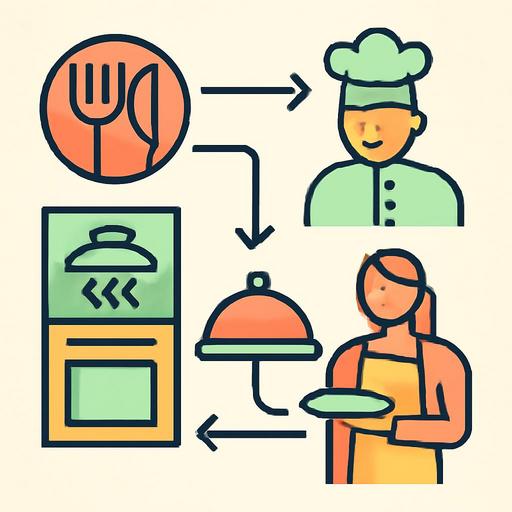
An order flow map is a visual representation of all the steps an order goes through from the moment it is taken from the customer to the moment it is served to the table. Mapping this is what it means to take your restaurant's operational pulse and discover where congestion occurs. Let's examine step by step how to create this map and how to eliminate bottlenecks.
Why Is Your Order Flow Map So Critically Important?
Most restaurant owners think problems only appear during busy hours. The reality, however, is that bottlenecks are always there; they only become visible when volume increases. Without your order flow map, you only notice problems when a customer complaint arrives or when staff become overloaded.
A flow map gives you the following:
- Transparency: You see clearly what happens at every stage of the order
- Measurability: You can track how long each step takes
- Accountability: It becomes clear which team member is responsible for which stage
- Continuous improvement: You can optimize your processes by making data-driven decisions
Map Your Order Flow Step by Step
To map your order flow, adopt a practical rather than theoretical approach. Here is the method for creating a map specific to your restaurant:
1. List All Touchpoints
Write down every step in an order's life cycle. For a typical restaurant, these might be as follows:
- The customer sits at the table
- The server presents the menu
- The customer places their order
- The server enters the order into the system or writes it on paper
- The order is relayed to the kitchen
- The kitchen receives the order and puts it in the queue
- The chef or cook begins preparing the order
- The dish is cooked and plated
- The service staff picks up the dish
- The dish is served to the table
When writing your own restaurant's flow, include details such as whether you use a QR menu, whether there is a tablet at the table, and whether you offer self-service or full service.
2. Measure the Duration of Each Step
For a week, use a stopwatch to measure how long each step takes across different shifts and different levels of busyness. For example:
- Taking the order: 3-4 minutes during normal hours, 8-10 minutes during busy hours
- Relaying the order to the kitchen: instant in a digital system, 2-5 minutes with a paper ticket
- Preparation time in the kitchen: 8-12 minutes for starters, 15-20 minutes for main courses
These measurements will show you which stages take longer than expected.
3. Mark the Bottleneck Points
As you analyze your measurements, ask the following questions:
- At which step are wait times the longest?
- At which stage do errors occur most frequently?
- At which point do staff struggle the most?
- Which step gets completely clogged during busy hours?
The Most Common Bottlenecks and Their Practical Solutions
Bottleneck 1: The Order-Taking and Recording Stage
Are your servers writing long notes when taking orders from customers? Do they go to the register to relay the order to the kitchen? This is a classic bottleneck. Especially during busy hours, if a queue forms among servers in front of the register or order terminal, this point causes serious time loss.
Solution: Mobile order-taking systems solve this problem at its root. Servers can enter the order directly at the table via a tablet or smartphone, and the order is instantly pushed to the kitchen screen. Alternatively, having customers place their own orders via a QR menu can eliminate this stage entirely.
Bottleneck 2: Communication Breakdown Within the Kitchen
If coordination cannot be maintained between the cold kitchen, hot kitchen, grill, and dough station, the different parts of a table's order become ready at different times. The result: either the dishes go cold or some customers wait for others.
Solution: Provide order synchronization on kitchen screens. While each station sees the order on its own screen, a central screen should display the status of all stations. This way, the chef or kitchen manager can track in real time which part of which order is ready and ensure coordination.
Bottleneck 3: Ready Dishes Waiting in Service
The kitchen has prepared the dish, but the server doesn't come to pick it up. The dish goes cold while waiting at the pass, quality drops, and the kitchen team experiences unnecessary stress. This is a common problem, especially in restaurants where the dining room is far from the kitchen or where there are not enough servers.
Solution: Use service notifications. When a dish is ready, send a notification to the servers' mobile phones or a service screen. Some restaurants create awareness within the team by using timers that show how long ready dishes have been waiting.
Bottleneck 4: Incorrect or Incomplete Order Transmission
The handwriting on paper tickets is illegible, the server enters the order incorrectly, or the customer's special requests are not relayed to the kitchen. The result: the dish comes back, is remade, and both time and resources are wasted.
Solution: Predefine item variations and special requests in your digital ordering system. When options such as "rare," "extra spicy," and "has an allergy" become standard, both the error rate drops and communication becomes clearer.
Continuous Monitoring to Prevent Bottlenecks
Mapping your order flow once is not enough. Restaurant operations are dynamic; the menu changes, staff change, and the customer profile evolves. For this reason, continuous monitoring is essential.
On a weekly or monthly basis, track the following metrics:
- Average order preparation time
- Table turnover rate
- Error rate per order
- Maximum wait times during busy hours
- Number of orders processed per staff member
Share this data regularly with your team. Transparency is the key to detecting problems early and creating a solution-oriented culture.
Strike the Balance Between Technology and People
Investing in technology to solve bottlenecks is important, but technology alone is not enough. Even the most advanced digital kitchen screen is useless if the staff are untrained or the processes are not clear.
For a successful order flow, bring together the following:
- Technological infrastructure: Order management, kitchen screens, notification systems
- Clear processes: Standard operating procedures where everyone knows what to do and when
- A trained team: Staff who use the systems effectively, notice bottlenecks, and act proactively
- Data-driven management: Leadership that bases its decisions on measurements rather than intuition
Take Action: Start Tomorrow Morning
You don't need a large investment or a long project management process to map your order flow. You can start tomorrow morning by doing the following:
- Conduct a one-day process observation: track orders and note the times
- Hold a short meeting with your team: ask the question, "At which stage do you struggle the most?"
- Identify the biggest bottleneck and focus on it first
- Make a small change and measure the results after a week
Remember: a perfect flow map is not created in a day. With a continuous-improvement mindset and small steps taken each week, you can transform your restaurant into a more efficient, more profitable, and less stressful business.
Integrated digital solutions like Restomas make it easier to detect bottlenecks and increase your operational efficiency by making your order flow visible.
