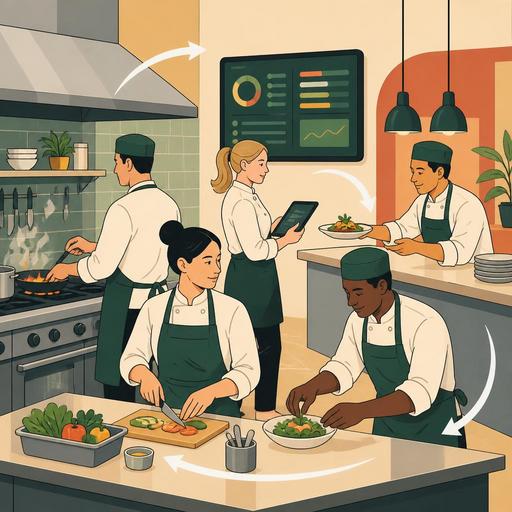
How Does Kitchen Staff Rotation Balance Efficiency and Team Cohesion in Restaurants?
Kitchen staff rotation is not merely a method used to fill shift gaps in restaurants; when set up correctly, it is a strategic planning tool that preserves service continuity, strengthens intra-team solidarity, and reduces operational fragility. But when rotation is done without a plan, it can produce the opposite result: command of stations drops, the error rate rises, areas of responsibility blur, and intra-team tension climbs under service pressure. For this reason, the real question shouldn't be "is rotation good or bad?" but "which tasks, which people, and at which intensity levels are suitable for rotation?"
In many businesses, the hot station, cold prep, dessert output, dishwashing flow, and prep processes are managed disconnected from one another. Yet kitchen performance is determined far less by individuals one by one than by the quality of the flow between stations. A well-designed rotation plan helps staff understand one another's workload; a poorly designed plan dilutes expertise. The factor that determines this distinction is not the frequency of rotation but its goal and how it's measured.
When does staff rotation deliver efficiency?
For rotation to deliver efficiency, every employee doesn't need to be able to do every job. The real goal is to prevent the operation from depending on a single person at critical bottlenecks. For example, if the salad and cold-starter station constantly creates a pile-up during lunch service, keeping only one specialist staff member at that station may look fast in the short term. But if the whole flow falls apart on a day off, during illness, or in a sudden rush, there's a rotation gap here.
Similarly, in kitchens where only the sous chef controls the order-ticket flow and the portioning standard, the decision center is concentrated in a single person. This creates delays, especially during busy hours. When rotation here is supported with a task-handover and shadow-training model, it becomes possible for a second person to sustain the same quality standard.
- If critical stations depend on a single person, rotation delivers efficiency.
- If the new-staff turnover rate has risen, rotation speeds up onboarding.
- If branching out or shift expansion is planned, rotation serves as manager development.
- If recurring delays in service form at specific points, rotation is useful for bottleneck analysis.
Conversely, in tasks requiring fine knife skill, advanced cooking technique, or high-speed station memory, constant rotation can lower quality. In other words, rotation doesn't replace expertise; it builds a structure that backs up expertise.
Solidarity or expertise? You need to escape the wrong dilemma
Restaurant owners often see rotation as a "soft" practice that boosts team solidarity and fixed task assignment as a "hard" model that delivers efficiency. Yet in real life these two extremes aren't separate from each other. In a kitchen without solidarity, knowledge sharing drops; and in a kitchen where knowledge sharing is low, efficiency can't be sustained.
For example, if the prep team doesn't understand why the service team constantly asks for last-minute products, they may interpret it as a lack of discipline. The service side, too, may find the prep side slow. When a controlled station swap is done once or twice a week, employees don't just learn a new task; they also see one another's pressure points. This reduces a culture of blame and makes communication concrete.
However, there's an important limit here: an arrangement where everyone moves to a different point every day, in the name of solidarity, produces uncertainty rather than belonging. If employees don't know what their performance is measured against, motivation drops. For this reason, each staff member should have a main station and a second station they can support. A third area should be considered only for emergencies or training.
An actionable task-matrix example
A simple but effective method is to divide kitchen tasks into three categories:
- Core competency: The station the employee manages on their own
- Support competency: The second area where they can lend a hand during a rush
- Development area: A third task they're learning alongside training
Such a matrix makes rotation controlled rather than random. It also makes it easy to see which flexibility exists in which shift.
How should a rotation plan be prepared?
A successful plan isn't built merely by distributing names across the shift schedule. First it should be clarified which tasks in the kitchen are genuinely suited to rotation. Then, for each task, the error tolerance, training time, and service risk should be determined. For example, the rotation logic for garnish prep and the meat-cooking station is not the same.
The following sequence yields safer results in practice:
- Classify stations by risk level. Plan slower transitions in areas where the cost of error is high.
- Define a competency level for each employee. Instead of "knows it," use clear phrasing such as "manages it alone," "does it with support," and "needs training."
- Set the rotation frequency according to service intensity. Experiment in more controlled shifts, not on Friday night.
- Create short checklists. Make the grammage, presentation, prep sequence, and hygiene steps visible.
- Collect feedback after the shift. Note where slowdowns occurred and where support was needed.
Digital tracking provides great convenience here. Seeing which products receive heavy orders during which hours on the menu, which prep items regularly create congestion, and where the bottleneck forms on a per-shift basis bases rotation on data rather than guesswork. When the order flow, prep tempo, and task distribution can be tracked on a single screen, the manager can plan more precisely instead of making intuitive decisions like "who looked free?"
The most common rotation mistakes
The reason rotation gains a bad reputation is often not the method but execution mistakes. The most common mistake is trying to solve a problem by constantly moving an underperforming employee to different stations. This approach both hides the problem and damages the perception of fairness within the team.
The second mistake is putting rotation on the agenda only when there's a staffing shortage. If employees move to a different task only during a crisis, this is an emergency reflex, not a development system. In a moment of crisis, the chance of magnifying errors is high, not learning.
- Using rotation like a punishment
- Forcing transitions without training
- Moving people around every shift
- Leaving the station lead unclear
- Continuing the plan without measuring results
Especially with multi-product menus, kitchen rotation should be considered together with menu complexity. If a large number of modified orders, promotional products, or seasonal add-on items are being managed at the same time, the rotation plan should also be simplified accordingly. When menu management and staff planning are run independently of each other, the kitchen looks flexible on paper but breaks down at the moment of service.
A clear action plan for restaurant owners
Kitchen staff rotation doesn't require choosing between efficiency and solidarity. When set up correctly, it strengthens both at once. To achieve this, the restaurant owner or operations manager needs to move away from the "everyone should know every job" approach and proceed with the goal that "critical jobs can be reliably sustained by at least two people."
As a first step, open the next two weeks' shift plan and ask these questions: Which station depends on a single person? Which task carries a day-off risk? Which employee can reliably provide support in a second area? During which busy hours does the kitchen flow slow down? When these questions are answered in writing, rotation stops being an abstract team policy and turns into a manageable system.
Then start small. Instead of rotating the entire kitchen at once, apply a controlled transition at a single station. Evaluate the results based on service time, error type, team feedback, and prep order. If necessary, support rotation by simplifying some of the operational loads on the menu. Because even the best staff plan struggles with an uncontrolled, complex menu.
When the order flow, menu updates, and operational visibility are tracked more systematically with digital tools like Restomas, it becomes easier to manage kitchen rotation within a measurable rather than intuitive framework.
