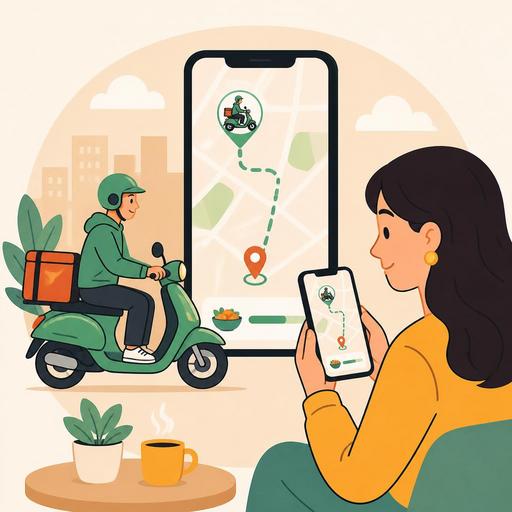
How Live Courier Tracking Strengthens Customer Trust in a Restaurant
Live courier tracking, for restaurants that offer takeaway service, is not merely a dot moving across a map; it is a critical experience tool that strengthens the customer's sense of control over their order, reduces uncertainty, and can lower complaints before the order even reaches the door. Especially during busy hours, if the answer to "Where is my order?" isn't clear, customer satisfaction is quickly damaged. By contrast, a system that makes the delivery process visible lets the restaurant both appear more trustworthy and manage its operation more calmly.
Today, customers don't just expect fast delivery; they also want to understand the process. Has the order been prepared, has the courier picked it up, is there a delay on the route, how long until delivery? Answering these questions proactively reduces call traffic while building this perception in the customer's mind: "This business has the process under control." And trust is built on exactly this.
Why does reducing delivery uncertainty create trust?
Customer trust is most often related to process transparency as much as to product quality. Even a delicious order can be remembered negatively if no information is given at the moment of a delay. Live tracking solves two important problems here: the unknown and silence.
For example, when a customer places an order on a busy Friday evening, even if the estimated delivery time appears on the screen, that time alone may not be enough. If the system clearly presents stages such as "being prepared," "handed to the courier," and "approaching," the wait becomes more manageable psychologically. Because the customer isn't just waiting; they're seeing the progress.
This visibility is especially valuable in the following situations:
- When delivery times stretch out in heavy weather conditions
- In locations with difficult delivery access, such as apartment buildings, office towers, or campuses
- When courier traffic increases during the lunch and evening peak hours
- With first-time customers, when trust in the business hasn't yet formed
The customer doesn't always judge a delay with the same severity; they most often take issue not with the delay itself but with not being informed. Live courier tracking shows that the restaurant isn't leaving the customer in the dark.
What concrete differences does live tracking create in restaurant operations?
The impact of live-tracking technology on the customer side is strong; but the truly sustainable benefit emerges on the operations side. Because trust becomes lasting not just through a good interface but through a well-managed process.
1. It reduces phone and message traffic
In many businesses that offer takeaway service, a significant portion of the teams lose time answering questions like "Has the courier left?" and "How much longer?" When the order status is conveyed clearly to the customer, the pressure on the front register, the call center, or the social media DM inbox eases. This lets the staff focus on running the operation rather than solving problems.
2. It improves kitchen and courier coordination
Live tracking should not be thought of as a map feature on its own. It is far more valuable when it works together with order management. When the kitchen preparation time, courier assignment, and delivery flow are tracked in a single order, disconnects like "the order is ready but there's no courier" or "the courier has arrived but the package isn't ready" become more visible. This gives the business an advantage in estimating the service time.
3. It makes proactive communication easier in the event of a delay
For example, if the courier encounters unexpected traffic on the route, it's important to notice this before the customer complains. Thanks to live monitoring, when the possibility of a delay arises, the team can give the customer a short and clear update. This approach preserves trust even when a problem occurs. Because the customer doesn't have to discover the situation on their own.
What are the critical touchpoints that increase trust in the customer experience?
What makes a live-tracking system effective is not just the technical infrastructure, but how the experience is designed. There are a few basic touchpoints restaurant owners should pay attention to here.
- Show a realistic delivery time. Exaggeratedly short times may bring the first order, but they damage repeat orders. Setting the customer's expectation correctly is the first step toward trust.
- Keep status notifications simple. Clear phrases such as "being prepared," "handed to the courier," and "approaching" make it easier for the customer to understand the process.
- Show the map and order status in sync. If there's movement on the map but the order screen isn't updating, the system confuses rather than reassures.
- Don't forget the post-delivery close. A "Your order has been delivered" notification, followed by a short feedback flow, completes the experience.
Let's consider a concrete example: a burger restaurant struggles to manage delivery times during the evening rush. Customers frequently call to ask about the status of their order, and stress rises within the team. When the customer is shown which stage the order is at with live courier tracking, the call load drops. At the same time, the manager, by seeing more clearly in which regions deliveries are often delayed, can reorganize the shift plan and courier distribution. Here, trust is fed not only by the screen the customer sees, but by the improved order behind it.
What should restaurants do to use live courier tracking efficiently?
Setting up the technology isn't enough on its own; it needs to be supported with process. Restaurants can increase the impact of live tracking with the following steps:
- Re-map your delivery zones. Note the neighborhoods that are constantly delayed, the building types, and the traffic hours.
- Review preparation times on a per-item basis. If certain menu items cause the courier to wait, make adjustments suited to the takeaway flow.
- Train staff on status communication. How to inform the customer in the event of a delay should be standardized.
- Evaluate order management and delivery tracking in the same flow. Systems that work separately may look digital on the surface but create disconnects in practice.
- Examine complaint records together with route and time information. Separate out whether the problem stems from courier performance, a kitchen delay, or regional congestion.
This issue becomes even more critical, especially in businesses that take orders across multiple channels. When orders originating from the phone, the website, the QR menu, a marketplace, or social media remain scattered across different screens, the delivery experience becomes inconsistent. Businesses that can manage the order flow and courier visibility in a more integrated way both give the customer clearer information and increase decision-making speed within the team. This is exactly where the value of platforms focused on restaurant digitalization, like Restomas, emerges: bringing menu, order, and operational data together within a single logic creates the foundation that supports the sense of trust on the delivery side.
Make the sense of trust lasting through process design, not technology
Live courier tracking is a powerful tool; but on its own it is not a miracle. If the kitchen pass is disorganized, if delivery zones aren't defined realistically, or if customer communication is weak, the map feature merely makes the problem more visible. By contrast, when used with the right process design, it sends the customer this message: "Your order is under control."
For restaurants, trust is no longer only about taste, portion, or price; it's about being predictable at every step of the experience. Live tracking makes this predictability visible. When the customer knows where their order is, they worry less, feel less need to make contact, and perceive the business as more professional. This comes back as repeat orders, positive reviews, and a calmer operation.
Businesses that want to make the delivery experience more transparent and manageable can build a more consistent customer experience by considering Restomas's digital order and operations flow together.
