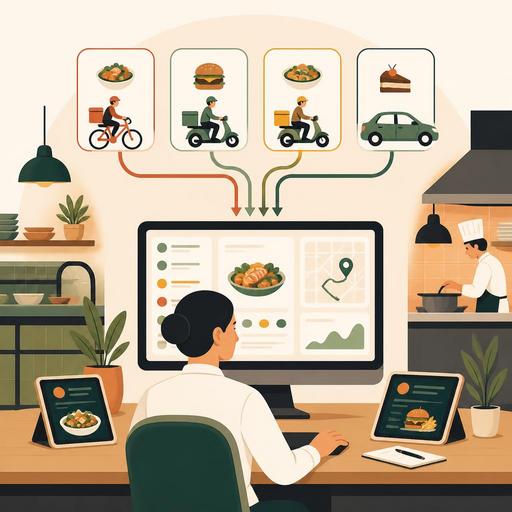
A Guide to Managing Getir, Trendyol, and Migros Orders on a Single Panel
Managing Getir, Trendyol, and Migros orders on a single panel has become, for restaurants whose delivery volume is growing, not just a convenience but a need that is directly tied to operational quality. (Getir, Trendyol, and Migros are food-delivery marketplaces.) Receiving orders from several marketplaces at once seemingly creates a revenue opportunity; but if the order flow, menu updates, stock status, courier prep time, and staff coordination are not monitored from one center, that opportunity can very quickly turn into chaos. Especially during peak hours, switching between different screens, approving the wrong product, leaving an out-of-stock item open, or passing incomplete information to the kitchen directly affects the restaurant's speed and the customer experience.
In this article, we'll examine multi-channel delivery operations from a deeper angle: the problem isn't just "using several apps." The real issue is whether the entire flow, from the moment the order lands on the screen to it being prepared in the kitchen, becoming ready for delivery, and updating menu decisions, is managed with a single operational logic.
Why is the real problem in multi-marketplace management not the number of screens?
Many businesses see the problem only as a crowd of devices. On the counter, one tablet sits for Getir, one for Trendyol, and another for Migros; staff look at the relevant device as orders come in. At first glance this method seems to work. But the problem is less about the number of screens and more about decisions being scattered.
For example, when the special sauce on your burger menu runs out during the lunch rush, you have to close it manually across three separate channels. If the product is closed on one platform but stays open on another, orders keep coming in. As a result, either the customer is called, or the product is canceled, or an unsatisfying alternative is sent. The loss here is not just one order; the kitchen rhythm is disrupted, staff take on an unnecessary communication burden, and review ratings come under risk.
Similarly, a price change, a product-image update, editing promotional sets, or revising opening hours all carry a higher chance of error when managed separately by channel. That is why successful businesses approach multi-marketplace management not as "order collection" but as centralized operational design.
The operational effects of consolidating Getir, Trendyol, and Migros orders on a single panel
The single-panel approach makes the biggest difference during peak hours, because instead of thinking about which order came from which app, staff can prioritize all orders in a single flow. That way distraction is reduced and the kitchen team works with a standard prep order.
1. Order acceptance and prep time are simplified
Instead of tracking sound alerts from different devices, having all orders land on a single screen shortens the intake process. The staffer at the register or the delivery lead reviews the order and passes clear information to the kitchen. This is especially important for detailed notes such as added ingredients, removed content, and drink preferences.
2. Menu and stock management become more consistent
When a product is temporarily out of stock or you want to close it for sale at the end of the day, an update made from a single center provides operational confidence. The same logic applies to price revisions. In structures where each channel is managed separately, even a single forgotten product can lead to needless cancellations.
3. Staff training becomes easier
Instead of getting a new employee accustomed separately to three different marketplace panels, teaching a single-flow logic is faster. This reduces the risk of error during shift handovers. Process standardization provides a serious advantage especially for businesses with high staff turnover.
4. Reporting becomes more meaningful
Seeing orders in one center makes it easier to understand at which hours pileups form, which products create congestion, and which channel strains kitchen capacity the most. That way decisions are made not by intuition but through daily operational observation.
5 critical decisions to clarify before setting up a single panel
Moving to a single screen is not just a matter of technical connection. To get a healthy result, you first need to clarify internal business rules.
- Which products will be shared across all channels? You don't have to open every product on every platform. Separate out products that are hard to prepare, carry a high waste risk, or travel poorly.
- Who will have authority to close out stock? The kitchen, the shift lead, or the register? If authority is unclear, closing a product gets delayed.
- How will prep time be updated? When it gets busy, the decision to extend the time must be made quickly; otherwise delivery expectations break down.
- Will there be a separate menu logic for delivery? A product that works well in the dining room may not perform the same way in delivery.
- How will the cancellation and missing-product scenario be managed? Customer communication, alternative suggestions, and internal team notifications should be defined in advance.
Systems set up without these decisions in place soon revert to manual intervention. In other words, technology is not a solution on its own; you need a clear workflow that the technology supports.
How does single-screen management make a difference in concrete scenarios?
To see the issue more concretely, let's consider three typical scenarios.
Scenario 1: A product runs out during the lunch rush
A popular chicken bowl runs out faster than expected. If you use separate panels, one employee closes the product on Getir, Trendyol is forgotten, and on Migros a variation stays open. With the single-panel approach, when the product status is updated centrally, this chain of errors is largely prevented.
Scenario 2: A promotional menu price change
Due to a cost increase, you need to revise the price of a particular menu. Doing this channel by channel both takes time and creates inconsistency. The old price lingering on one platform can create a trust issue with the customer. Centralized menu management preserves brand consistency here.
Scenario 3: Information loss during a shift change
If the evening shift doesn't know which products the day team temporarily closed or which order notes frequently caused errors, the problem repeats. Having order, menu, and operational decisions visible in a single-panel logic makes handovers between shifts easier.
An actionable transition plan for restaurant owners
If you still manage Getir, Trendyol, and Migros orders separately today, it is better to proceed in a controlled way rather than make the switch in a single day.
- Map out your current flow. Who sees the order, who approves it, how is it passed to the kitchen, and who decides to close a product? First, put today's process in writing.
- Simplify the menu. Identify products that cause problems in delivery. Reduce items that have many variations but sell little.
- Flag the channel-based differences. The same product structure may not be needed on every platform. But the shared core menu must be clear.
- Prepare a one-page operations guide for staff. Briefly write down order acceptance, closing out-of-stock products, updating times during a rush, and the steps to follow in case of an error.
- Read the reports weekly. The most-canceled products, the menus that need editing most often, and the bottlenecks during peak hours should all be tracked regularly.
This transition plan makes technology part of daily operations. The aim is not just to see orders in one place; it is to build fewer errors, clearer team coordination, and a more predictable service routine.
What makes the single-panel approach valuable in the long run?
In the long run, the biggest benefit is that the restaurant owner makes operations "manageable" rather than "reactive." A structure where you constantly track which tablet an order came from is not suited to growth. If you want to open a new location, expand the menu, or increase delivery volume, you first need to centralize the basic flow.
The important point here is this: digitalization is not just a technology investment placed on the front end. Real efficiency emerges when the kitchen, register, packing, and menu management meet on the same line. The centralized order and menu management approach offered by restaurant-focused platforms like Restomas touches precisely this need: helping teams work in a calmer, more controlled, and more consistent way.
If your delivery operation is growing but screens are multiplying while your sense of control diminishes, moving to a single-panel logic is a step that should no longer be postponed; Restomas can offer a practical starting point for businesses that want to make this transition more orderly.