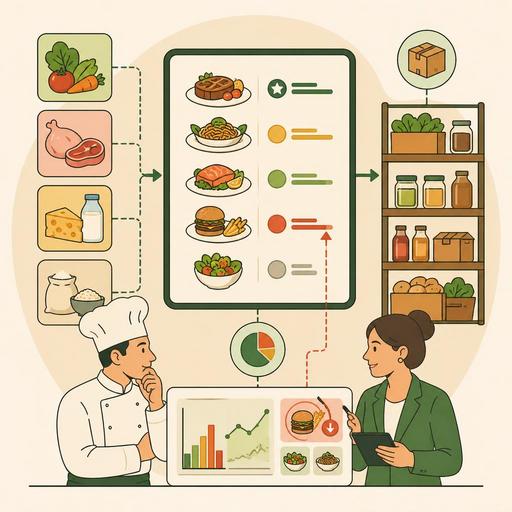
Using Menu Engineering to Find Low-Selling Items and Optimize Stock
Stock optimization through menu engineering is a critical approach in restaurants not only for increasing profitability but also for balancing the kitchen workload, reducing waste, and clarifying purchasing decisions. In particular, the failure to identify low-selling items in time creates chain problems such as ingredients sitting on the shelf, unnecessary prep processes, a complicated menu flow, and stock with a low turnover rate. For this reason, the topic is not just about the question "which product sells little?"; the right question should be "why does which product sell little, and how does this affect stock?"
In many businesses, menu evaluation is done by intuition: decisions are made based on the chef's observation, the register's comments, or the service team's gut feeling. Yet menu engineering addresses product performance with indicators that need to be read together, such as sales frequency, contribution margin, preparation difficulty, ingredient sharing, and stock risk. Looked at this way, a low-selling product is not always one that should be removed from the menu; sometimes it is poorly positioned, sometimes its price is misaligned, and sometimes the ingredient it uses is inefficient in terms of supply.
Why is a low-selling product not just a sales problem?
Low-selling products often generate a greater operational cost than it appears. Because keeping a product on the menu creates a burden not only at the moment of sale, but also on the purchasing, storage, prep, staff training, and service sides. For example, if a separate sauce, a separate side, and separate presentation equipment are needed for a starter that sells a few times a week, the product can unnecessarily complicate operations despite generating low revenue.
The point to note here is the difference between low sales performance and low strategic value. Some products may be the brand's signature dish, while others may be on the menu for a specific customer segment. But apart from these exceptions, the effect on stock of products that consistently see low demand should be reviewed regularly.
- Ingredients sit in storage longer due to a low turnover rate.
- If cross-use is weak, the same ingredient cannot be utilized in other products.
- The prep standard deteriorates; staff are more prone to mistakes on a rarely made product.
- The purchasing plan goes off track; frequent purchasing in small quantities or unnecessarily high safety stock forms.
- Menu clutter increases; the customer's decision time can lengthen.
For this reason, low-selling product analysis should be handled not just as a sales report but also as a stock behavior analysis.
How are low-selling products identified through menu engineering?
The first step is to regularly track product-level sales counts over a specific period. But the count information alone is not enough. Because some products, even if they sell little, can generate a high contribution margin; some products, even if they sell a lot, can be inefficient in terms of stock and labor. For this reason, the evaluation needs to be done in several layers.
1. Read sales frequency over periods
Examine the product not daily but within meaningful periods. Weekday vs. weekend, lunch vs. evening, season, and campaign periods should be read separately. For example, a salad that does well in summer can naturally slow down in winter; this does not mean the product is a failure. However, products that consistently stay low over a four-to-eight-week period give a clearer signal.
2. Map out ingredient dependency
In which other products do the ingredients used by the low-selling product appear? If the product is tied to two or three ingredients exclusive to it on the menu, the risk is great. For example, a special sauce used only in a single sandwich, or a niche ingredient bought for a single dessert, increases the likelihood of sitting in stock and going to waste.
3. Evaluate the prep effort
Some products, despite selling little, have a long preparation time. If there is a need for marinating, pre-cooking, special portioning, or separate equipment, the product's invisible cost on the kitchen rises. Menu engineering here looks not only at the recipe on paper but also at the flow effect it creates in the kitchen.
4. Check visibility and positioning
If a product sells little, the reason is often not the product itself. Remaining in the lower rows on the digital menu, having an insufficient description, lacking a photo, or a poorly set-up price anchoring effect can all lower sales. In businesses that use a QR menu, the product ordering and category structure therefore carry critical importance.
In restaurant management, being able to track order data and menu updates in the same flow makes decision-making easier at this point. Before removing a product entirely, making a change to the description, category, price, or pairing and then monitoring the result is a sounder method.
What decisions should you make instead of immediately removing a low-selling product?
There is no single solution for every underperforming product. The right approach is to place the product into one of four basic decision groups.
- Keep it on the menu, increase its visibility: suitable for products that are profitable but not noticed enough.
- Simplify the recipe: it is possible to offer the same product with fewer ingredients and higher cross-use.
- Make it seasonal or offer it in a limited way: a periodic offering instead of a permanent menu item can reduce stock pressure.
- Remove it from the menu: if low sales, low contribution, and high stock risk are seen together, this is the clearest solution.
Let's consider a concrete example: say a special toast with goat cheese on the menu at a cafe receives a small number of orders per week. If the goat cheese is used only in this product, needs to be consumed shortly after opening, and staff use a separate station while preparing it, the problem is significant. In this case, there are three options: remove the product, also use the cheese in other breakfast products, or move the product to the weekend brunch menu. The right decision is made not solely based on the sales count but according to the ingredient's role within the menu.
An actionable work plan for stock optimization
You do not need to set up complex systems to combine menu engineering with daily operations. Regular data tracking and a clear meeting rhythm make a big difference in most businesses.
- Pull the product sales list for the last 6-8 weeks.
- Identify the lowest-performing products. Not just the count, but also periodic consistency matters.
- Map the recipe ingredients of these products. See which ingredients are used only in these products.
- Mark ingredients with a high waste risk. Products with a short shelf life are the priority.
- Evaluate the prep burden with the kitchen team. Note products that sell rarely but require a lot of effort.
- Run digital menu tests. Try changing the product name, description, category order, or visual presentation.
- Measure the result again after two to four weeks. If there is no improvement, the reason for keeping the product on the menu should be questioned.
For this plan to be sustainable, the sales, menu, and operational data should not be scattered. When the order flow, product performance, and menu updates can be tracked from a single center, decisions are based on concrete observation rather than intuition. In particular, having QR menu, order management, and product-level reporting processes work together makes it easier to distinguish which product is genuinely without potential and which is merely poorly presented.
A leaner menu, a stronger operation
In restaurants, a strong menu is not always a long menu. On the contrary, a well-chosen and regularly optimized menu simplifies purchasing, eases staff training, increases service consistency, and speeds up the guest's decision process. Identifying low-selling products is therefore not a negative elimination exercise but a process of sharpening the business's focus.
The most efficient businesses evaluate products not just by "is it liked?" but by "how does it affect stock, the kitchen, and profitability?" Stock optimization through menu engineering comes into play precisely here: not to shrink the menu, but to make it smarter. Noticing low-selling products early through regular reporting, controlled menu tests, and product-level operational analysis provides a more predictable kitchen management throughout the year.
Restomas's digital menu and order management infrastructure can help you make these decisions in a more organized and measurable way by making product performance more visible.
