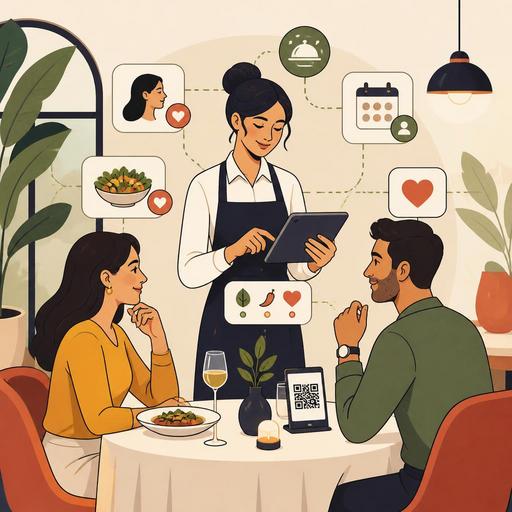
Designing Personalized Service by Remembering Guest Preferences in Restaurants
Designing personalized service by remembering guest preferences in restaurants is a critical approach not only for making a guest feel special, but also for building more consistent service, more accurate communication, and stronger loyalty. Systematically remembering that a guest prefers coffee without sugar, wants their dish without spice, likes tables by the window, or needs a high chair is far more than a well-meaning gesture; it is a well-designed operating model. What is more, this model is not just for fine-dining restaurants; it can be applied at different scales, from neighborhood cafes to multi-location businesses.
Why is personalization not simply "knowing the customer"?
Many businesses leave personalization up to their staff's strong memory. The server knows what the regular guest likes, the barista remembers it, the chef takes notes. But this approach falls apart easily when the team changes or during busy hours. Genuine personalized service design takes that information out of being dependent on individuals and turns it into a process.
The important question here is this: Which customer information improves service quality, and which is unnecessary detail? For a restaurant, the valuable data is usually the preferences directly tied to operations. For example:
- Dietary restrictions and allergen sensitivities
- Service details such as cooking temperature, sauce preference, and spice level
- Seating choice: quiet corner, outdoor area, by the window, high table
- Reservation behavior: do they come on weekday lunches or weekend evenings?
- Recurring order patterns: the same coffee, the same starter, the same drink pairing
When this information is collected correctly, the business gives the guest the feeling that "we know you." When it is collected incorrectly, it creates a useless pile of data that the team cannot use. That is why the first step of personalization is not collecting data; it is defining which preference will turn into service.
At which touchpoints should customer favorites be collected?
A single moment is not enough to remember guest preferences. The most accurate result is achieved by collecting preference information naturally at different touchpoints. This keeps the information current and avoids overburdening the team.
1. The reservation stage
Notes taken during the reservation are one of the most valuable starting points for personalization. Details such as a birthday celebration, a visit by a family with children, a request for a quiet table, or a particular seating arrangement become visible here. If the reservation system works with standard note fields, the team can enter information in the same format for every guest, and nothing gets lost.
2. The moment of ordering
If a customer always wants "lemonade with little ice" or says "no pickles on the burger," this information should be sorted out as either a one-time request or a recurring preference. Consistent use of note fields on order management screens makes recurring preferences visible. Especially in QR menu and digital ordering flows, customer choices are recorded in a more standardized way, which makes it easier to spot recurring tendencies.
3. Post-payment and post-visit feedback
Some preferences only become clear at the end of the experience. A guest might say "the table was too noisy" or "next time I'd like to see a gluten-free option." This kind of feedback should be evaluated not just as a complaint, but as a clue for future service design.
How do you build an operating model that turns preference information into action?
The real difference is made not by collecting the information, but by surfacing it to the right person at the right moment. If you want to remember customer favorites, your team must have clear answers to these three questions:
- Who enters this information?
- Where does this information appear?
- How is this information applied at the moment of service?
For example, if there is a "filter coffee, no sugar, large" note for a frequent guest, this information should not stay only at the register. The barista should be able to see it when taking the order, the service staff should be able to confirm it, and when needed it should also connect meaningfully to a campaign or recommendation flow. Likewise, if the reservation notes say "arriving with a stroller," the floor plan should be arranged accordingly.
This is where the contribution of digital systems becomes clear. Unifying the QR menu, reservation management, order notes, and table flow into a single operational logic takes customer information out of scattered notes and makes it usable. On platforms focused on restaurant digitalization, such as Restomas, managing these kinds of processes centrally is especially useful for reducing the loss of information between teams.
The critical point to watch here is this: personalization should not give the feeling of "knowing too much" to the point of making the guest uncomfortable. Knowing what a guest ordered before is helpful; presenting it in an exaggerated way can feel artificial. The best practice is subtle touches that make the customer's experience easier.
Practical ways to make favorites visible in menu design
Personalization is not done with service phrases alone; the structure of the menu is also part of this experience. Digital menus in particular help you read customer behavior better and turn preferences into recurring patterns.
For instance, if a breakfast business notices that customers frequently choose the "omelet without cheese + tea without sugar" combination, this should not remain merely past order data. A recommendation flow close to this on the menu can provide a convenience that creates a personalized feeling. Similarly, when areas such as spice level, extra ingredients, drink pairings, or portion choices are standardized, the customer can place an order suited to their own preference more quickly.
- Use modular product options: create clear preferences such as mild, medium, and very spicy.
- Simplify the add-on and removal fields: set up a clear structure for requests such as "no onions," "no sauce," or "gluten-free bread if available."
- Build recurring combinations into the menu logic: do not require the customer to keep writing special notes.
- Define short notes visible to the service teams: produce actionable commands instead of long descriptions.
This way, personalization becomes manageable not only for the front-of-house experience, but also for the kitchen and service.
Why does personalization fail without staff training?
Even the best system remains ineffective if the team does not know how to use it. In most restaurants the problem is not a lack of technology; it is a lack of standards. Employees need to know which note is important, which information counts as a recurring preference, and how to reflect it to the customer in a natural way.
The training should make the following framework clear in particular:
- Not every customer note carries the same importance; notes that affect operations take priority.
- Allergen and health-related preferences should be handled separately from service preferences.
- When confirming preference information with the guest, a short and natural tone should be used.
- Notes should contain actionable service information, not personal commentary.
Let us give a concrete example: when a guest arrives, the phrase "You sat at that table last time, so we've prepared it for you again" can create a warm experience for some customers. But the more natural approach is often confirming language such as "Would you prefer a table on the quieter side, if one is available?" In other words, personalization is not a memorized sentence; it is service intelligence suited to the context.
Start small and build a measurable personalization system
Instead of trying to collect all customer data at once, it is wiser to start with the three preference areas that will have the greatest impact on your business. For a cafe, for example, drink customizations and seating preferences may stand out, while in a dinner restaurant the cooking temperature, allergen notes, and reservation expectations may be more critical.
The following road map can be applied as a starting point:
- List the 10 most frequently repeated customer notes.
- Classify them as "service," "kitchen," and "reservation."
- Define a standard entry format for each category.
- Clarify on which screen these notes will appear.
- In your weekly meeting, review which notes actually turned into action.
This method takes personalization out of being an abstract statement about hospitality and turns it into a system you can operate. In the end, the goal is, before impressing the customer, to offer them a less frictional and more consistent experience every time they visit.
Remembering customer favorites strengthens a restaurant's memory; with the right digital infrastructure, this memory can preserve service quality even when the team changes. Restomas can offer a simple starting point for businesses that want to make these kinds of flows more organized and actionable.