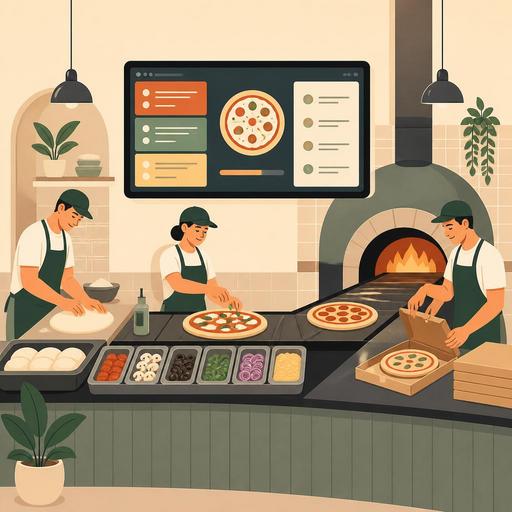
Reducing Cook Time and Waste in Pizza Restaurants with a KDS
Cook-time optimization and waste reduction in pizza restaurants with a KDS is a critical topic for businesses that want to keep the kitchen flow under control, especially during peak hours. The pizza line consists of interconnected steps such as dough preparation, saucing, topping placement, oven sequencing, slicing, and packaging. In this chain, a single delay both lengthens the service time and increases hidden costs like wrong production, remakes, and product loss. A KDS — that is, a kitchen display system — turns this complexity into a manageable process by making visible how the order lands in the kitchen and how it flows between stations.
In pizza operations, the problem is often not just a “high number of orders.” The real problem is that orders don't reach the right station at the right moment, the preparation priorities aren't clear, and the oven capacity can't be balanced against the order flow. In setups working with paper tickets, similar items arriving at the same time can't be grouped, special requests can be missed, and when takeaway orders are handled at the same rhythm as dine-in orders, delivery performance can break down. A KDS makes these invisible bottlenecks visible.
The bottlenecks that waste the most time on the pizza line
In a pizza kitchen, time loss usually arises not from one big mistake, but from small hiccups stacking on top of each other. For example, an item ready to go into the oven is prepared, but the operator hasn't noticed the new ticket. Or two large pizzas that need to come out at the same time, but one waits at the topping station. As a result, one product overcooks and the other comes out late; on the customer side this means dissatisfaction, and on the kitchen side it means the risk of a remake.
The most common bottlenecks are these:
- Poor planning of oven capacity: Loading too many items into the oven at once, or not noticing empty capacity.
- Skipping special notes: Missing details like extra cheese, no onions, or half-and-half toppings.
- Mixing dine-in, grab-and-go, and takeaway orders: When the priority order isn't clear, delivery delays increase.
- Disconnection between stations: The dough-stretching, topping, and oven sides not working at the same pace.
- Ready items waiting: A pizza coming out of the oven sitting too long in the slicing or packaging area.
At this point, a KDS is about more than just showing orders on a screen. When set up correctly, it separates orders by type, delivery channel, preparation time, and station. This way, instead of asking “what's the next job,” the team acts according to the flow on the screen.
How does cook time become more consistent with a KDS?
On the pizza line, the goal isn't to push out every order as fast as possible, but to establish a consistent and predictable rhythm. Because starting too fast and then piling up in front of the oven also creates inefficiency. Here the KDS works as an operational tool that balances order timing.
1. Sort orders by preparation logic
Seeing similar products back to back reduces the team's decision load. For example, if two medium margheritas, one large mixed, and one half-and-half special pizza come in at the same time, the screen flow can display them in line with station logic. This way, topping transitions scatter less, the ingredient-gathering time shortens, and the worker doesn't have to rethink with every order.
2. Make the oven entry a separate control point
In a pizza operation, the area that truly sets the rhythm is usually the oven. For this reason, statuses like “preparing,” “ready for oven,” “in oven,” and “packed” should appear clearly on the KDS screen. In such a flow, the team understands which product is genuinely delayed. Otherwise, you can't tell whether the problem is at the topping station, in the oven, or at packaging.
3. Define channel-based priorities
The customer in the dining room and the order waiting on a courier shouldn't be managed the same way. If the customer is waiting at the door for a grab-and-go order, that order needs to stand out on the screen. For a takeaway order, the courier's departure time should be synchronized with the kitchen's preparation time. When the KDS makes these priorities visible, unnecessary rushing decreases, and the right order is prepared at the right time.
Here, the benefit grows when POS integration and order management work together. Because the order isn't transferred to the kitchen manually, the risk of delay and misreading drops. Businesses working with digital infrastructures like Restomas can ease the decision load on the pizza line by ensuring the order flows more cleanly from source to kitchen.
Why does waste occur and how does a KDS reduce it?
In pizza restaurants, waste isn't only spoiled ingredients. Wrong product preparation, the wrong size choice, a skipped extra ingredient, an overcooked item, an order that was cancelled but already put into production, and remade pizzas are all part of waste too. These losses often don't show up on their own in the register report; yet they quietly erode profitability.
The KDS's most important contribution to reducing waste is lowering uncertainty. When the team clearly sees what they're preparing, when, and with which note, the rate of wrong production naturally falls.
- It makes product notes visible: Notes like “no olives,” “gluten-free base,” or “cut in half” are more prone to getting lost on a paper ticket.
- It reflects cancellations and changes instantly: When an order is revised, the old production is prevented from continuing.
- It reduces waiting items: Because a prepared pizza doesn't sit longer than necessary, quality loss and the need for remakes drop.
- It surfaces recurring errors: It becomes easier to observe at which hours, on which products, and at which station problems arise.
Let's consider a concrete example: on a Friday evening, orders for two medium promotional pizzas are increasing. In a paper-ticket setup, one worker uses standard dough instead of thin crust, and on another order the extra sausage note is missed. Two products are remade. With a KDS, because product variations and add-ons are clearly separated on the order card, the chance of error drops. The gain here isn't just ingredient savings; it's the preservation of oven time, staff effort, and the delivery rhythm.
An applicable 7-step KDS plan for the pizza line
To get value from a KDS, installing a screen alone isn't enough. You need operational design. The plan below offers an applicable starting framework for pizza restaurants:
- Simplify the menu according to production logic: Clearly separate similar bases and variations.
- Set up a station-based screen flow: Separate the dough, topping, oven, and packaging steps from one another.
- Standardize order statuses: Have every worker use the same stage names.
- Define a peak-hour scenario: Set a separate flow for campaigns, match days, or weekend evenings.
- Increase the visibility of special notes: Make allergen, removed-ingredient, and added-ingredient notes prominent.
- Separate preparation and delivery channels: Process dine-in, grab-and-go, and takeaway orders with different priority logic.
- Do a short end-of-day kitchen review: Have the team go over together which products waited and which were remade.
The strength of this plan is that it designs the technology around the human flow. The screen shouldn't make the team's job harder; it should make decision-making easier.
Which indicators should you track to measure success?
You don't need complex reports to understand improvement on the pizza line. Even a few basic operational indicators give you clear direction. What matters is monitoring these indicators regularly and with the same method.
The main areas you can track:
- Time from order to oven entry
- Time from oven exit to delivery
- Number of remade pizzas
- Frequency of errors caused by special notes
- Number of orders piling up during peak hours
The goal here isn't to pressure the team, but to diagnose the bottleneck in the right place. If the delay constantly occurs before the oven, the problem may be in ingredient preparation. If products come out on time but delivery is delayed, packaging or courier coordination should be reviewed. Seeing the digital order and kitchen flow within a single ecosystem makes this distinction easier to draw.
Conclusion: On the pizza line, it provides control rather than speed
The real value of a KDS in pizza restaurants is not just to speed up the kitchen, but to make it more controlled and less error-prone. Cook-time optimization is achieved not by throwing products into the oven faster, but by managing orders in the right sequence, at the right station, and with the right information. Waste reduction, too, often comes not from big savings projects but from systematically reducing small errors.
Especially in pizza businesses taking multi-channel orders, when the KDS, POS integration, and digital order management are considered together, both kitchen visibility and service consistency strengthen markedly. Every step that simplifies the process means a calmer team during peak hours and a more predictable operation.
If you want to make your pizza line more visible and manageable, Restomas's solutions for restaurant digitalization can be a good starting point for simplifying your operational flow.
