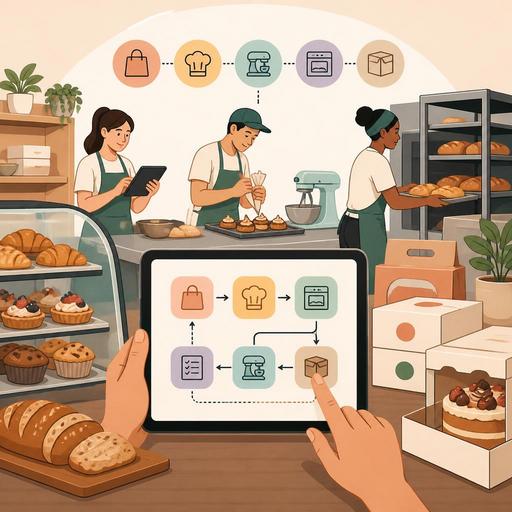
A Guide to Pre-Order Production Planning in Patisseries and Bakeries
Prep optimization through a pre-order system in patisseries and bakeries does not mean merely taking orders early; it is a business model that makes the production flow, the distribution of staff tasks, stock usage, and delivery times more predictable. Especially for businesses that produce fresh daily, pre-ordering gives clearer answers to critical questions such as "how much product should go out, which tray should go into the oven at which time, and which order should move straight from the packaging line rather than from the display case?"
One of the biggest challenges in patisserie and bakery businesses is that demand fluctuates within the same day. Morning commute hours, the lunch break, school dismissal, the weekend breakfast traffic, special-occasion cakes, office treats, and bulk orders for pastries and pies all load onto the same kitchen capacity. A pre-order system does not eliminate this load; but it makes it plannable. This way the business can strike a more controlled balance between overproduction and underproduction.
Which problem does a pre-order system solve in patisseries and bakeries?
Many businesses limit pre-ordering to birthday cakes or custom-designed products only. Yet simit, rolls, sandwiches, a box of croissants, a meeting treat, a breakfast package, gluten-free products, an iftar box, or corporate bulk purchases are also suited to the pre-order model. The real benefit here is not so much that the order is taken early, but that prep decisions are made based on data.
For example, a 20-person office pastry order for 8:30 a.m. delivery and an order for 2 boutique cakes for 11:00 a.m. delivery may fall on the same production day, yet their prep logic differs. The first requires an early dough plan, tray capacity, and a hot delivery; while the second demands decoration, the cold chain, and time sensitivity. If orders are not gathered in a single place, this difference is missed and the kitchen works under last-minute pressure.
When the pre-order infrastructure is set up correctly, the business sees improvement in the following areas:
- The production sequence becomes clearer.
- Ingredient prep is not left to the last minute.
- The staff shift takes shape according to order intensity.
- Delivery times are managed more realistically.
- Customer communication is handled with less phone traffic.
How should the pre-order flow be designed for prep optimization?
For a pre-order system to work, simply opening an order form is not enough. Every step from receiving the order to delivering it must be defined according to the business's realities. The healthiest structure for patisseries and bakeries is to set product-based rules.
1. Classify products by prep time
Not all products are managed with the same operational logic. Croissants, bread, layer cakes, dry pastries, and bulk breakfast orders have different prep times. For this reason, it is useful to separate the products on the menu with the following logic:
- Standard products that can be prepared the same day
- Products that require at least a few hours of planning in advance
- Special productions that must be ordered a day in advance
- Products that involve personalization
This classification is the foundation for offering the customer a realistic delivery time. Otherwise, the system takes the order, while the kitchen gets squeezed in an unplanned way trying to fulfill it.
2. Open delivery and pickup times according to capacity
Many businesses try to create customer satisfaction with a "delivery at any time you want" approach; but this method disrupts operations during busy hours. A more accurate approach is to define specific delivery time slots. For example, slots such as 8:00-9:00, 9:00-10:00, or 2:00-4:00 p.m. make the production and packaging plan more predictable.
In businesses that use digital order management, this slot logic is especially valuable. Because orders are seen on a single panel instead of being scattered across phone notes, and the kitchen team knows in advance how many orders will go out in each time band. This makes it possible to manage prep intensity not by gut feeling, but with a visible workload.
3. Standardize order notes
Notes such as "to be inscribed on top," "no fondant," "no sesame," "packaged sliced," and "service time 10:15" are critical details in patisserie and bakery operations. However, when the free-text field is left uncontrolled, the risk of error grows. For this reason, frequently received requests should be turned into selectable options.
For example, if in a cake order the size, filling, delivery date, candle request, inscription request, and allergen information are taken in separate fields, both the customer is guided more clearly and the production team does not struggle with missing information.
How is pre-order data turned into a production, stock, and staff plan?
This is the point that truly makes the difference. Collecting orders is not an advantage on its own; you need to turn that data into a production decision. Since patisseries and bakeries produce fresh every day, poor planning translates directly into waste, a loss of labor, or customer dissatisfaction.
Consider a concrete example: on Friday evening, the system shows a high number of breakfast boxes, mini-sandwich trays, and roll-and-pastry orders for Saturday morning. Thanks to this data, the business can:
- Increase the dough preparation the night before.
- Add extra staff to the morning shift.
- Set aside packaging materials in advance.
- Reduce display-case production in a controlled way to lower the risk of excess product.
Similarly, pre-order data plays a critical role on special occasions. When it becomes clear which products come to the fore during periods such as Mother's Day, Valentine's Day, New Year's, school events, or corporate meetings, the business determines both menu visibility and production priority more deliberately.
At this point, the ability of digital tools such as the QR menu, order management, and POS integration to talk to one another becomes important. When it can be seen at a glance which channel an order came from, which products are clustering, at which hours pile-ups occur, and which products are open to cancellation or revision, prep optimization ceases to be a daily reflex and turns into an orderly system.
Ways to discipline operations without spoiling the customer experience
When setting up a pre-order system, some businesses act too rigidly and lose the customer, while others act too flexibly and lock up the kitchen. The balanced model is the one that makes the rule not invisible but understandable.
- Clearly state the appropriate prep time for each product.
- Clarify the early-order advantage on busy days.
- Limit delivery times according to capacity.
- Standardize the post-order confirmation message.
- Differentiate change and cancellation conditions by product type.
For example, a standard cake and a custom-designed cake should not have the same cancellation rule. A bulk pie order and a product selected and set aside from the display case should also not be managed in the same process. If the customer clearly sees the rules at the time of ordering, the friction that arises later decreases.
Moreover, when the business presents clear use cases on its social media accounts and web order flow, such as "meeting treats delivered tomorrow morning," "special-occasion boxes," and "corporate breakfast packages," it makes pre-ordering more understandable. The customer intuitively grasps what to order and how far in advance.
6 steps patisseries and bakeries can apply right away
If you are setting up a pre-order system from scratch or want to improve an existing structure, you can start with these steps:
- Label products by prep time. Separate them as same-day, next-day, and special production.
- Define delivery slots. Offer capacity-controlled time ranges instead of any hour.
- Structure order notes. Reduce free text and increase selectable fields.
- Create a busy-day calendar. Define different order rules for special occasions.
- Bring the kitchen and sales screen together on the same data. Provide centralized tracking instead of phone, DM, and register notes.
- Review weekly order patterns. Regularly monitor which product clusters on which day and at which hour.
In patisseries and bakeries, a pre-order system should be set up not just to take more orders, but to produce in a more controlled way. When designed correctly, this system brings order to the kitchen's rhythm, simplifies the staff's work, offers the customer a more reliable delivery experience, and reduces prep pressure in businesses that produce fresh daily.
Restomas offers digital solutions that help patisseries and bakeries manage their pre-order, menu management, and operational flow more neatly from a single center.
