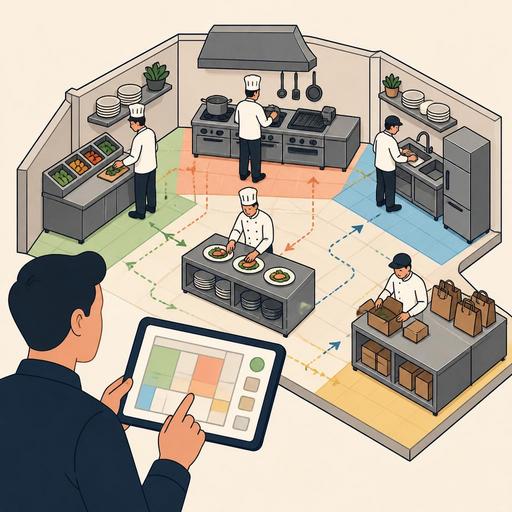
A Guide to Production Efficiency per Square Meter in Restaurant Kitchen Layout
Production efficiency per square meter in restaurant kitchen layout does not mean only using the space more densely; it means speeding up the order flow, reducing staff movement, clarifying equipment use, and managing capacity while preserving service quality. A kitchen can be large yet operate inefficiently; it can be small yet produce high output when planned correctly. For this reason, the topic is not only architectural but also a matter of operations, menu structure, and digital tracking.
Many businesses focus first on the equipment list when planning a kitchen. Yet the real question is this: how many orders can this space handle during busy hours, in what sequence, and with what staff movement? Efficiency per square meter comes into play precisely here. The goal is not to make every square meter generate sales; it is to ensure that prep, cooking, transit, packaging, and service flow work without blocking one another.
What Does Efficiency per Square Meter Measure?
Efficiency in a restaurant kitchen should not be reduced to a single number. Because the same square meter produces different results in different concepts. While the bar area may be critical in a coffee shop, the hot line and plating section are more decisive in an a la carte restaurant. For this reason, when evaluating efficiency per square meter, several indicators must be read together.
- Hourly order capacity: How many orders can a given kitchen area put out in a stable manner during peak hours?
- Output per station: How much production can the grill, fryer, oven, salad, or dessert line do within its own area?
- Staff movement intensity: Are employees taking more steps than necessary for a product, equipment, or service point?
- Waiting and overlap time: Do two people constantly crossing paths in the same aisle, or a pile-up at a single counter, lengthen service time?
- Menu-aligned use of space: Are the best-selling products prepared in the most accessible area of the kitchen?
For example, in a burger-focused business, if bread prep, protein cooking, garnish, and packaging are not close to one another, the time per order grows even if the square footage is sufficient. Similarly, in a cafe serving breakfast, having the egg station and the cold-prep counter at opposite ends creates a bottleneck, especially during the weekend rush.
For an Accurate Calculation, First Map the Flow
The biggest mistake in calculating efficiency per square meter is mistaking empty space for usable space. In reality, not every area in the kitchen produces equal value. Points such as the front of the cold room, the dishwashing transit line, the area around the service door, or the staff turning area are not active production areas but are essential for the flow. For this reason, you first need to see the real movement on the plan.
- Identify the order's entry point: Which channel does the order come from — dining room, takeaway, online order, or kiosk?
- Lay out the prep steps: Which stations does the product pass through, and which steps can be carried out simultaneously?
- Mark the bottleneck points: Where does waiting most often form — a single fryer, a narrow passage, or the plating table?
- Create a peak-hour scenario: With orders arriving at the same time, which station struggles first?
- Map the space to sales: Does the highest-volume product group really deserve the most space in the kitchen?
This exercise often produces surprising results. For example, an oven-product line that takes up a lot of space on the menu but sells little may be occupying unnecessarily large space in the kitchen. By contrast, the saucing and packaging table used constantly for takeaway may be squeezed into a temporary corner. In such a case, the problem is not the small size of the space but the wrong allocation of it.
The Most Common Efficiency Losses in Layout Planning
Restaurant owners often attribute kitchen inefficiency to a shortage of staff. Yet the problem frequently stems from the layout. The same team can work more fluidly with the right plan. The following mistakes in particular reduce production per square meter:
1. The distance between the best-selling product and its equipment
If the main equipment for the most frequently prepared product is far from the prep counter, employees move unnecessarily all day. This increases fatigue and raises the error rate.
2. Takeaway and dining-room orders overlapping on the same line
Having the product plated for the dining room meet the courier order in the same finishing area creates serious congestion, especially during the lunch and dinner peaks. If possible, the final-touch and handover areas should be separated.
3. Storage decisions overshadowing operations
Keeping dry-goods or packaging stock very close to the production line looks practical in the short term; but by narrowing the active prep area, it costs efficiency in the long run.
4. Failing to revise when the menu expands while the kitchen stays fixed
As the business grows, the menu becomes more complex, but the kitchen layout often stays the same as on day one. When new product categories are added, the roles of the stations should also be redefined.
Consider a concrete example: a cafe running breakfast, burgers, dessert, and takeaway all at once will inevitably have problems if it uses a single finishing counter. Breakfast plates demand a wide area, burger packaging demands fast flow, and dessert presentation requires delicate work. Gathering them all at the same point is not using the square footage efficiently — it is piling the confusion into the same area.
Practical Planning Decisions That Boost Efficiency
Good kitchen planning does not have to start with an expensive renovation. Most businesses first see significant improvements with small adjustments. The goal here is not to add more equipment, but to put the right equipment in the right place.
- Set up stations by product family: Sections such as salad, grill, fried food, beverages, and dessert should be positioned according to the order flow.
- Shorten the first-touch to last-touch distance: There should be no unnecessary roaming between the start of a product's prep and its final stage before service.
- Consider the packaging area separately: Especially in businesses with delivery volume, packaging should be a separate micro-station, not the tail end of the kitchen.
- Separate prep time and service time: If the area used for mise en place creates a bottleneck during busy service, make a time-based or space-based separation.
- Measure the transit aisles: Aisles where two people cannot pass safely and quickly create an invisible loss of capacity.
Here digital operational data provides a major advantage. Planning done without seeing which products peak at which hours, which orders come in together, and which product group tires the kitchen remains incomplete. Order management and menu performance data help you match the kitchen layout to the real pattern of use rather than to intuition.
How Is Efficiency per Square Meter Improved with Digital Data?
In modern restaurant management, the kitchen plan is not a document drawn once and left alone. As the menu changes, delivery channels increase, and the service type shifts, the kitchen must adapt accordingly. For this reason, it is important to update the efficiency calculation at regular intervals.
For example, thanks to a digital order flow, the following questions can be answered more clearly: which products pile up in the busiest 90 minutes? Which product group occupies the prep area the most? At which hours does takeaway put pressure on the dining room? This information affects not only the staff shift but also the counter layout and equipment priority.
When systems such as the QR menu, order management, and POS integration work together, the business begins to read not only the sales total but also the rhythm of operations. For example, by seeing products frequently ordered together you can bring the prep stations closer, remove from the menu products that see low demand but occupy a lot of space, or simplify the production line at certain hours. This way, efficiency per square meter ceases to be an abstract goal and becomes the measurable result of daily decisions.
Conclusion: The Goal Is Not a More Cramped Kitchen, but a Smarter One
Production efficiency per square meter in a restaurant kitchen is not about fitting more equipment into a smaller space. The real aim is to make the order flow seamless, use the staff's energy correctly, and align the menu structure with the kitchen's real capacity. If you can provide better service in the same space not with more effort but with clearer processes, then you have planned correctly.
Start not with a major renovation but by observing the kitchen flow: identify the best-selling products, the congested stations, the unnecessary steps, and the overlapping handover points. Then support this observation with digital order data. This way, you can prepare your kitchen not only for today's volume but also for your growing operation.
Restomas can help you place kitchen planning decisions on a more solid foundation by making order flow and menu data more visible.
