How Does Switching to QR Contactless Payment Pay for Itself Quickly in Restaurants?
QR contactless payment has become not just a new collection method in restaurants; it has turned into an operational decision that simplifies the service flow, speeds up table turnover, and reduces the micro-tasks on staff. Especially during busy service hours, small-seeming steps such as requesting the check, taking the POS device to the table, card approval, the receipt process, and returning to the cash register and kitchen add up and affect both the guest experience and team efficiency. That is why many business owners want to understand not how long it will take for the cost of switching to QR contactless payment to be recovered, but where and how it generates returns within daily operations.
The critical point here is not to read the topic solely through commissions or device cost. The real value emerges in operational details such as the time it takes to close the check, the repetitive time staff spend per table, the probability of errors in the order-and-check flow, and the guest's perception of waiting. In a well-designed system, the QR menu, order management, and payment flow are not disconnected from one another; they work as parts of a single service experience.
Why is QR contactless payment not just a payment step?
In many restaurants, payment is seen as a separate transaction that takes place at the end of the service process. Yet from the guest's perspective, the final minutes of the experience are among the most powerful moments that define the entire visit. Even if the meal went well, waiting for the check, waiting for the POS device to arrive, or experiencing confusion with a split check can lower satisfaction.
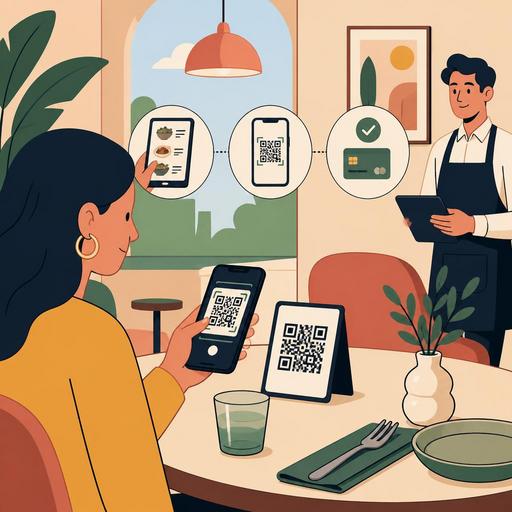
In a scenario using QR payment, the guest scans the code on the table, sees the check, reviews the items if needed, and completes the payment. The server's role does not disappear; on the contrary, they go from being the person carrying the payment to the person managing the experience. This change makes a difference especially in the following businesses:
- Restaurants aiming for fast table turnover during the lunch service
- Venues with a busy weekend evening service
- Businesses trying to manage a high number of tables with few staff
- Cafes and casual dining concepts where split-check requests come frequently
For example, imagine a server taking check requests from three tables at the same time during a crowded lunch service. Instead of going back and forth between the cash register and the table, allowing tables to close their own checks in a controlled way frees up time for the team to focus on their real job, that is, service quality. This looks small on paper; however, it is one of the areas where bottlenecks form most during busy hours.
At which operational points does the return on investment occur?
There is no single, universal answer to the question "how long until it pays off?" because the number of tables, the type of service, the staffing structure, and the existing technology infrastructure differ in every business. However, the areas where the return occurs are quite clear. When a restaurant owner starts to measure these areas, they see the impact of the investment more soundly.
1. Shortening the check-closing time
When the time between the guest requesting the check, staff noticing it, fetching the POS device, and completing the transaction shortens, the table becomes ready for a new service faster. Especially in businesses with customers waiting in line, this difference directly affects the revenue potential.
2. Reducing staff movement
If the server does not need to return to the cash register or search for a device for every payment, the team is interrupted less. This makes it easier to focus on more valuable tasks such as water follow-up, add-on suggestions, table cleaning, and greeting.
3. Reducing check errors and communication breakdowns
Seeing the check on an item-by-item basis, quickly resolving disputes about incorrect items, and clarifying split payments are all easier in a digital flow. A check seen on a screen rather than verbal confirmation reduces operational friction.
4. Increasing guest satisfaction
Some guests want speed, while others prefer minimal social contact during payment. QR contactless payment can meet both expectations. A guest who is not kept waiting perceives the experience as more fluid.
4 hours, 4 days, 4 weeks: What should a restaurant owner measure?
The way to make the fast-return idea in the title meaningful is not to expect a miracle the moment the system is set up; it is to track the right indicators from the very first moment. The following framework provides a practical starting point:
- The first 4 hours: Can the team use it without disrupting the flow? Can the guest open the check? Is there an extra transaction burden at the cash register?
- The first 4 days: Did the payment waiting time shorten during the busiest hours? Are servers making fewer trips to the cash register?
- The first 4 weeks: Is there a visible relief in table turnover, service quality, and the distribution of tasks within the shift?
What matters here is not the abstract feeling that "we installed technology"; it is to create a visible difference in the daily flow. For example, if a queue forms in front of the single register at a small cafe, QR payment can ease this queue. In a mid-sized restaurant, the real benefit may be the reduction in staff having to break away from the service area to close a check. Not every business gains from the same place; but with the right setup, a bottleneck should definitely be targeted.
The most common mistakes during the transition process
Setting up a QR payment solution can be quick technically; however, if the operational adoption process is not managed well, the team does not take ownership of the system. The most common mistake is thinking of payment independently of the menu and order flow. If the guest first sees the menu somewhere else, places the order on a different channel, and pays the check through a separate structure, the experience becomes fragmented.
For this reason, the healthiest approach for restaurants is to handle the digital menu, order management, and payment flow in an arrangement that talks to each other. The organic benefit of platforms like Restomas emerges precisely here: it becomes possible to show current products on the QR menu, reflect operational changes quickly, and make the payment experience a natural continuation of the service flow.
- Mistake 1: Rolling out the system to the field without training staff
- Mistake 2: Not providing enough guidance to the guest
- Mistake 3: Leaving the menu-price-check sync weak
- Mistake 4: Imposing the same usage scenario on all tables
- Mistake 5: Measuring success solely by the first-day usage rate
On the staff side, this approach works particularly well: "This system is not replacing you; it is taking you out of the payment-carrying task and opening up room for service quality." If the team feels the benefit in their daily workload, adaptation happens much faster.
Implementation plan: Clear steps for a smooth transition
An actionable plan for restaurant owners who want to make the switch to QR contactless payment efficient might look like this:
- Identify the bottleneck: Is the problem a register queue, late check closing, or staff fatigue?
- Segment the tables: Define different usage scenarios such as fast-consumption areas, family tables, and busy-hour tables.
- Match the menu and check flow: The guest should see the items on their check consistent with the products they saw on the screen.
- Hold a short shift training: The server, register, and manager should speak the same language.
- Observe in the field during the first week: Note the steps that generate the most questions and update the guidance.
- Track results with small metrics: Monitor indicators such as check-waiting complaints, register congestion, and table-closing time.
To give a concrete example, at a bistro with a busy evening service, the most common problem servers face may be multiple tables requesting the check at the same time. For this business, QR payment is a tool that preserves the service rhythm before it directly creates more sales. In another example, at a cafe that works mainly with coffee and desserts, if the congestion in front of the register disrupts the guest flow, the at-table payment experience can relieve the area. In other words, the return is related to how accurately you target the business's weakest point.
Conclusion: A fast return is possible with the right setup
QR contactless payment becomes meaningful when it is approached not as a "trendy" technology in restaurants but as an operational tool that improves the service flow. What determines the return is not only the setup cost; it is the shortening of the payment time, the more efficient use of staff, the more fluid experience the guest has, and the check closing with less friction.
For restaurant owners, the right question is this: "How many minutes, how many steps, and how many unnecessary waits will this system win back for us?" If you can produce clear answers to this question in the field, the payoff of the investment starts to become visible not in theory but in daily operations. Restomas can make this transition more manageable for businesses that want to simplify the QR menu, order flow, and digital restaurant experience under a single roof.
