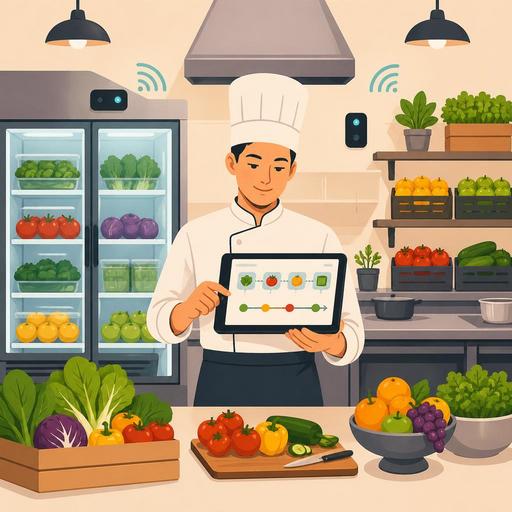
7 Digital Methods to Reduce Fruit and Vegetable Waste in Restaurants
Technological methods that reduce fruit and vegetable spoilage are becoming increasingly critical for keeping food costs under control, organizing the kitchen workflow, and delivering a more consistent guest experience in restaurants. Fresh products can rapidly lose value due to improper storage, irregular stock tracking, a flawed purchasing plan, and weak demand management on the menu. For this reason, the topic is not just about putting a thermometer in the storeroom; it is about making the entire process digitally visible, from purchasing to recipes, and from the menu to the daily production plan.
In many businesses, the problem arises not from a single big mistake but from the accumulation of small disconnects. The cold room temperature fluctuates briefly, it is not clearly marked which crate arrived first, the prep team chops based on guesswork, and slow-selling items on the menu cause the same ingredient to sit in storage for days. As a result, the amount of product thrown away increases. Yet with the right use of technology, it is possible to meaningfully reduce this loss.
1. Monitor temperature and humidity continuously, not manually
Although fruits and vegetables may not seem as sensitive as meat and dairy products, they are quickly affected by small deviations in storage conditions. Leafy products, fresh herbs, delicate fruits like strawberries, and cut vegetables, in particular, are defenseless against temperature instability. That is why writing down the temperature by hand twice a day is often not enough.
Here, the most effective approach is to use digital temperature and humidity monitoring systems. Thanks to sensors, the conditions in a cold room or refrigerator are monitored regularly; when limits are exceeded, a notification is sent to the responsible person. This way, instead of noticing after a product has spoiled, the condition that leads to spoilage is caught earlier.
Let's consider a concrete example: in a restaurant with strong side-dish, salad, and breakfast operations, lettuce, arugula, parsley, and fresh mint are used heavily. If the refrigerator door is opened and closed too much during service hours, there may be brief temperature spikes inside. Manual tracking can miss this; sensor-based monitoring, on the other hand, makes this fluctuation visible. The frequency of door openings, the shelf layout, or the product transfer flow can then be reorganized.
2. Reinforce the FIFO rule with labeling and digital stock logic
Many kitchens think they know the FIFO principle, that is, "first in, first out"; however, in practice, crates pile on top of one another, labels get smudged, and dates become invisible on prep containers. Technology here is not just about complex software. Even a simple but disciplined digital labeling system significantly reduces spoilage.
At product intake, the delivery date, opening date, target use-by date, and area of use should be clearly marked. When this data is matched with digital stock records, the team sees more clearly which product needs to be processed first. Confusion is reduced especially when there are batches of the same product arriving on different supply days.
- Make day-based distinctions with color-coded labels.
- Add not only the name but also the date and shift information to prepared-product containers.
- Enter stock intakes into the system the moment they are received; do not record them in bulk at the end of the day.
- Track slow-moving products separately in a weekly report.
For example, in a brunch business that uses avocado, if products at different ripeness levels are not marked separately, either the firm product is cut too early or the ripe product waits too long. Simple labeling and stock visibility make it easier to determine which batch is suitable for guacamole today and which is suitable for slicing tomorrow.
3. Stop excess prep with sales-data-driven prep planning
A significant portion of fruit and vegetable waste occurs not in storage but on the prep counter. Excess chopping, washing, or portioning done without knowing the daily sales rhythm leads to serious losses, especially in businesses dominated by salad bars, breakfast, and side dishes. For this reason, prep production should be managed with data, not "according to habit."
By looking at past sales, the day of the week, the weather, reservation density, and the campaign period, it is possible to plan the prep quantity more accurately. Here, a stronger forecast emerges when POS data, reservation flow, and order history are evaluated together.
For example, if bowl and salad sales are high during weekday lunch hours, while hot dishes come to the fore in the evening, then the prep of arugula, cherry tomatoes, cucumber, and fresh herbs can be split according to shifts. Instead of doing all the daily prep at once in the morning, dividing it into a first block and a second block lowers the spoilage risk.
Systems that provide digital order and sales visibility in restaurant management help the kitchen team answer the question "how much should we prepare?" more clearly. When menu performance and stock movement are seen side by side, the prep items that generate the most waste are identified more easily.
4. Evaluate menu engineering together with stock shelf life
Menu planning is often approached solely in terms of profitability and popularity. Yet in businesses that use fresh products, whether a dish stays on or is removed from the menu can directly affect the fruit and vegetable spoilage rate. Using the same ingredient strategically across multiple products is one of the most practical methods for extending stock shelf life.
For example, if fresh basil is used only in a single pasta dish and that product gets low sales, a significant portion of the basil can go to waste. However, if the same ingredient is also used in pizza, sandwiches, the soup of the day, or a special sauce, the rate of use increases. Similarly, sensitive products such as mushrooms, zucchini, lemon, parsley, mint, avocado, and red berries should be cross-used wisely within the menu.
Digital menu management provides a major advantage here. It is possible to quickly reduce the visibility of a slow-selling product, highlight the special of the day, update the recommendation areas according to the fresh stock on hand, and make controlled redirection before a product runs out. Instead of a structure that stays fixed for weeks on a printed menu, a more agile menu management reduces the spoilage risk.
- List the fresh products that spoil most often.
- Match all the recipes that these products appear in.
- Identify the ingredients tied to a single product.
- Increase the menu items that offer a cross-use opportunity.
- Make daily or weekly digital menu revisions.
5. Standardize the supply and intake process with photos and checklists
The source of spoilage is not always in-house processes. Sometimes the problem begins the moment the product enters the business. Crushed tomatoes, overripe bananas, dampened greens, bruised strawberries, or herbs that have sat too long already have a shortened shelf life when accepted into the kitchen. For this reason, the receiving process should be made more systematic.
The practical solution is to use digital checklists and, when necessary, photographed intake records. When appearance, firmness, smell, packaging condition, temperature, and delivery time are recorded in a standard way at product intake, both team discipline increases and supplier performance is monitored more objectively.
For example, if fruit quality varies from batch to batch at a cafe that makes smoothies and desserts, it is difficult to track which day's product spoils faster from verbal memory. Yet when delivery records are kept, problematic supply days or product groups are distinguished more clearly. This way, the purchasing decision is supported by data.
6. Make end-of-day waste logging mandatory and look for patterns
The most powerful way to reduce waste is to make it visible. Scattered observations like "some arugula wilted," "a few strawberries softened," or "there was leftover cut fruit" do not help on their own. However, if records are kept regularly, recurring patterns emerge: which shift over-preps, which product is left on hand on which day of the week, which menu item sells lower than expected?
At this point, the daily waste log should be short and practical. Instead of expecting long reports from the team, the product name, quantity, reason, and shift information are enough. After a few weeks, the picture becomes clear. Perhaps the problem is not storage but the habit of bulk purchasing at the start of the week. Perhaps products wear out before service because the salad station is kept too full. Perhaps a supporting ingredient waits longer than needed because of a product that is not highlighted on the digital menu.
Technology increases decision speed here. When orders, stock, reservations, and menu movements are seen together, spoilage ceases to be merely a kitchen problem; it turns into a manageable operational indicator.
Conclusion: Reducing spoilage requires a connected system, not a single device
There is no single miracle device for reducing fruit and vegetable spoilage. What truly makes the difference is temperature monitoring, stock rotation, prep planning, menu flexibility, supply intake, and waste analysis working in connection with one another. For restaurant owners, the most correct approach is to first identify the 5 product groups that generate the most waste, then digitalize the purchasing-storage-preparation-sales cycle of these products step by step.
Even small improvements produce serious results when they accumulate: fresher service, more controlled costs, fewer emergency purchases, a more organized kitchen workflow, and a more predictable operation. Solutions that ease restaurant digitalization like Restomas can make implementing these improvements more practical by making menu and operational data more visible.
