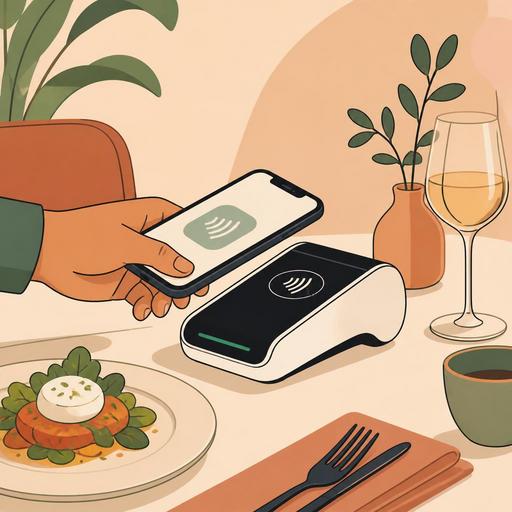
The Wallet-Free Payment Era in Restaurants with Apple Pay and Google Pay
The use of Apple Pay and Google Pay in restaurants is not just about adding a new payment option; it is part of a broader transformation in which customer expectations, the service flow, and register processes are changing. Today, many guests arrive at a venue without carrying a physical wallet, review their order from their phone, and want to settle the bill with their phone as well. This change has become more visible especially in quick-service restaurants, coffee chains, businesses with heavy lunch traffic, and a new generation of customers who value a contactless experience.
However, the matter is not about saying yes to the question "Do you accept Apple Pay?" The real point is how you correctly fit these payment methods into the restaurant's daily operations. As the payment step speeds up, order accuracy, table management, POS integration, the tipping flow, and staff guidance must also be reconsidered. Otherwise the technology stays in the display window while operations continue with old habits.
Why are Apple Pay and Google Pay changing the restaurant experience?
Apple Pay and Google Pay let the customer pay without taking out a card, often without entering a PIN, and with less need for physical contact. From the restaurant's perspective, the most important effect of this is reducing friction at the moment of payment. Especially in cafes and quick-service businesses where queues form at the register, even a few small delays magnify the perception of a queue. Mobile-wallet payment can make the flow smoother at this point.
In fine-dining or service-focused restaurants, the effect is a bit different. Here, comfort and the perception of modernity come to the fore as much as speed. When the bill arrives and the customer does not search for a wallet, does not hand over a card, and completes the transaction in a short time, it improves the final impression formed at the end of the experience. In hospitality, the final moment of contact is very critical; a pleasant dinner can be overshadowed by a slow, confusing payment process.
Let's consider a concrete example: a bowl restaurant or coffee shop busy during lunch hours may be managing order-taking time well. But if the payment terminal is slow, customers are waiting to find their card, or the cashier is giving repeated guidance, the bottleneck forms not in ordering but in collection. Accepting a mobile wallet does not solve this bottleneck on its own, but it can significantly reduce it.
For which restaurant types is it a more critical need?
The same priority level does not apply to every business. While accepting Apple Pay and Google Pay turns directly into a competitive advantage in some concepts, it is at the level of a basic expectation in others. When deciding, the customer profile, the service model, and the number of payment points should be evaluated together.
- Quick-service restaurants: Queue management and transaction speed are the most critical areas.
- Cafes: In single-item, low-basket, frequently repeated purchases, payment comfort affects loyalty.
- Brands targeting a young audience: Mobile-first users expect contactless payment.
- Grab-and-go and self-service points: When the flow at the register is disrupted, the entire operation slows down.
- Restaurants inside hotels or premium businesses: The experience standard and the perception of modern service matter.
By contrast, the topic is not unimportant for a neighborhood restaurant or a traditional family business either, because customer behavior is changing not only in big cities or chains. Especially in areas that host tourists, are near office districts, or have a high density of young professionals, mobile payment is no longer an "extra" but an expected service.
Accepting payment is not enough: how should it be integrated into operations?
The most common mistake is to see the new payment method merely as a terminal feature. Yet for a successful implementation, the front register, table service, the QR menu, the order flow, and reporting must be considered together. When a customer wants to pay with Apple Pay or Google Pay, the staff must not hesitate, must know which terminal is suitable, and must guide the transaction naturally.
A practical checklist is useful for restaurant managers here:
- Verify the POS and payment infrastructure: Do the current devices truly support mobile wallets without issues?
- Train staff with short scenarios: Standardize clear guidance such as "contactless payment is done here" and "the tip is selected on this screen."
- Review the payment points: Will collection be smoother at the register, at the table, or via QR?
- Connect the menu and order flow: Let the order coming from the digital menu and the payment record be tracked with the same operational visibility.
- Test the refund and cancellation processes: Does the team know what to do when a problem arises?
For example, in a restaurant that uses a QR menu, the customer first reviews the menu from their phone, conveys the order to the server or creates it digitally, and then wants to close the bill with an experience that is also close to their phone. If the menu is digital but the payment is disconnected in this flow, the user experience fragments. This is why, in systems focused on restaurant digitalization like Restomas, it is important to address menu management, the order flow, and operational visibility together.
The invisible details in the customer experience
Mobile-wallet payments are often summarized as "fast"; but the value the customer feels is broader. First, the customer feels a sense of control. The phone is already in their hand; they do not search for a card and do not have to carry a wallet. Second, especially in crowded environments, the transaction is completed with fewer interruptions. Third, for foreign guests, a familiar payment experience is offered.
The point to watch here is that the technology should not pressure the customer. Some businesses, while promoting the new payment method, push the classic card or cash option into the background and create unnecessary tension. The right approach is to offer options and design a smooth experience according to the customer's preference.
Another invisible detail is the tipping process. In restaurants that take payment at the table, how the digital payment screen presents the tip selection matters. At this stage, staff should be able to guide the customer in a natural and professional manner without pressuring them. Otherwise the advantage of fast payment can turn into an uncomfortable final moment of contact.
A clear action plan for restaurant owners
If you are thinking of moving to accepting Apple Pay and Google Pay, evaluate the matter not just as a technology investment but as a service-design decision. The following steps give a sounder result in practice:
- Profile your customers: Are young professionals, tourists, office workers, or students predominant?
- Observe the bottleneck at the moment of payment: Is the problem really in ordering, at the register, or at the table?
- Run a single-shift pilot: Track mobile-payment usage and staff adaptation at certain hours.
- Optimize terminal placement: Device access becomes critical, especially during peak hours.
- Align the QR menu and order flow: Do not let the customer's digital journey be fragmented.
- Give the team short, repeatable training: Use real service scenarios instead of long presentations.
The most accurate question for business owners is this: not "Do we accept this payment method?" but "How frictionless can we make the customer's moment of payment?" If you can give an operational answer to this question, mobile wallets produce real value.
In the coming period, wallet-free customer behavior will become even more visible in restaurants. Businesses that prepare for this transformation early and systematically will not just look modern; they will simplify the service flow, make the team's job easier, and strengthen the customer's final impression. Restomas can offer a simple starting point for restaurants that want to build this digital flow more holistically on the menu, order, and operations side.