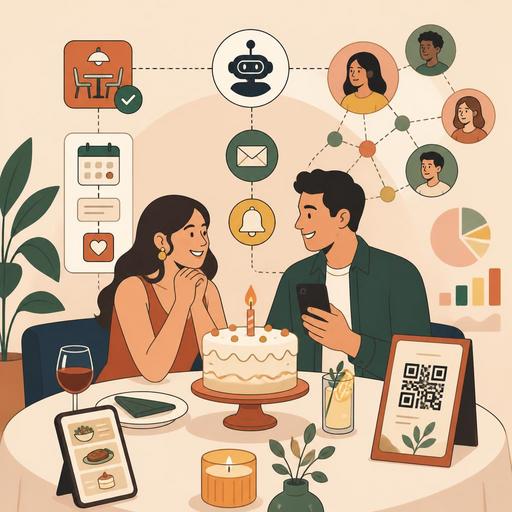
Automating Birthday Campaigns and ROI in Restaurants
Automating birthday campaigns is, for restaurants, not just about sending a kind celebratory message. When designed correctly, this approach becomes a system that brings the guest back to the table, grows the basket, and makes visible where the marketing budget is working. Especially when digital touchpoints such as reservations, the QR menu, order history, and customer data come together, birthday communication can move beyond a one-time promotion and turn into a measurable revenue channel.
Many businesses still run birthday campaigns manually: an Excel list, sending messages one by one, the same discount for everyone, and afterward an inability to clearly answer the question "did it work?" Yet on the restaurant side, the real value lies in automating to whom, when, and which offer is sent. This way both the team's workload decreases and the campaign's return on investment is tracked more soundly.
Why should a birthday campaign be managed systematically rather than manually?
A birthday is one of the rare moments when a customer expects personal attention from your brand. If this expectation is met correctly, the customer experience strengthens; if it is designed poorly, the campaign turns into an unnecessary discount cost. The problem usually arises not in the offer itself but in the targeting. Giving the same coupon to every customer seems easy, but a regular guest and a user who placed a single order months ago do not have the same motivation.
The first advantage of systematic management is timing. Will you send the message on the birthday, a day before, or during the birthday week? The second advantage is the offer structure. Instead of offering a percentage discount to everyone, giving a free dessert to some segments, an advantage on a menu for two to others, and reservation priority to others can produce more controlled results. The third advantage is measurement: how many people opened the campaign, how many made a reservation, how many used the coupon, did the average check rise?
Digital infrastructure is decisive at this point in restaurants. If customer data is collected from reservations, the loyalty program, online orders, or QR menu interactions, birthday campaigns become smarter. Seeing the data in one place reduces the need for manual list-merging and standardizes communication flows.
For ROI, first define the right goal
Measuring a birthday campaign's success only by "how many coupons were used" falls short. For an ROI assessment, the business must first determine its real goal. In some restaurants the aim is to fill empty weekday tables. In others, converting a new customer into a repeat visit is the priority. In some premium businesses, the aim is to create an experience that feels special without giving a high discount.
For this reason, the campaign goal can be clarified with one of the following frames:
- Repeat visit: Win back a customer who has not come in the last 90 days
- Higher check: Encourage a group reservation or add-on sales through the celebration
- Filling low-intensity hours: Limit the campaign to certain days and times
- Enriching customer data: Collect data such as birth date, preferences, and communication consent
Let's consider a concrete example: when a neighborhood cafe sends "a percentage discount special to your birthday" to everyone, it may also be giving an unnecessary discount to loyal customers who would come anyway. A smarter design, by contrast, can offer a coffee-and-dessert pairing to customers who have not come in the last two months, while giving frequent customers the chance to try the new-season dessert for free. In the first scenario, cost control is weak; in the second, the offer is shaped according to behavior.
In the ROI calculation, it is healthier to look at the following questions together: How much additional revenue arose because of the campaign? What is the promotion cost given for this revenue? Did the time spent on sending messages and team operations decrease? Did a second visit occur within 30 days after the campaign? Especially for businesses that use automation, the reduction in the staff's manual tracking workload is also an invisible but important gain.
Without segmentation, a birthday campaign easily becomes inefficient
The most common mistake in birthday campaigns is seeing the customer as a single type. Yet in restaurants, segmentation can be built with very practical data. There is no need for a complex data-science project; organized and usable customer fields are often enough.
Basic segments you can use
- By visit frequency: Frequent, occasional, long-absent
- By spending level: High, medium, low average check
- By channel preference: Dine-in, takeaway, reservation-based
- By product interest: Breakfast customer, evening-service customer, dessert- or beverage-focused customer
- By branch: Customers who regularly come to a particular location
For example, the birthday offers of a steakhouse and a third-wave coffee shop should not be the same. For the steakhouse, a reservation-focused campaign that triggers a dinner for two may make sense. For the coffee shop, a "bring a friend" structure or a special beverage campaign usable during the birthday week may work better.
Another benefit of segmentation is protecting the margin. Instead of giving a high-spending, loyal customer a direct high discount, offering a small experience-focused gesture is often more appropriate. By contrast, a long-lost customer may need a stronger incentive. This way the promotion cost is not distributed the same across every segment.
In restaurant management, if reservation data, order history, and menu preferences can be seen in the same flow, defining these segments becomes easier. Especially businesses that use a digital menu and order management can more easily analyze which products were chosen more after the campaign.
How should you set up the automation flow?
An effective birthday automation consists not of a single message but of a flow. The aim is not to overwhelm the customer but to remind them at the right moment and make the action easy.
- Data collection: Collect the birth date and communication consent through the reservation form, membership, Wi-Fi login, loyalty registration, or the post-payment feedback screen.
- Segment definition: Tag the customer by visit frequency, spending, and channel.
- Offer matching: Define a suitable offer type for each segment, not a single campaign.
- Timing: Plan the message before the birthday, on the day, and, if needed, as a final reminder.
- Action point: Add a clear next step, such as a reservation link, QR-menu redirect, or a campaign code.
- Measurement: Track usage, reservations, average check, and repeat-visit data with a campaign tag.
The important point here is to make the campaign compatible with operations. For example, if the kitchen and service team do not know the campaign conditions, confusion arises at the table. If campaign visibility can be provided through POS integration or order notes, the risk of error drops on both the register and the service side. Likewise, having a "birthday visit" tag in the reservation system helps the team design the table experience more attentively.
A good automation does not just send a marketing message; it also supports in-house preparation. Seeing a team unaware of the campaign when the guest arrives diminishes the impact of the entire investment.
Which offer models work more soundly in restaurants?
The best offer is not the biggest discount. A sound offer is one that drives the customer to act without harming profitability. Some models commonly used in restaurants produce a more balanced result:
- A free complementary product: Items with manageable margins such as dessert, coffee, or a mocktail
- An advantage conditional on a certain basket: A special treat with the purchase of a main course or a menu for two
- A reservation-focused offer: A campaign valid only on certain days or times
- Birthday-week usage: A chance to balance operations without squeezing into a single day
A concrete example: if a brunch-focused business leaves its birthday offer open on Saturday, when the weekend is already full, it can create an unnecessary discount. Instead, offering a reservation advantage valid on weekdays is more rational. In a restaurant with strong evening service but weak lunch service, the campaign can be designed to support low-intensity time slots.
The offer copy also matters. Instead of "percentage discount" language, wording such as "a treat to accompany your celebration" or "a reservation-only experience" is more suitable, especially for businesses that want to protect their brand perception. In the premium segment, this difference is even more pronounced.
Which metrics should you look at when evaluating campaign performance?
To understand the real value of a birthday campaign, do not focus only on the instant usage rate. Build a broader frame:
- Message-to-reservation conversion
- Average check on campaign-used bills
- Coupon or offer usage rate
- Repeat visit within 30-60 days after the campaign
- Which segment works more efficiently
- Which offer type protects the margin better
When these data come together, you can clearly answer the following questions: Was it necessary to give a discount to frequent customers? Did a takeaway customer convert to a dining-room reservation? Did the birthday-week design produce a more balanced result than the single-day design? This is exactly where the real power of automation emerges: building a learning system.
In conclusion, automating birthday campaigns is a powerful step that both personalizes the customer experience in restaurants and makes the marketing investment measurable. When the right data collection, clear segmentation, an operations-aligned flow, and regular performance tracking come together, campaigns rise above the "same coupon for everyone" level and turn into a real revenue-optimization tool.
Digital restaurant infrastructures like Restomas can help you set up such campaigns with more control by managing reservation, order, and customer data more systematically.
