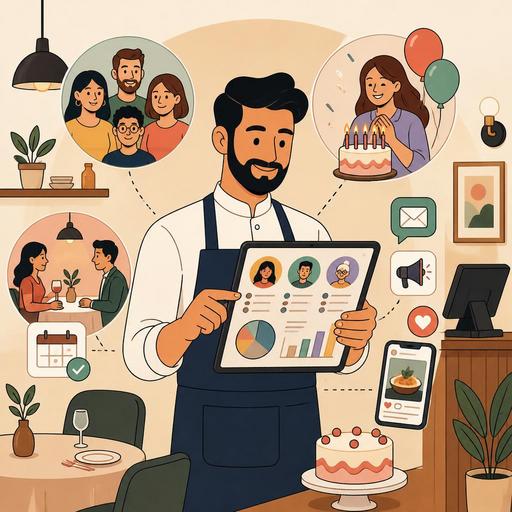
A Guide to Birthday Campaign Automation and ROI in Restaurants
Birthday campaign automation in restaurants, when set up correctly, is about more than just sending a celebratory message. The real value emerges when the right offer reaches the right customer, on the right channel, at the right time. This allows businesses both to increase the likelihood of a repeat visit and to build a more measurable marketing structure by keeping campaign costs under control. Especially for restaurants that evaluate data such as reservations, the QR menu, order history, and customer notes together, birthday campaigns can turn into a powerful revenue and loyalty tool.
Why are birthday campaigns still a powerful restaurant marketing tool?
A birthday is one of the moments when a customer is most open to receiving communication. A standard discount message is often easily forgotten; but an offer prepared for a personal day captures higher attention. From a restaurant's perspective, the advantage of this campaign is that, instead of trying to create demand from scratch, it makes use of a moment where the emotional bond is already strong.
The critical point here is not to send the campaign to everyone in the same way. For example, the offer presented to a frequent customer should not be the same as the offer sent to a customer who has not visited in a long time. Likewise, birthday triggers work differently for a family restaurant, a breakfast venue, a fine-dining business, or a quick-service concept. While group reservations stand out in a family restaurant, a celebration with a group of friends or a special-drink offer may make more sense at a third-wave coffee shop.
A well-designed birthday automation serves three goals:
- Triggering a repeat visit
- Raising the average check
- Dividing customer data into more meaningful segments
Which data should be collected for a successful automation?
The performance of a birthday campaign depends, before the campaign copy, on data quality. The mistake many restaurants make is simply taking the birth date and sending everyone the same coupon. Yet for deeper segmentation, the following fields are far more valuable:
- Last visit date: a customer who came recently and one who has been unseen for six months should be handled differently.
- Visit frequency: a thank-you-focused offer is more suitable for a regular customer, and a win-back-focused offer for an infrequent one.
- Average spending level: sending low-perception campaigns to a high-spending customer can have the opposite effect.
- Reservation habit: a celebration package or group-reservation incentive makes sense for customers who book tables in advance.
- Product preferences: information on a preference for dessert, coffee, cocktails, breakfast, or main dishes personalizes the campaign.
- Communication channel consent: a channel preference such as SMS, email, or WhatsApp directly affects performance.
If this data is scattered across different systems, campaign management becomes harder. A digital structure where the reservation flow, order history, and customer notes can be seen in one place makes it easier for the automation to actually work. This is exactly where the practical benefit of digitalization in restaurants becomes visible: the team focuses on action instead of preparing manual lists.
How do you segment? Why is the same offer for every customer wrong?
Segmentation is the main factor that determines whether a birthday campaign will be profitable. Opening the same campaign to everyone looks easy; but it can produce results such as distributing unnecessary discounts, straining operations during busy hours, and weakening brand perception.
1. Loyal customers
For customers who come more than once a month or create regular reservations, offers that make them feel special are more effective than aggressive discounts. For example, advantages such as a free dessert, a celebration drink, or priority reservation strain the margin less. In this segment, the aim is to support the already-strong bond with a visible gesture.
2. Dormant customers
For customers who have not come in a long time, the birthday is a win-back opportunity. Here the offer can be a bit stronger; but the expiration date must be clear. For example, campaigns that begin before the birthday and run for a short time push the undecided customer to action more easily.
3. Guests with high spending potential
For this group, experience-focused communication is more suitable than low-budget coupon language. Frameworks such as a chef's recommendation, a special table note, a tasting-menu pairing, or a celebration reservation provide more accurate positioning.
4. Customers with a high likelihood of bringing a group
Birthday celebrations in particular are not single-person visits. Group-focused offers can be presented to customers who have previously made large reservations or are frequently seen in a family concept. For example, options such as a shareable dessert for a certain number of people, a celebration presentation, or table priority at reservation are valuable.
You can set up the segmentation logic with a simple flow:
- Identify customers whose birthday is approaching.
- Divide them into clusters based on last visit and frequency.
- Customize the offer by average spending and preference category.
- Make the channel choice according to consent status.
- Measure the campaign through reservation and order outcomes.
How is ROI measured? Looking only at the number of coupons used is not enough
To understand the success of a birthday campaign, looking only at how many people opened the message or used the coupon falls short. The real question restaurant owners should ask is this: Did this campaign create additional revenue, a repeat visit, or a higher basket?
The following indicators are useful in measuring ROI:
- Campaign usage rate: how many of those who received the message made a reservation or placed an order?
- Incremental revenue impact: what is the total spending of the visits that came through the campaign?
- Discount cost: what did the comp, discount, or advantage given cost the business?
- Basket difference: is the average check of customers who came via the birthday campaign different from regular visits?
- Second-visit impact: did the customer return after the campaign?
Consider a concrete example: a restaurant sends a free dessert to loyal customers, and a limited-time special offer usable with a reservation to customers who have not come in a long time. When the conversion of the two segments is tracked separately, perhaps the free-dessert segment provides higher satisfaction at a lower cost, while the win-back segment creates fewer but higher-check reservations. This very distinction shows you where you should allocate budget in your next campaigns.
For this reason, it is important to connect campaign codes, reservation notes, and order results on the POS side to one another. When the data is seen on a single screen, it becomes clearer which segment is actually profitable.
How do you design a birthday campaign that works without disrupting operations?
A good campaign is not only one that brings sales, but also one that preserves the service flow. Birthday offers can create pressure especially on evening density, weekend reservations, and kitchen capacity. That is why the campaign design must be considered together with operations.
- Set a date window: the offer may be valid only on less busy days.
- Add a reservation requirement: this makes table planning easier.
- Put product-based limits: instead of a campaign open to every menu item, select certain product groups.
- Differentiate by location: in multi-location structures, each location's density is not the same.
- Inform staff in advance: the server and register team must clearly know the campaign conditions.
For example, a brunch-focused cafe can fill empty capacity by directing the birthday offer to weekday breakfast hours. A restaurant that is already full during evening service, on the other hand, can design its birthday communication around reservation priority or a celebration comp. This way, the campaign creates value without generating discount pressure.
An actionable 30-day action plan
You do not need a large marketing team to launch birthday campaign automation. A small but disciplined design is enough.
- Week one: review your customer data; clean up birth date, communication consent, visit frequency, and spending information.
- Week two: create at least three segments: loyal, dormant, and high-spending-potential customers.
- Week three: write a separate offer and message copy for each segment. Clarify the reservation requirement and the validity days.
- Week four: test the campaign on a small group of customers; track the reservation, usage, and check impact.
In this process, your goal is not to run a perfect campaign in one go, but to build a system that learns. As you see which offer works in which segment, the automation becomes smarter. When the QR menu, reservation management, order data, and customer history are evaluated together, birthday campaigns cease to be a simple discount; they turn into a measurable, personalized, and operations-friendly growth tool.
Restomas can help businesses that want to manage customer data, the reservation flow, and digital restaurant operations in a more organized way make these kinds of campaigns more sustainable.
