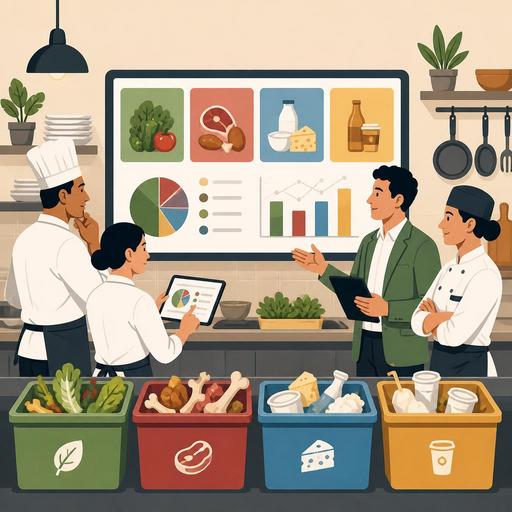
Making Losses Visible in Restaurants with Category-Based Waste Analysis
Category-based waste analysis in restaurants is far more valuable than seeing the total loss as a single figure; because the real problem is often hidden not in the total waste, but in which product group, which shift, and which process the loss occurs. When categories such as meat, dairy, greens, baked goods, sauces, beverages, or desserts aren't examined separately, the business is slow to notice problems that are high-cost but growing silently. For this reason, you need to treat waste not just as a kitchen error, but as the shared output of purchasing, storage, preparation, portioning, service, and menu planning.
In many businesses there's the information that “there's waste,” but no clear answer to the question “in which category, why, and how often?” Yet a category-based approach makes the loss visible and moves the team's discussion from abstract opinions to concrete actions. This way, you can more healthily manage not just cost, but also product standards, stock accuracy, and the guest experience.
Why is tracking waste by category more accurate than by total?
The total waste rate gives the business a general alarm; but what improves the operation is the level of detail. For example, within the same day you might have both portion overruns on meat products and spoilage in greens. Both are waste, but the solutions are completely different. One requires recipe standards and portion control, while for the other you need to review purchasing frequency, storage temperature, or the preparation plan.
Category-based analysis provides the following advantages:
- It highlights high-cost products: Especially with products like red meat, seafood, coffee beans, imported beverages, or specialty cheeses, even small deviations can create a serious impact.
- It separates the cause of loss: Spoilage, wrong preparation, overproduction, wrong portioning, returns, or recording errors don't all get lost under a single heading.
- It shows shift and station differences: Performance differences between the prep kitchen, the hot station, the bar, or the takeaway line become visible.
- It supports menu decisions: Products that regularly generate waste provide data for questions like whether they should stay on the menu, whether the recipe should change, or whether the prep model should be revised.
For example, if waste is high in milk-based drinks at a café, the problem isn't just that “milk is expensive.” The demand for large-size drinks may not match the standard pitcher in use, the frothing technique may vary across barista training, or the wrong gram weight may be used during peak hours. Similarly, if greens used as a garnish in a restaurant frequently end up in the trash, the main problem may not be supply but a usage imbalance in the menu.
Which category breakdown gives restaurants the most functional result?
When doing waste analysis, very general classes are inadequate, while overly detailed classes become unsustainable. The best approach is to build a category structure that combines purchasing logic with the production flow. Every business's menu is different; but for most restaurants, the breakdown below is functional:
- Main proteins: red meat, chicken, fish, seafood
- Dairy and breakfast products: milk, cream, cheese, yogurt, eggs
- Vegetables and greens: leafy products, fresh herbs, the tomato group, garnish vegetables
- Dry goods and basic production: legumes, rice, pasta, flour-based products
- Sauces and prep items: daily-made sauces, marinades, base mixes
- Dessert and patisserie products: daily production, losses from slicing and presentation
- Bar and beverages: alcoholic drinks, coffee, syrups, soft drinks, ice, garnish fruit
Under these categories, it's useful to also tag the causes of waste separately. For example: spoilage, preparation waste, portion overrun, customer return, wrong order, breakage/spillage, count discrepancy. This way, you produce regular answers not just to “what was lost?” but also to “why was it lost?”
Here, digital tracking makes an important difference. When the QR menu, order flow, kitchen production, and stock movements are kept disconnected, the waste record often relies on remembering after the fact. By contrast, when product, recipe, and sales data are monitored together, you see earlier how fast each category is consumed and where the deviation begins.
How do you set up category-based waste analysis step by step?
For the analysis to work, you don't need a complex system, but consistent recording discipline. To start, the following steps are enough:
- Set the first 4-week baseline recording period. Record every instance of waste instantly and by category. A “we'll tally it later” approach corrupts the data.
- Define standard waste causes. The team must stop everyone using different phrasing; for example, instead of “spoiled,” “went off,” or “left over,” use a shared cause list.
- Clarify the recipes. If the portion standard is unclear, waste and overuse get mixed up with each other.
- Add shift and station information. At which time window or with which team the same product produces more loss is a critical finding.
- Compare with sales. Separate high-selling, low-waste products from low-selling products that create high preparation loss.
- Do a short weekly review. Instead of waiting a month, spot the first deviations in a weekly meeting.
Let's consider a concrete example: a grilled-chicken salad is in high demand at lunch service. But in the chicken category, preparation- and portion-related waste is rising. At the end of the review, two problems may emerge: the chicken is being overcooked before the rush, or the service team is plating by eye instead of using the standard gram weight. If waste is also high in the greens category for the same product, this time the issue of the salad base being over-prepared in advance comes up. A single product reveals two separate operational problems through two different categories.
What decisions turn waste data into action?
Waste analysis is only valuable when it produces decisions. For restaurant owners and managers, the most effective actions generally cluster in the following areas:
1. Fixing the purchasing and supply plan
If the loss is caused by spoilage, the problem often starts not in the kitchen but in the order quantity or the delivery rhythm. Smaller but more frequent purchasing can lower waste in some categories. This approach is especially effective for fresh herbs, greens, seafood, and patisserie products.
2. Adjusting the prep amount to the sales rhythm
If the daily preparation amount is disconnected from the real sales pace, a “let's have it ready” mentality creates unnecessary loss. Matching the prep plan to past sales is important, especially for sauces, garnishes, breakfast items, and desserts.
3. Making recipe and portion standards visible
A recipe written on paper but not applied on the ground inflates waste. A kitchen screen, digital recipe viewing, or station-based preparation notes can reduce non-standard usage.
4. Reevaluating low-efficiency products on the menu
Some products may look like sales draws but constantly generate waste due to production complexity, low turnover, or a many-component structure. In this case, the product doesn't have to be removed entirely; options like reducing the portion, simplifying the contents, or offering it only at certain hours can be considered.
5. Doing team training with data, not assumptions
Instead of saying “be more careful,” you need to go after whichever error recurs in whichever category. Training such as pour standards for the bar team, trim usage in the kitchen, and preventing wrong orders in service should be targeted with data.
Why does digital visibility make a difference in waste management?
Waste often looks like a stock problem; yet behind it lie the order flow, the menu structure, and operational coordination. Thanks to digital menu management, products with low sales but high preparation are spotted more easily. With order-management tools, you can see at which hours and on which products there are cancellations, changes, or surges. With POS integration, when sales data and stock movement are evaluated in the same picture, count discrepancies are separated more clearly from real operational loss.
Especially in restaurants with many products or businesses managing more than one service channel, scattered data makes waste invisible. Monitoring menu movement, the order flow, and operational data on a single dashboard helps the manager move from saying “there's a problem” to being able to say “the problem is in this category, in this process.” This both simplifies staff communication and reduces unnecessary cost arguments.
In conclusion, category-based waste analysis is not just a cost-control tool; it's a practical way to establish menu engineering, team management, and operational standards. The fastest way to shrink the total loss is to first clarify where the loss occurs. Digital infrastructures like Restomas can make it easier for restaurants to take data-based, applicable decisions while setting up this visibility.
