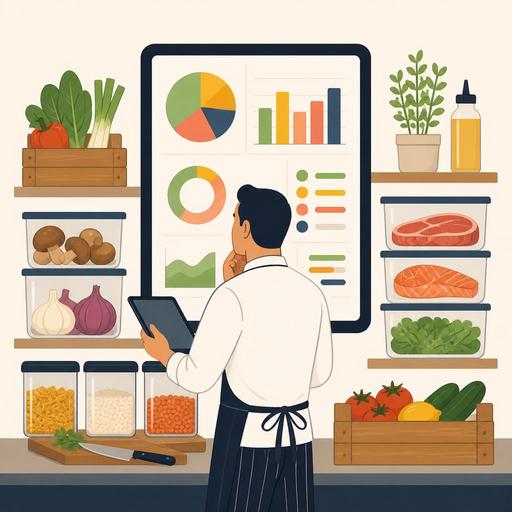
A Guide to Boosting Profitability with Category-Based Waste Tracking in Restaurants
Category-based waste tracking in restaurants lets you understand exactly which product group, which shift, and which process a loss occurs in, instead of seeing the total cost only at the end of the month. In many businesses, because waste is assessed as a single line item, the real problem stays invisible: vegetable-prep waste and portioning errors melt into the same total, and overproduction and spoilage-driven loss get mixed together. Yet for a restaurant manager, what is critical is not just the question "how much loss is there?" but "where exactly does the loss occur and with which decision can it be reduced?"
For this reason, it is more functional to address waste analysis not at the product level but at the category level and the cause level. Main headings such as meat, chicken, seafood, dairy, fruits and vegetables, baked goods, sauces, beverage garnishes, and takeaway consumables, when examined together with the purchasing, storage, preparation, production, service, and refund processes, reveal a much clearer picture. Such an approach gives the kitchen chef operational control and the owner profitability visibility.
Read waste not as a total figure but by category and cause
A single monthly waste total alerts management but does not produce a solution. That is because two losses that look the same in size can have completely different causes. For example, high waste in red meat may stem from a wrong trim standard, while loss in greens may occur due to over-purchasing despite low turnover. These two problems are not the same, so the action plan should not be the same either.
In practice, restaurants need to track waste along the following two axes:
- By category: meat, chicken, fish, dairy, vegetables, fruit, dry goods, bakery products, beverage-prep items
- By cause: spoilage, expiration, wrong production, over-preparation, portion overrun, service returns, spillage/breakage, off-recipe use
For example, in a burger restaurant, tomato, lettuce, and pickle waste may look small individually. But when these are gathered under the heading "cold-station prep waste," it may become clear that excessive mise en place is being done per shift. Similarly, in a coffee shop, milk waste may increase not only due to spoilage but also due to wrong frothing, re-making drinks, and unmeasured use.
Which categories most often produce hidden losses in restaurants?
Every business has a different menu structure; however, some categories should be monitored more closely by nature. Especially for products with a high unit cost or a short shelf life, small deviations quickly affect profitability.
1. Protein groups
In meat, chicken, and seafood, the loss is often more visible because of the purchase price; but the real problem is often that the preparation standard varies. The same tenderloin being trimmed at different gram weights by different staff, off-portion use, or errors during thawing can create serious deviation. The solution here is not just to look for a cheaper supplier; it is to manage standard recipes, clear portion cards, and preparation records together.
2. Vegetables, fruit, and greens
This group is neglected in most restaurants with the thought "there's always some waste anyway." Yet products that seem low-cost at the salad, garnish, breakfast-prep, or sandwich station can turn into significant losses when added up. Especially the daily chopping amount prepared without demand forecasting is the main reason for product going into the bin at the end of service.
3. Dairy and sauce bases
Cheddar, cream, milk, yogurt, butter, and pre-made sauces are open to both recipe deviation and gaps in shelf-life management. In a pasta restaurant, if the sauce's production amount is not planned according to the sales rhythm, the waste is visible in the kitchen but its cause is in planning. Likewise, baristas' differing milk-use habits can quietly raise coffee costs.
4. Dough and baked goods
In products like pizza, bread, croissants, dessert bases, or burger buns, the loss often arises not from stock but from a wrong production plan. If bulk preparation is done instead of controlled production according to the day's peak hours, end-of-day returns or staleness become inevitable.
How do you set up an applicable tracking system for waste analysis?
For restaurants that want to reduce waste, the most critical point is not to build a flawless system but to build a simple system that runs regularly. To start, the following structure is quite effective:
- Define the main categories: Create 6-10 main product groups according to your menu and purchasing structure.
- Standardize the waste causes: Fix causes such as spoilage, over-preparation, wrong production, portion overrun, and returns for the team.
- Record by shift: Keep a short record at the moment it occurs instead of a bulk estimate at the end of the day.
- Compare recipe and actual use: Compare the number of products sold with theoretical consumption.
- Do a weekly review: See weekly deviations instead of waiting for a monthly report.
For example, if grilled chicken salad is a top seller, it is theoretically known how many grams of chicken, lettuce, sauce, and garnish should be consumed. If there is a constant gap between the number sold and the stock outflow, the problem is either in portioning or in preparation discipline. At this point, tracking the digital order flow, recipe standards, and stock movements together provides an important advantage. In restaurant digitalization solutions like Restomas, being able to see menu, order, and operations data in the same flow makes it easier to notice which product group most often produces deviation.
Questions a manager should ask to turn data into action
A waste report is not useful on its own; it produces value when interpreted with the right questions. In your weekly review, focus on the following questions:
- In which category did the highest loss occur?
- For which reason was this loss recorded?
- Is the same loss concentrated in a particular shift, day, or staff member?
- Is there a recurring mismatch between the sales forecast and the preparation amount?
- Does the recipe standard exist but is not applied, or does the recipe not fit real operations?
Let's consider a concrete example: suppose cheese, greens, and bread waste is rising in a cafe that does weekend brunch service. At first glance this may seem natural because of the crowd. But when the records are examined, it may become clear that the preparation plan was not made according to the number of reservations, and that the portion standard slipped in the open-plate presentations. The solution here is not to cut costs; it is to match the preparation amount with the reservation data, shrink the open prep containers, and clarify the pre-service portion visuals with the team.
Strike a balance to reduce waste without harming the guest experience
Waste control should not mean undersized portions or overly restrictive kitchen discipline. The aim is not to cut from the guest's plate; it is to eliminate faulty planning and off-standard practice. For this reason, good waste management actually protects the customer experience too.
For example, if there are products on the menu that frequently sell out, the solution is not to do high-volume preparation all day. Instead, thanks to a digital menu and real-time product management, visibly updating sold-out items reduces both kitchen stress and unnecessary advance preparation. Similarly, orders dropping to the kitchen clearly and error-free lowers waste caused by wrong production. The digitalization of operations provides here not just speed but the advantage of controlled production.
In conclusion, category-based waste tracking in restaurants is one of the most practical yet most frequently postponed areas of cost control. Seeing the total loss is the beginning; real progress starts when you break the loss down by category, cause, and process. When you set up an effective tracking system, you clarify which product group produces a loss and why, you identify training needs more accurately, and you make your purchasing and production plan data-driven. This way, waste stops being an end-of-month surprise and turns into a daily, manageable operation.
Restomas can help you make more controlled decisions to reduce waste by making restaurant operations more visible, from the menu to the order flow.
