IoT Stock Alarms with Cold-Storage Sensors in Restaurants
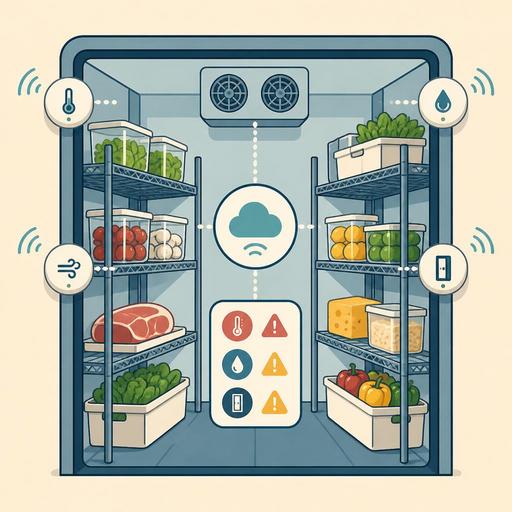
An IoT stock alarm system with cold-storage sensors is not just a technical solution that monitors temperature in restaurants; it is an operational infrastructure that simultaneously affects product safety, waste control, purchasing planning, and service continuity. Especially in businesses that use meat, dairy products, sauces, prepped items, and semi-finished goods, even small deviations inside the storage unit can disrupt menu continuity, inflate costs, and create unseen crises within the team. For this reason, the topic is not merely the question "what temperature is the storage?"; it is being able to take action at the right moment with the right data.
Why is temperature not the only real risk in cold storage?
Many businesses run storage monitoring by having staff look at a thermometer at certain times and take notes. Although this method looks sufficient at first glance, in practice it creates three fundamental gaps: there is no continuity, it is open to human error, and it is not connected to stock. Yet the risks inside the storage unit often do not stem from a single cause.
For example, the door being opened frequently, products being stacked in a way that blocks air circulation, a drop in equipment performance during the night shift, or misinterpreted defrost cycles can cause short but critical fluctuations in the temperature graph. These fluctuations do not always mean a product has spoiled; but it is hard to make a safe decision without knowing which product was at risk and for how long.
This is where IoT sensors come in. Sensors do not just show the instantaneous temperature; they provide data on time-based monitoring, threshold-breach alerts, door-open-duration tracking, humidity changes, and, in some scenarios, equipment behavior. The real value emerges when this data is interpreted together with kitchen and stock management.
How does an IoT stock alarm system work in restaurant operations?
A well-structured system treats the storage unit not as a separate technical area, but as part of daily operations. The basic flow is usually as follows:
- Temperature and, where needed, humidity sensors are placed inside the storage unit.
- Additional sensors are used for door movement or door-open duration.
- Data is transferred to the cloud or a central management panel at certain intervals.
- When a predefined threshold is exceeded, an alarm goes to the relevant people.
- The alarm is evaluated together with stock and product categories.
- If necessary, a product quarantine, rapid consumption, reorder, or technical-service action is initiated.
Consider a concrete example: in the storage unit of a restaurant that prepares desserts, dairy products, and cold mezze, the temperature rises during the night. Even if the team sees the storage as normal in the morning, the system, having recorded the deviation that occurred during the night, can indicate the risky time window. This way, the chef can give clearer answers to the questions "which products were on that shelf, which should be used first, which should be checked?"
The important aspect of this approach is that the alarm does not go only to the technical team. If a role-based notification design is set up for the business manager, the purchasing manager, and the kitchen team, the data becomes more usable. This is exactly the point that creates value in restaurant digitalization: not collecting data, but speeding up the decision flow.
Which alarm logic should be set up for which products?
Managing all stock with a single alarm rule is often a mistake. Because every product has a different risk profile. Raw meat, daily dairy products, frozen items, sauce bases, and prep containers should not be handled with the same sensitivity.
1. Critical perishable products
For raw proteins, dairy products, seafood, and ready dessert bases, more frequent data readings and a lower-tolerance alarm threshold are needed. The aim here is not only to prevent spoilage, but also to make food-safety decisions documentable.
2. High-cost products
For special meats, imported cheeses, premium pastry products, or limited-supply ingredients, a temperature deviation is also a financial risk. For these products, the post-alarm action plan must be written in advance: quality control, rapid consumption, removal from the menu, or notification of the supplier, for example.
3. Prep items that affect menu continuity
When the sauces, marination containers, mise en place preparations, and semi-finished goods used in the restaurant's best-selling products spoil, it is not only a product loss; the service flow is also disrupted. For this reason, the alarm system should be read together with stock levels. If the at-risk product is heavily used on the menu, the system should warn the manager early for alternative production or re-preparation.
It makes sense here to connect with the digital menu and order management infrastructures. For example, if a particular prep item is at risk, the visibility, stock status, or sales flow of the menu items tied to that product can be updated quickly. This kind of synchronization reduces the "product believed to be in stock but cannot be served" problem during busy hours.
The most common mistakes in setup and the right practices
Buying a cold-storage sensor is not a solution on its own. Most failed setups stem not from sensor selection, but from a process-design error.
- Placing the sensor in the wrong spot: sensors too close to the door, in the fan's airflow line, or in contact with products can produce misleading data. The aim is to read the average risk area correctly.
- Defining a single alarm threshold: not every deviation is of the same importance. The warning, critical alarm, and urgent-action levels should be separate.
- Sending the alarm only to technical staff: if the kitchen and operations team are not informed, the data does not turn into action in the field.
- Monitoring data disconnected from stock: without knowing which product is in the storage unit, the commercial impact of an alarm cannot be calculated.
- Creating alarm fatigue: too-frequent and context-free notifications cause teams to ignore the alerts.
For correct implementation, a small but effective framework can be set up:
- Label critical product groups separately.
- Create a different threshold and notification plan for each storage unit.
- Add the post-alarm steps to the shift procedure.
- Make stock in-and-out records visible on the same panel as the storage data.
- Review the alarm records weekly and perform a root-cause analysis.
The most valuable outcome for the manager: moving from early warning to decision automation
For the restaurant owner or business manager, what matters is not reading the raw data coming from the sensor, but being able to see the cost, menu, and labor impact of that data. For example, an alarm that comes in before the morning opening should not just say "the storage is warm"; it should make visible which product groups are affected, the estimated operational risk, and which action is the priority.
At this point, integration with restaurant software makes a big difference. When the order flow, stock status, product availability, and kitchen prep lists come together in the same digital ecosystem, the cold-storage data becomes more meaningful. A manager being able to see both the at-risk stock and the menu items tied to that stock on a single screen seriously shortens decision time.
For example, if there is a risk in dairy-based prep items before brunch service, the team can quickly plan an alternative recipe, temporarily remove some products from sale, or update their visibility in the QR menu. This way, the problem is solved internally before it reaches the guest. This is exactly the practical equivalent of digitalization: the ability to turn technical data into service quality.
An actionable 30-day starter plan for restaurants
If you do not yet have such a structure in your business, you can proceed gradually without thinking of it as a large technology project.
- In the first week, clearly list which critical products are kept in which storage units.
- In the second week, write down the risk scenarios that require an alarm: the door being left open, a temperature deviation, an equipment failure, and so on.
- In the third week, determine the roles that will receive notifications: chef, manager, purchasing, technical service.
- In the fourth week, test the post-alarm action flow and review the menu-stock connection.
The aim of this plan is not to build a flawless system in a single day, but to make the unseen storage risks measurable. Risk you can measure becomes risk you can manage. Especially in kitchens with many products and in businesses with busy service, this difference creates operational confidence beyond reducing waste.
Restomas, with its structure that makes restaurants' stock, order, and digital operational flow more visible, can offer a foundation that makes connecting cold-storage data to daily management more meaningful.
