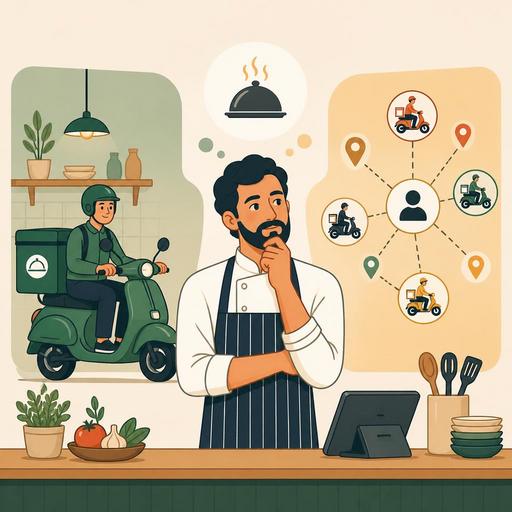
In-House Couriers vs. Outsourcing in Restaurants: A Cost Analysis
The question of whether restaurants should employ couriers in-house or outsource them eventually confronts every business whose takeaway volume is growing. The issue is not merely a matter of salary or commission; topics such as delivery speed, customer experience, order accuracy, peak-hour management, and brand control also directly influence this decision. Especially now that takeaway has turned into a separate line of business from dining-room operations, the right model preserves profitability while the wrong one generates hidden costs.
For a restaurant owner, the most critical point is this: the courier model should be chosen not according to "habit" but according to order structure and operational reality. The needs of a neighborhood-scale kebab shop and a burger brand taking orders across a wide radius are not the same. For this reason, you need to evaluate the difference between keeping a courier team in-house and outsourcing courier service item by item.
Why is it wrong to decide based on salary and commission alone?
At first glance, the comparison looks simple: if couriers are in-house, there is salary, insurance, equipment, and a shift plan; with outsourced service, you pay a fee per order or tied to revenue. But the real cost picture is broader. That is because the delivery model affects many areas, from the kitchen's pace to customer satisfaction.
For example, a restaurant with its own couriers can manage the delivery zone and priority order more flexibly. It can offer faster service to regular customers, recognize problematic addresses, and exert tighter control over how the product is carried. By contrast, in low-volume businesses, idle courier time can create significant inefficiency. During hours when no orders come in, the staff cost keeps running.
In the outsourced model, the fixed staff burden decreases. This is an important advantage, especially for businesses whose demand fluctuates greatly throughout the day. But here, too, the level of control can drop. Even if the restaurant prepares the order flawlessly in the kitchen, the delivery experience becomes dependent on the performance of a third party. Customers often do not distinguish the source of a delay; they attribute a bad experience directly to the restaurant brand.
The real cost line items of building an in-house courier team
Businesses that want to build their own courier team usually calculate only the monthly wages. Yet the total cost of ownership is more comprehensive. The following items should be evaluated together:
- Wages and benefits: Salary, insurance, meals, transport, and the potential burden of overtime.
- Equipment: Thermal bag, helmet, raincoat, phone, line, and backup equipment when needed.
- Vehicle expenses: If a motorcycle or scooter is used, maintenance, fuel, tires, breakdowns, and depreciation.
- Planning cost: Preparing shifts, managing leave, and the need to fill in during absences.
- Training: Finding addresses, delivery protocol, communicating with the customer, and product-handling standards.
- Operational risk: Insufficient courier numbers during peak hours or idle capacity during quiet hours.
Even so, the in-house team model has strong points. Especially in restaurants that take a high number of repeat orders in a particular neighborhood, couriers learn the area, recognize customers, and the delivery process becomes predictable. For example, for a pide restaurant that sends a large number of orders to the same residential complex every evening, building an in-house team can be more efficient. That is because route knowledge settles in, delivery time shortens, and the relationship with the customer becomes standardized.
Moreover, when you have your own team, you decide which area to prioritize during campaign hours. If you can track which products are being prepared, which orders are waiting, and which courier is out on the order management screen, the in-house team model runs more efficiently. At this point, seeing the order flow from a single panel and managing the kitchen and delivery as parts of the same operation makes a big difference.
The advantages and hidden costs of outsourcing courier service
The outsourced courier model is a lower-risk entry point, especially for businesses that are just starting out or whose delivery volume is not yet predictable. It is possible to begin takeaway without making a fixed staff investment. Being able to scale capacity more easily as demand grows is also an important advantage.
For example, consider a café that is quiet on weekdays but very busy on weekends. If it builds its own team to match the weekend volume, the weekday cost balloons. If it builds it to match the weekday level, orders are delayed during busy times. Outsourced service can absorb this fluctuation more flexibly.
However, there are three critical risks here:
- Fragmentation of the brand experience: The customer orders from the restaurant but receives the delivery to a different standard.
- Reduced operational visibility: Even if the order is ready, when a courier will be assigned and how quickly they will deliver is not always under your control.
- Unit cost growing at high volume: A model that looks advantageous at low volume can become expensive in total as orders increase.
For this reason, the outsourcing decision should ask not only "is it cheap right now?" but also "at what volume does it become expensive?" In addition, platform commissions, delivery service fees, and the extra burdens that arise during campaign periods should be evaluated together.
Which model is more suitable for which restaurant?
There is no single correct model for every business. The following framework helps when making the decision:
An in-house courier team may be more suitable
- If you take dense and regular orders in a particular area
- If your average basket size is highly sensitive to delivery quality
- If the way the product is carried directly affects taste and presentation
- If customer loyalty matters more to you than platform visibility
- If you can manage shift and delivery tracking digitally
The outsourced model may be more suitable
- If your order volume is irregular and hard to predict
- If you are testing demand in a new area
- If you do not want to increase the burden of staff management
- If you operate across a wide delivery area
- If your priority is flexible cost rather than fixed cost
There is also a hybrid model. Some restaurants serve nearby areas with their own couriers while outsourcing more distant areas. This approach helps preserve brand control in the core area while growing capacity during peak hours. Using a different model during the lunch and evening peaks is also possible.
A practical 5-step cost analysis for the right decision
To make a sound decision, you need to proceed with regular data rather than intuition. The following steps can be applied:
- Map the order pattern of the last 8-12 weeks: Break down demand by day, hour, area, and basket size.
- Calculate the real cost per delivery: For the in-house team, divide total staff and equipment expenses by the number of deliveries; for outsourcing, add up all per-order deductions.
- Track the causes of delays and errors separately: Clarify whether the problem is in the kitchen, in courier assignment, or in route time.
- Measure regional profitability: Not every neighborhood is equally profitable; distant but low-basket areas can post a loss.
- Run a 30-day pilot: Try an in-house team in one area and outsourcing in another segment, then compare the results.
At this point, seeing orders from a single center, evaluating kitchen preparation time and delivery time in the same report, and tracking which products perform better in takeaway on a per-menu basis become critical. When discussing the courier model, restaurants often realize too late that the real problem is menu complexity, incorrect preparation times, or a pileup of orders during peak hours. Digital order management makes these blind spots visible.
In conclusion, there is no one-sentence answer to the question "keep couriers in-house or contract them out." For businesses that need flexibility at low volume, outsourcing may be more sensible; restaurants with a strong order flow in a particular area, on the other hand, can achieve higher control and more balanced costs with their own teams. The best decision belongs to businesses that consider the delivery model together with the kitchen flow, menu structure, area density, and customer expectations.
Restomas can help restaurants evaluate this decision based on data by bringing the order flow, menu management, and operational visibility together in one place.
