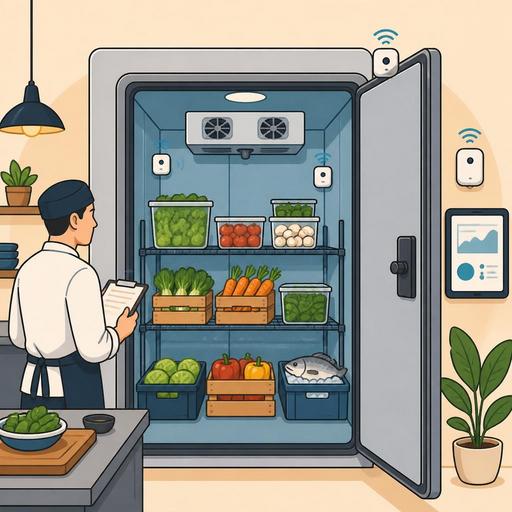
IoT Stock Alarms in Restaurants with Cold Storage Sensors
Cold storage sensors and an IoT stock alarm system are becoming critical in restaurants not only for monitoring temperature but also for protecting product safety, reducing waste, clarifying shift communication, and speeding up purchasing decisions. Especially in businesses working with meat, dairy, seafood, prep sauces, and semi-finished products, a small deviation inside the storage area can turn into a major operational crisis during service hours. For this reason, the subject is not just technical equipment but directly a matter of cost, quality, and brand trust.
In many businesses, cold-room control still relies on staff checking a thermometer at certain times and jotting down a note. This method isn't entirely useless; but in situations such as busy service, shift changes, a forgotten door, a malfunctioning fan, or incorrect shelf placement, problems noticed late lead to serious losses. IoT-based sensors, by contrast, monitor data such as temperature, humidity, door-open duration, and in some scenarios product movement in real time, producing an alert before the problem grows.
In a cold storage room, the real risk isn't only temperature
Restaurant owners often reduce the risk to the single question "is the unit cooling?" Yet the problem in the field is more layered. Situations such as different shelves within the same storage area showing different temperature behavior, products near the door being affected faster, staff placing newly arrived product in front of older product, or received goods arriving already at borderline temperature create chain problems.
For example, consider a steakhouse business. Vacuum-packed meat products received in the morning are placed into storage; during midday prep the door is opened frequently; before evening service there's heavy traffic in and out. If the sensor measures at only a single point, short-term temperature spikes near the door shelves may go unseen. Similarly, in a patisserie-cafe model, humidity and door-open duration are at least as important as temperature for milk, cream, and ready-made dessert components.
For this reason, instead of merely collecting data, an effective system should answer the following questions:
- In which storage area, on which shelf, and during which time window did the deviation occur?
- How long did the deviation last, and who noticed it?
- Which product groups could this affect?
- How should the purchasing, prep, and service plan be revised?
How does an IoT stock alarm system connect to restaurant operations?
A successful IoT stock alarm system doesn't leave the sensor as a standalone device; it relates it to inventory, the production plan, and task flow. The real value emerges here. Because when a temperature alarm comes in, what the business needs is not just to receive a notification but to quickly initiate the right action.
For example, if the temperature in the storage area holding chicken products goes outside the threshold, the system's ideal output is not just an "alert." At the same time, the following actions should be triggered:
- An instant notification going to the relevant shift supervisor
- The potentially affected product group being flagged
- The kitchen prep plan being updated if necessary
- The new purchasing need becoming visible
- The incident being logged so that recurring risks can be analyzed
This is where the power of restaurant digitization comes in. In digital operations run with platforms like Restomas, when menu, stock, order flow, and branch management are considered within the same framework, a problem in storage doesn't stay isolated. For example, if a particular product group is at risk, the visibility of the related items on the menu, the preparation capacity, or alternative product planning can be managed faster. This approach takes the sensor out of being merely a technical maintenance tool and elevates it into a decision-support layer.
5 practical setup principles for the right sensor configuration
Many restaurants invest in technology yet don't get the benefit they expected; because purchasing the device gets confused with designing the process. For an efficient result, the following setup principles are important:
1. Don't settle for a single sensor
In large or frequently used storage areas, a single measurement point can be misleading. The area near the door, the back shelf, and the sensitive-product zone may behave differently.
2. Create a product-based risk map
Not every product has the same critical level. Raw meat, dairy, seafood, and ready-made dessert components should be prioritized.
3. Set the alarm threshold according to operational reality
A threshold that's too narrow can create unnecessary notification fatigue; one that's too wide causes late intervention. The goal is to set a clear alarm logic the team will take seriously.
4. Define the task owner after the alarm
Even if the notification goes to everyone's phone, no one taking responsibility is a common problem. A primary and a backup responsible person should be designated for each alarm type.
5. Read sensor data together with stock movement
When the time a problem occurred in storage is read side by side with product in-and-out data, it becomes clearer which ingredient carries a higher risk.
Concrete use scenarios: which business gains what?
In fine dining restaurants, protecting high-cost proteins comes to the fore. A short circuit or a cooling loss overnight can affect the backbone of the next day's menu. Instant alarms and product-based impact analysis make it easier to produce an alternative plan without having to cancel service.
In QSR and chain structures, standardization is more critical. The same product being exposed to different storage conditions at different branches creates quality inconsistency. Centrally monitoring sensor data helps establish discipline across branches.
In cafes and patisseries, milk, cream, sandwich prep, and dessert components are more sensitive. Here even short-term door openings can create risk during busy production hours. When alarm history is examined together with shift habits, the need for training becomes visible.
In hotel restaurants and open-buffet operations, the transfer of product from storage to the kitchen and the service area is multilayered. Sensors alone aren't enough; they must be considered together with receiving, prep, and consumption tracking. At this point, being able to see the digital menu, order, and stock flow within the same operation provides an important advantage.
An action plan restaurant owners can apply in 30 days
Before investing in the subject, you don't need a complex transformation plan. For a more controlled start, the following framework can be applied:
- Classify your cold storage areas according to product risk.
- Identify the 10 product groups that could create the most loss.
- Flag the areas with high door-opening frequency.
- Put shift-based temperature-check responsibilities in writing.
- In the first phase, place sensors in the critical storage areas.
- Create the standard response flow to be applied when an alarm comes in.
- Relate the stock, purchasing, and menu plan to these alerts.
- Review the alarm logs weekly and weed out recurring causes.
The important part of this plan is not buying technology but turning data into an operational decision. If alarms come in but no one takes action, the system goes no further than an expensive thermometer. If the alarm data is connected to menu planning, the prep list, purchasing, and branch coordination, then real efficiency forms.
In conclusion, cold storage sensors are a strategic tool in restaurants not only for food safety but also for stock accuracy, waste control, team discipline, and service continuity. Especially for businesses advancing on the path of digitization, sensor data should be considered not in isolation but together with menu and operations management. This way, a business structure can be built that intervenes before the problem grows rather than reporting after the fact.
Restomas can help you consider such critical processes from a single center, with digital flows that make restaurant operations more visible and manageable.
