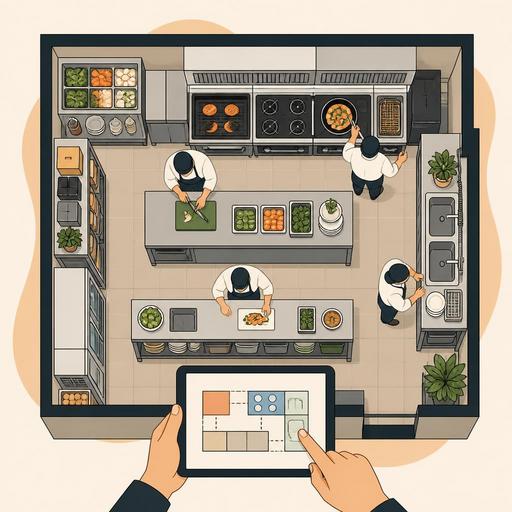
How to Increase Efficiency per Square Meter in Restaurant Kitchen Layout
Efficiency per square meter in restaurant kitchen layout is a topic that directly affects profitability, especially in areas where rent pressure is high. A larger kitchen does not always produce a better result; what matters is how well the existing space fits the order flow, equipment use, and staff movement. For this reason, kitchen planning should be evaluated not just as an architectural matter but also as a matter of operations, menu management, and service speed.
Many businesses focus on the equipment list when setting up a kitchen, but the factor that actually makes the difference in daily operation is economy of movement. A cook taking needless steps between the prep counter and the cooler, the dishwashing flow cutting across the hot-production area, or takeaway orders clashing with the service exit create efficiency losses that grow much faster in small spaces. The calculation of efficiency per square meter therefore must answer not only the question "how many tables were served" but also "by what flow was that service produced."
What Does Efficiency per Square Meter Mean?
Efficiency per square meter in a kitchen helps you understand how orderly, fast, and error-free production can be within a given space. The square-meter measure alone is not enough; two kitchens of the same size can produce completely different results due to layout differences. For this reason, several dimensions should be considered together when making an evaluation:
- Production capacity: How many orders can be prepared in the same time window?
- Movement intensity: How much do staff move needlessly between stations?
- Waiting points: At which stage do orders pile up?
- Space utilization: Are the counter, storage, cooking, and passage corridors balanced?
- Menu fit: Is the kitchen layout suited to preparing the best-selling products?
For example, in a business that works mainly with burgers, the bun-prep, grill, garnish, and packaging stations should be set up close to one another. If breakfast, pasta, dessert, and heavy takeaway service are all being run at the same time in the same kitchen, the problem may be not just the smallness of the space but the product mix burdening the kitchen plan.
The Flow Map You Should Look at First in Kitchen Planning
The starting point of an efficient kitchen design is not the equipment catalog but the product flow map. Without clarifying which stations a plate or takeaway order passes through from the moment it enters the kitchen until it leaves, layout decisions will produce problems over time.
A simple flow map can be drawn up in the following order:
- Determine which channel the order comes from: dine-in, QR menu, takeaway, phone, online order.
- Write down the prep steps for each product.
- Mark the equipment and counters used in these steps.
- Observe the steps staff take.
- Note the conflicting points: waiting, backtracking, cross-passage, double workload.
For example, dine-in plates merging with courier packages at the same exit counter creates a bottleneck, especially during busy hours. Similarly, prep staff crossing the hot-production line to get products from storage is problematic in terms of both safety and speed. When a flow map is drawn up, business owners often see that the problem is not a "small kitchen" but a "misrouted kitchen."
Digital order management also provides important support here. Gathering orders on a single screen makes it easier to see which product group creates pile-ups at which hours. This way, the kitchen layout can be reorganized not by intuition but according to the real operational flow.
Layout Decisions That Increase Efficiency Without Expanding the Space
Not every business has a renovation budget. But efficiency per square meter often increases through correct layout decisions far more than through major construction work. Especially in small and mid-sized restaurants, the following adjustments can make a serious difference:
1. Set up stations according to the best-selling products
Instead of allocating equal space to the entire menu, put the products that make up the bulk of sales at the center. As the production chain of the most frequently ordered plates shortens, service speed increases. Products that sell little but occupy equipment, on the other hand, create an invisible cost in the kitchen.
2. Separate the prep and finishing areas
When ingredient chopping, portioning, and pre-prep are done on the same surface as final plating, confusion arises. Even if the space is small, physically separating tasks provides an advantage in terms of both hygiene and rhythm.
3. Increase vertical storage
In many kitchens, the problem is not the scarcity of square meters but storage spreading across the floor. Wall shelves, labeled containers, and overhead storage solutions separated by product group ease the working surface.
4. Reduce cross-traffic
Dishwashing, prep, hot production, and the service exit should not pass through one another. Especially during busy service hours, layouts where two staff members constantly have to yield to each other waste more time than it appears.
5. Create a separate mini exit point for takeaway orders
In businesses where takeaway is growing, the courier waiting area should be separated from dine-in service. Even a separate shelf, a takeaway check point, or a small pickup counter can reduce the load on the main line.
The Direct Relationship Between Menu Design and Kitchen Efficiency
Kitchen efficiency is not just about the physical plan; menu structure is also a direct determinant. A very broad but operationally fragmented menu disrupts space utilization in small kitchens. Different cooking techniques, special equipment requirements, and a large number of semi-prepared items make storage and station planning harder.
Let's consider a concrete example: a business serving pizza, stews, third-wave coffee, and dessert all at once is divided among the oven, stove, coffee bar, cold display, prep area, and different equipment needs. This variety may look attractive in terms of sales, but if the kitchen space is limited, each category lowers the efficiency of the others. By contrast, a menu that shares similar ingredients, uses a common prep line, and limits cooking techniques enables more fluid production in less space.
Digital menu management is useful at this point. Seeing which products are frequently ordered, which ones slow down the kitchen, and at which hours certain categories cluster makes menu-simplification decisions easier. Especially updating product visibility through the QR menu can offer flexible solutions, such as not featuring the line items that strain operations at certain hours.
An Applicable Checklist for Efficiency per Square Meter
If you want to do a quick assessment in your business, you can start with these questions:
- Has a prep flow been drawn up for the 10 best-selling products?
- Do staff take more steps than necessary for an order?
- Does the hot-production line cut across the dishwashing flow?
- Do takeaway orders slow down dine-in service?
- Do low-selling products take up unnecessary equipment or storage space in the kitchen?
- Is storage spreading across the floor, or are vertical solutions being used?
- Is order intensity tracked by the hour and the station plan adjusted accordingly?
The answers to these questions show which points can be improved before opening a new branch or knocking down a wall. Successful kitchen planning often comes not from a search for "more space" but from measuring the existing space correctly.
In conclusion, efficiency per square meter in a restaurant kitchen is a management topic that begins with the architectural drawing and matures with order data. When layout, menu, equipment, and digital flow are handled together, even small kitchens can run more controllably at a high tempo. Making the order flow and menu management visible with digital tools such as Restomas can help make this planning more measurable.