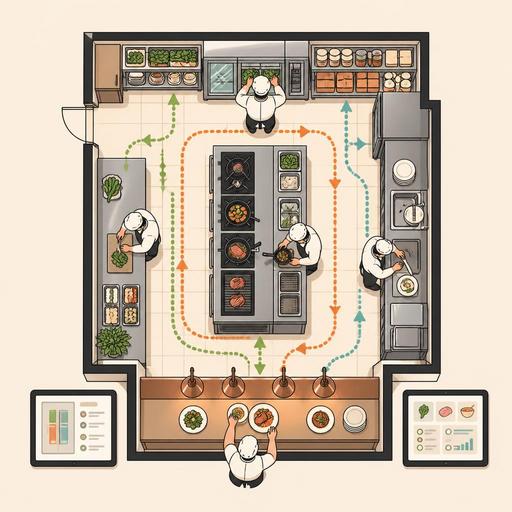
How to Plan Square-Meter Efficiency in a Restaurant Kitchen
Calculating efficiency per square meter in a restaurant kitchen does not simply mean cramming more equipment into a small space. The real goal is to build a layout that speeds up the order flow, reduces unnecessary steps for the staff, and keeps preparation and service processes from clashing. Especially in businesses where rent pressure is rising and takeaway meets dining-room operations in the same kitchen, square-meter efficiency becomes a direct determinant of profitability, speed, and team performance.
Many businesses see kitchen planning as a fixed decision made during construction. Yet a well-planned kitchen is a living system: as the menu changes, as order channels diversify, and as peak hours shift, the use of space should be reevaluated too. For this reason, the efficiency calculation should be done not only on a drawing but on the basis of the actual service flow, staff movement, and product-preparation logic.
In calculating efficiency per square meter, first clarify what you are measuring
The first mistake is the assumption that "a bigger kitchen is more efficient." An efficient kitchen is not the one with a large total area but the one that produces fewer bottlenecks in the same area. For this reason, instead of relying on a single metric for measurement, you need to look at several operational questions together.
- How many stations does an order pass through in the kitchen?
- How often do the prep staff and the hot-line team share the same corridor?
- Do takeaway and table-service orders create a pileup at the same exit point?
- Is the transition from cold storage to the prep counter and from there to the cooking area natural, or does it double back?
- Are the best-selling products aligned with the most easily accessible equipment and storage areas?
For example, in a business that works mainly with burgers, if the bread, sauce, sides, grill, and packing stations are disconnected from one another, the staff constantly work while turning back and forth. A kitchen that looks spacious on paper wastes time in practice. By contrast, a more compact but correctly sequenced layout can provide higher production capacity.
At this point, a simple internal audit can be done: during a busy hour, map the path a product follows from raw material to service. If the product zigzags inside the kitchen, you need to optimize the flow, not the square meters.
Build the station layout around the menu, not around habit
The most critical issue in kitchen planning is that the layout should be done according to the menu's production logic, not the technical specifications of the equipment. In many restaurants, devices are placed in the order they were purchased; over time, this creates an inefficient layout.
The right approach is to cluster product groups according to their preparation-and-cooking relationship. The kitchen flow of a grill-focused menu cannot be the same as that of a breakfast-focused menu. Likewise, the exit layout of a restaurant that serves only the dining room should differ from that of a business taking heavy takeaway.
Practical layout logic
- Storage: The products used most frequently each day should be kept in easily accessible areas.
- Prep: Washing, chopping, and portioning areas should complement one another.
- Cooking: There should be no unnecessary distance between equipment that operates at the same time.
- Assembly: Plating or packing should not be positioned too far from the cooking line.
- Exit: Server handover and courier handover should be separated where possible.
Let's give a concrete example: in a restaurant that serves pasta, pizza, and dessert, if the oven line is far from the dough prep and the side area, cross-traffic forms with every order. In this case, the problem is not the number of staff but the wrong use of square meters. Simplifying the menu or repositioning the stations can be more effective than hiring extra staff.
Space efficiency will not improve without measuring staff movement
The most neglected aspect of calculating efficiency per square meter is the steps the staff take. That is because time loss in the kitchen often arises not from waiting but from small, constantly repeated movements. Details such as turning back to the fridge, searching for missing equipment, waiting in line at a single sink, and clashing at a shared counter quietly slow down service speed.
You don't need expensive consulting to see this. During two busy service windows, record the following observations:
- At which station does a queue form?
- Which piece of equipment is used for two different tasks at the same time?
- Who moves around the most?
- For which product is the most backtracking done?
For example, if the fryer basket, the sauce cabinet, and the packing area are far apart, even a single product creates more touchpoints than necessary, especially during busy takeaway hours. The result is not only delay; portioning errors, incomplete product output, and staff fatigue increase as well.
Digital order management provides important support here. Tracking which channel orders come from, which products sell together during peak hours, and which stations they overload gives you the ability to update the kitchen layout with data rather than intuition. With systems like Restomas, when menu categories, the order flow, and operations screens are seen more clearly, it becomes easier to notice which order types strain the physical space.
Equipment choices and storage decisions either save space or lock it up
Efficiency in the kitchen is not only about layout; the size, multifunctionality, and frequency of use of the chosen equipment are also determining factors. Oversized equipment often does not add capacity; it merely narrows the working space. Likewise, keeping rarely used devices close to the main line wastes valuable working area.
For this reason, evaluate equipment with these three questions:
- Is this device actively used in every service?
- Can it take on more than one function?
- Is its footprint cost worth the operational benefit it provides?
A similar logic applies to storage. Dry goods, packaging, daily prep ingredients, and cleaning equipment should not be placed with the same logic. Especially in businesses with strong takeaway, packaging stock consumes more space than it appears. If this area is not accounted for in advance, the kitchen production area turns into storage.
A concrete recommendation: list the 20 most-used products and ingredients of the last 30 days. Review the distance between the storage point of these products and the station where they are used. If the most frequently touched products are in the hardest-to-reach place, your kitchen plan is inefficient in the field even if it looks neat on paper.
Manage the kitchen plan as a regular revision system, not a one-off project
Even the best kitchen plan can become outdated over time. The menu expands, delivery channels increase, working hours change, and staff roles shift. For this reason, calculating efficiency per square meter is not a drawing job done before opening; it is an operations management topic that needs regular review.
For this, you can set up a monthly or periodic review routine:
- Examine the best-selling products and the combinations ordered together.
- Note the stations that get clogged during busy hours.
- Identify products that sell little but require a large prep area.
- Separate the points where takeaway and dining-room operations clash.
- If necessary, reorganize the counter, shelves, prep sequence, and exit area.
For example, if fast service comes to the fore at lunch while more complex plates do so in the evening, making a shift-based prep plan instead of a single fixed layout may be more correct. In some businesses, the problem is not a lack of physical square meters; it is keeping the same layout even though the usage scenarios differ throughout the day.
In conclusion, square-meter efficiency in a restaurant kitchen is not about filling space but about using space intelligently. The right calculation considers station relationships, staff movement, product flow, storage logic, and order channels together. Gaining a few meters in the kitchen may not always be possible; but establishing a clearer flow in the same square meters creates the real difference for most businesses.
To see your operations with data and manage your menu and order flow more soundly, you can explore Restomas's solutions for restaurant digitalization.
