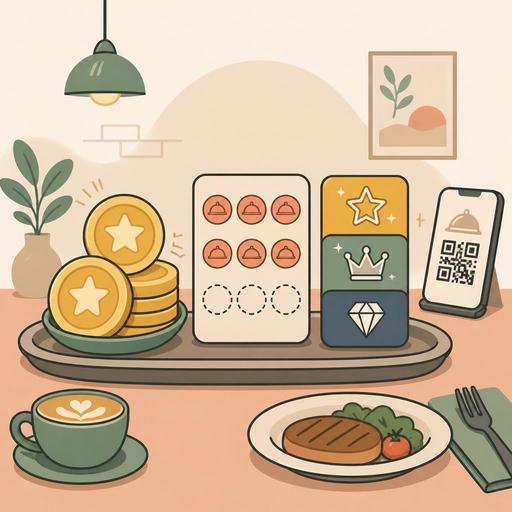
Choosing Between Points, Stamps, and Tiers in a Restaurant Loyalty Program
Making the right choice among a points, stamp, and tier system in a restaurant loyalty program is a critical decision not only for increasing repeat visits but also for simplifying the customer experience, reducing the staff workload, and keeping campaign costs under control. Many businesses set out by saying "let's set up a loyalty program"; however, what truly makes the difference is knowing which model genuinely fits your service structure, your menu flow, and your customer profile.
The need of a coffee-focused cafe and a family restaurant is not the same. While a customer needs to understand their reward instantly at a fast-service business, tiered privileges can yield stronger results at a restaurant with a higher average basket. For this reason, you need to evaluate the points, stamp, and tier systems one by one, and then think about them together with the digital menu, order management, and customer data.
Points system: flexible, but complex if not well designed
The points system is the model in which the customer accumulates points based on their spending or specific actions. Its biggest advantage is that it offers flexibility. You can define different point multipliers for different product groups, give extra points during low-traffic hours, or encourage trying new products with points.
For example, a restaurant that is busy during lunch hours can define extra points for orders placed during specific hours to liven up the calmer evening time slots. Similarly, a business that wants to increase takeaway orders can offer higher points on orders placed through an app or the QR menu. This way, the loyalty program becomes not just a "reward" but a tool for steering operations.
However, the weak side of the points system begins precisely here: too many rules, low clarity. If the customer cannot get a clear answer to the questions "How many points do I have, when will I use them, on which product is it valid?", the program loses its appeal. If staff have to explain at every register, the process slows down.
Which businesses is the points system more suitable for?
- Restaurants with a variable average check
- Businesses that want to cross-sell
- Brands that want to steer different channel behaviors
- Chain structures that want to analyze customer data in more detail
The critical point here is to keep the points system as visible and understandable as possible. Having the earning and usage conditions appear clearly on the digital menu or order screen reduces the explanation burden on staff. In addition, when a structure linked to order history is set up, it becomes possible to see which campaign genuinely generates repeat visits.
Stamp system: quickly understood, powerful for repeat visits
The stamp system is the loyalty model that is easiest to explain: "One stamp with each purchase, a reward when you reach a certain number." It is very effective, especially in routine consumption categories such as coffee, dessert, sandwiches, bowls, or similar. The customer clearly sees how close they are to the reward; this psychologically creates a desire for completion.
Let's consider a concrete example: for a cafe that sees the same customer several times a week throughout the day, a structure like "buy 8 coffees, the 9th is on us" is extremely understandable. Here, the customer does not need to do any math. Staff can also explain it easily. This simplicity makes the stamp system advantageous, especially during busy hours.
On the other hand, the stamp system is not ideal for every business. Because it is difficult to establish a direct relationship between the basket amount and the reward. If the same stamp is given to a customer who buys a 90 TL product and a customer who buys a 250 TL product, the profitability balance can be thrown off. In addition, in restaurants with broad menus, if it is not clear which products are included in the stamp, confusion arises.
Points to watch in the stamp system
- Clearly define the product group for which stamps are given.
- Calculate the cost of the reward product in advance.
- Use digital tracking to prevent abuse.
- Prefer a setup that runs automatically in the order flow, not at the register.
Digitalizing the stamp system makes a big difference here. Paper cards get lost, staff carry out error-prone transactions, and a risk of fake stamps arises. Whereas a digital structure that works with a QR menu, order history, or a customer account both appears transparent to the customer and enables the business to track real repeat-visit behavior.
Tier system: effective for brand loyalty and high spending
The tier system classifies customers according to specific thresholds and offers different advantages at each tier. Levels such as Bronze, Silver, and Gold are the best-known example of this. Instead of just giving rewards, this model offers the customer a feeling of "feeling privileged." Especially in restaurants that want to create a premium perception, the sense of membership can be a powerful tool.
For example, a restaurant experiencing reservation density can offer top-tier customers advantages such as early reservation access, invitations to special tasting nights, or priority for certain menu launches. Such benefits do not force you to give a direct discount; they strengthen loyalty while preserving the brand's value perception.
However, the tier system can look distant and elitist if the right communication is not established. If the customer cannot clearly see how to move up to the next tier, what they gain, and how to maintain their tier, the system does not attract interest. In addition, in businesses with a low-frequency customer base, the transition between tiers can be too slow.
In which situation does the tier system stand out?
- In reservation- and experience-focused restaurants
- In businesses with a higher average check
- In brands that want to do VIP customer management
- In concepts that want to offer privilege instead of discounts
Here again, the digital infrastructure is decisive. The system gains meaning when the customer's tier, earnings, and past visits are visible. When reservations, orders, and the customer profile are unified in a single place, the burden of manually tracking tier advantages is reduced.
Which loyalty model is more suitable for your restaurant?
The right model is not the one that is trending; it is the one that fits your business's behavioral structure. When deciding, ask these three questions:
- How often does the customer come? If there are frequent visits, the stamp system yields faster results.
- How much does the basket amount vary? If there are large differences, the points system can be fairer.
- Is the brand experience or the promotion the priority? In an experience-focused structure, the tier system is stronger.
Let's clarify with an example. At a neighborhood cafe with high daily coffee traffic, the stamp system is a natural starting point. However, if the same business eventually wants to grow dessert and sandwich sales alongside coffee, it can move to a hybrid model that gives points to specific product groups. In an experience-focused structure such as fine dining or a chef's restaurant, the tier system works more meaningfully with table-specific advantages and priority reservations.
The most common mistake is implementing everything at the same time. The approach of "let there be points, stamps, and tiers too" looks rich in the short term; but it tires the customer, strains the staff, and complicates campaign tracking. First choose a single main mechanic. Then, if there is a need, add a second layer.
5 clear actions for success in practice
- Start simple: In the first version, set up a single reward logic and reduce the exceptions.
- Train the staff: A team that cannot explain the loyalty program in 20 seconds cannot get the customer to join the program.
- Provide digital visibility: The customer should easily see their points, stamp, or tier.
- Connect it to the menu: Rewards should be chosen from products suitable for your stock and profitability structure.
- Track the data: Track which reward generates repeat visits and which one generates only an expectation of a discount.
A loyalty program is not a standalone campaign item; it produces real value when it works together with menu management, the order flow, the reservation system, and customer communication. For this reason, the system needs to be designed not on paper but within the operation. Seeing the digital menu, order management, and customer interactions in a single flow makes it easier both to understand which model works and to reduce the team's daily workload.
Platforms focused on restaurant digitalization like Restomas can help businesses that want to think about the loyalty setup within the same operation as the menu, orders, and customer experience build a more organized structure.
