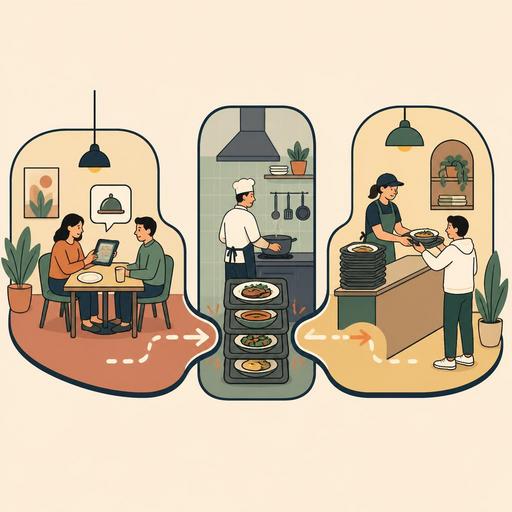
Finding Hidden Bottlenecks by Mapping the Order Flow in a Restaurant
An order flow map is a practical management tool that makes visible all the steps an order goes through in a restaurant, from the guest's moment of decision to production, service, payment, and feedback. In many businesses the problem is described as "we're very busy"; yet the real issue is often not the crowd but the flow quietly slowing down at certain points. Details such as delayed approvals, notes that reach the kitchen incomplete, a disconnect between the register and the dining room, or takeaway orders disrupting the dining-room operation directly affect revenue, table turnover speed, and guest satisfaction at the end of the day.
For this reason, the order flow should be addressed not just as kitchen performance but as an end-to-end operational chain. A well-drawn flow map lets you stop the "whose fault is it?" debate and focus on the question "at which step does the problem occur?" Especially for businesses that use digital tools such as QR menus, order management, reservations, and POS integration, this map also shows clearly whether the technology actually reduces the workload.
Why is the order flow map missing in most restaurants?
Many restaurant owners think they know the processes because the team does the same job every day. But daily habit normalizes invisible delays. A server may be taking orders quickly; but if the order does not drop to the kitchen in the right format, the advantage of speed is lost. The kitchen may be producing on time; but if the service sequence is disrupted, the guest still waits.
The most common mistake is to reduce the order flow to the performance of a single department. Yet bottlenecks often appear in the transitions between departments:
- The order taken at the table entered into the system late
- Special notes conveyed to the kitchen incompletely or confusingly
- Dine-in, grab-and-go, and takeaway orders arriving at the same time loaded onto the same production line
- A ready product reported to the service team late
- Table closing dragging on because of register congestion at the payment stage
Such problems look small individually. But at busy times like lunch service, deviations of a few minutes pile on top of one another and slow down the entire operation. This is exactly where the value of the order flow map emerges: it makes seemingly normal delays measurable.
How to map the flow: write down all the touchpoints the order passes through
The first step is to clearly define the order's start and end points. For example, in a table order the start may be the guest beginning to review the menu; the end is the completion of payment and the table becoming ready for a new guest. In a takeaway order, the start is channel selection and the end is delivery confirmation. Mapping a separate flow for each channel is the healthiest method.
Make the basic steps visible
- The guest reviews the menu
- The order is placed
- The order drops into the system
- The kitchen or bar begins production
- The product passes quality control
- The service or takeaway preparation stage is completed
- The product reaches the guest
- Additional requests are managed
- Payment is taken
- The table closes or the order is delivered
For each of these steps, ask the following questions: Who is responsible? Where does the information come from? At which point is the decision made? Where does waiting occur most? This exercise can be done on paper; but in businesses that use digital ordering and POS integration, the screen flow, approval sequence, and timestamps should also be examined separately.
Let's consider a concrete example: in a cafe, the guest becomes ready to order from the QR menu, but the server stops by the table a few minutes later to take the final approval. The problem here is not the menu but the approval step idling within the operation. In another business, the order may drop to the kitchen instantly; but because the hot and cold stations are not synchronized, a single table's products come out piece by piece. In both cases the guest says "it came late," but the root cause is different.
To find bottlenecks, look not only at time but at recurring errors
When doing a bottleneck analysis, everyone first looks at the total preparation time. While this is important, it is not enough on its own. What deserves real attention is the recurring deviations at a particular step, because chronic problems usually pile up at the same point.
What are the bottleneck signals?
- Regular delays in the same product groups
- An increasing error rate in orders with special requests
- An increasing need for verbal confirmation between the kitchen and service during peak hours
- Ready orders waiting on the counter
- A queue forming at bill closing
- Takeaway and dine-in orders disrupting each other
For example, picture a simple table order of a burger, a salad, and a beverage. The burger comes from the hot station, the salad from cold prep, and the beverage from the bar. If there is no common priority rule among these three flows, the service team may wait for one item while the other two stay ready. This creates quality loss and service delay. The problem here is not the staff's slowness but the fragmented design of the flow.
Similarly, if courier wait time is rising in takeaway, the problem is not always the kitchen. The order screen and the packing sequence may be out of sync, the missing-item check may be done at the last stage, or the payment-type information may reach the team late. To correctly identify bottlenecks, you must ask not only "which step takes the longest?" but also "which step produces the most rework?"
Improvement plan: simplify the flow, reduce decision points
After the map is drawn, the aim is not to speed up every step but to reduce unnecessary touchpoints. That is because most delays occur in the decision-making and information-transfer stages rather than in production. A good improvement plan relies not on the team's memory but on the clarity of the system.
Actions you can apply quickly
- Set separate priority rules for dine-in, grab-and-go, and takeaway orders
- Standardize special notes; use defined options instead of free text
- Designate a single channel for ready-order notifications
- Create a pre-preparation checklist for the most frequently delayed product groups
- Reduce register congestion by offering mobile or at-table payment solutions
- Update sold-out product information in real time on the menu and order screens
Here, digitalization does not just mean "putting up a screen." The real value is being able to push information from a single source. When the product status shown on the QR menu, the order management screen, and the POS records all reflect the same reality, the team asks for less confirmation and makes fewer errors. Seeing reservation intensity together with service capacity also strengthens the kitchen's preparation plan. So technology is not a solution on its own; but when set up correctly, it closes the broken points of the flow.
Without a weekly tracking system, bottlenecks come back
The order flow map is not a document to be drawn once and shelved. When the menu changes, new staff start, takeaway volume rises, or the table layout changes, the flow also changes. For this reason, a short control system that fits the business's weekly rhythm should be set up.
As a practical method, you can review the following three headings each week:
- The most-delayed step: Which stage created the most waiting this week?
- The most-recurring error: Which information gap or communication problem recurred?
- The quickest win: What can we simplify next week with a single change?
These meetings do not need to be long. What matters is collecting concrete examples from the team. Instead of general statements like "the kitchen couldn't keep up," clear observations should be discussed, such as "the notes got mixed up on sauced products," "the bar output dropped to the service screen late," or "a single POS device wasn't enough for payment." This way improvement decisions focus on processes rather than people.
In conclusion, the order flow map exposes the restaurant's invisible friction points. To achieve faster service, a more balanced kitchen load, and a more consistent guest experience, you first need to make the flow visible. For businesses that work with digital tools like Restomas, this visibility means not just collecting data but turning data into daily operational decisions.
If you wish, you can assess in a calm and practical framework how digital structures that make your order flow more visible with Restomas would fit your business.
